| Abortion cost | Many Republicans support a new Texas law that effectively bans most abortions, but they could find it costs them with college-educated suburban voters in the 2022 midterm elections. As Ryan Teague Beckwith reports, the measure risks driving away Americans who have stuck with Republicans on economic issues. Bargaining chip | Washington's reluctance to ease sanctions on the Taliban will hamper the group's ability to establish a new government in Afghanistan and risks deepening the nation's poverty. Yet as Saleha Mohsin explains, it may give the U.S. leverage to negotiate safe passage for the 100-to-200 Americans and thousands of Afghans who still want to leave. Cultural change | President Xi Jinping ordered sweeping action to clean up China's entertainment industry, with the broadcast regulator moving to ban film stars with "incorrect" politics, cap salaries and rein in celebrity fan culture. It comes as Xi's regulatory crackdown targets vast segments of the economy, from tech companies to the property industry. - Beijing's municipal government has proposed an investment in Didi Global that would give state-run firms control of the world's largest ride-hailing company, sources say.
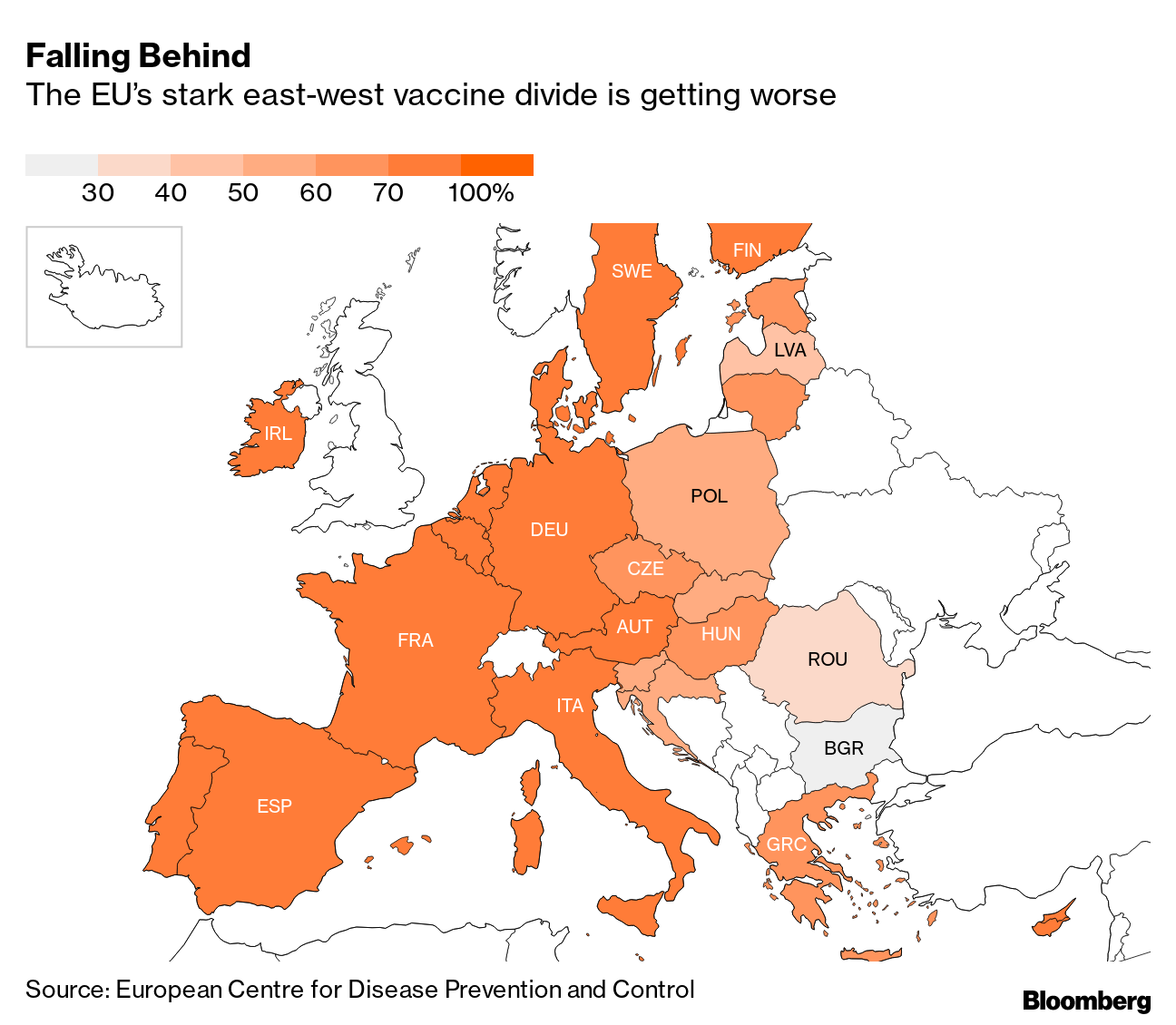 More than 70% of adults in the EU are now fully vaccinated against Covid-19, a key milestone for the bloc after its initial stumbles. But there are stark differences across countries, with a clear east-west dividing line.
Losing leverage | U.S. and European efforts to coax Iran back into nuclear talks are being blunted by support the Islamic Republic is receiving from China and Russia. As Jonathan Tirone reports, Iran has enriched uranium close to weapons grade while its economy is showing signs of stabilizing with the help of Beijing and Moscow, even as crucial oil exports remain heavily sanctioned. The Best of Bloomberg OpinionOld enemies | The return by former Prime Minister Donald Tusk to spearhead Poland's opposition against the ruling Law & Justice Party has reignited one of Europe's most bitter political rivalries. As Wojciech Moskwa and Dorota Bartyzel report, the outcome will shape the path of a country that's clashed with its EU partners and risks upending decades of harmony with the U.S. - Rishi Sunak is set to scrap the so-called triple lock on annual increases to the U.K. state pension as soon as next week, sources say, as the Chancellor of the Exchequer tries to rebuild public finances in the wake of the pandemic.
- U.S. President Joe Biden will survey damage from Hurricane Ida today as he visits Louisiana, where hundreds of thousands of homes and businesses remain without electricity.
- Almost 80% of African countries won't meet a target set by the world's highest health policy-setting body to fully vaccinate 10% of their most vulnerable populations against the coronavirus by the end of the month.
- AstraZeneca agreed to provide the EU with an additional 200 million vaccine doses under a deal that ends months of legal wrangling.
Pop quiz, readers (no cheating!). The president of which country laid out three outcomes for next year's elections — he will win, get arrested or be killed? Send your answers to balancepower@bloomberg.net. And finally ... A 36-year-old governor of a conservative Brazilian state who just came out as LGBTQ is the presidential hopeful favored by investors in what's shaping up to be a divisive election campaign, Simone Preissler Iglesias writes. Eduardo Leite, who won office in 2018 as part of President Jair Bolsonaro's right-wing wave, faces a challenge to make himself known more widely, starting with Brazilians who reject both the incumbent and his leftist adversary, former President Luiz Inacio Lula da Silva.  Eduardo Leite at his office in Porto Alegre, Brazil. Photographer: Tiago Coelho/Bloomberg | 





Post a Comment