| Xi Jinping pilots his "common prosperity" program in Alibaba's home province. Chinese hedge funds are offering the best graduates big six-figure salaries. Business travel as we know it may be gone, forever. Here's what you need to know this morning. President Xi Jinping is testing "common prosperity" policies in Alibaba's home province. The Zhejiang plan suggests Beijing wants to raise incomes through private sector investment in poorer areas, and to encourage rural residents to start their own businesses. If successful the pilot could be rolled out nationally. Meanwhile, Xi Jinping chaired a high-level meeting that "reviewed and approved" measures to fight monopolies, battle pollution and shore up strategic reserves — and much more; China plans to seriously tighten oversight of e-commerce companies like Alibaba and Pinduoduo; and Evergrande warned that it risks defaulting on borrowings if its all-out effort to raise cash falls short Asian stocks look set to dip as traders evaluate economic risks from the delta virus strain and the prospect of a reduction in pandemic-era central bank stimulus support. Futures for Japan, Australia and Hong Kong all fell. U.S. stocks edged back from all-time highs amid some mixed data, including a drop in consumer confidence to a six-month low and a record jump in home prices. Treasury yields climbed following losses in European sovereign bonds. The dollar was steady. President Joe Biden defended the U.S. pullout from Afghanistan as concerns over the country's fate and the impact from those fleeing the Taliban mount. The president praised the evacuation of 120,000 people and rejected criticism that the exit was mishandled. Elsewhere, UN Secretary-General Antonio Guterres called on countries to provide rapid aid, noting that almost half of the Afghan population — 18 million people — need assistance to survive; and EU ministers vowed to help Afghanistan's neighbors prevent "uncontrolled large-scale illegal migration movements." Here's why the withdrawal may prove to be a bigger problem for Europe than for the U.S. Chinese hedge funds are offering elite new graduates salaries of up to $300,000 — triple the $100,000 sticker price of Wall Street. Graduates are in particular demand at funds which use computer models to trade, which have been lifted by inflows from rich individuals in the world's second-biggest economy. The higher wages are in line with a broader global trend that goes beyond hedge funds, as business at financial firms is booming. In the span of a few months, entry-level salaries at top investment banks have quickly shot up into six figures, even before bonuses. Business travel as we've known it is a thing of the past, with companies around the world signaling that new communications tools are making travel less of a necessity — and saving a pile of cash in the process. A Bloomberg survey of 45 large businesses in the U.S., Europe and Asia shows that 84% plan to spend less on travel after the Covid-19 pandemic. The ease and efficiency of virtual software, cost savings and lower carbon emissions were the primary reasons cited for the cutbacks. Spending on corporate trips could slide as low as $1.24 trillion by 2024, from a pre-pandemic peak in 2019 of $1.43 trillion. If you are planning a trip, here's where you can go right now and which countries are still sealed off. This is what's caught our eye over the past 24 hours: Copper is often thought to reflect the health of the world economy, earning it the moniker of "Dr Copper." So it's worth asking just what the metal is saying about the impact of logistics snarls right now. Citigroup's China Copper End-Use Tracker continues to show demand for the metal slowing. Notably, copper used for "cooling and air-con" has been a weak spot for three months now, falling 18.1% year-on-year in July. That's its biggest drop since early 2020, when a swathe of the Chinese economy was shut down to deal with Covid. 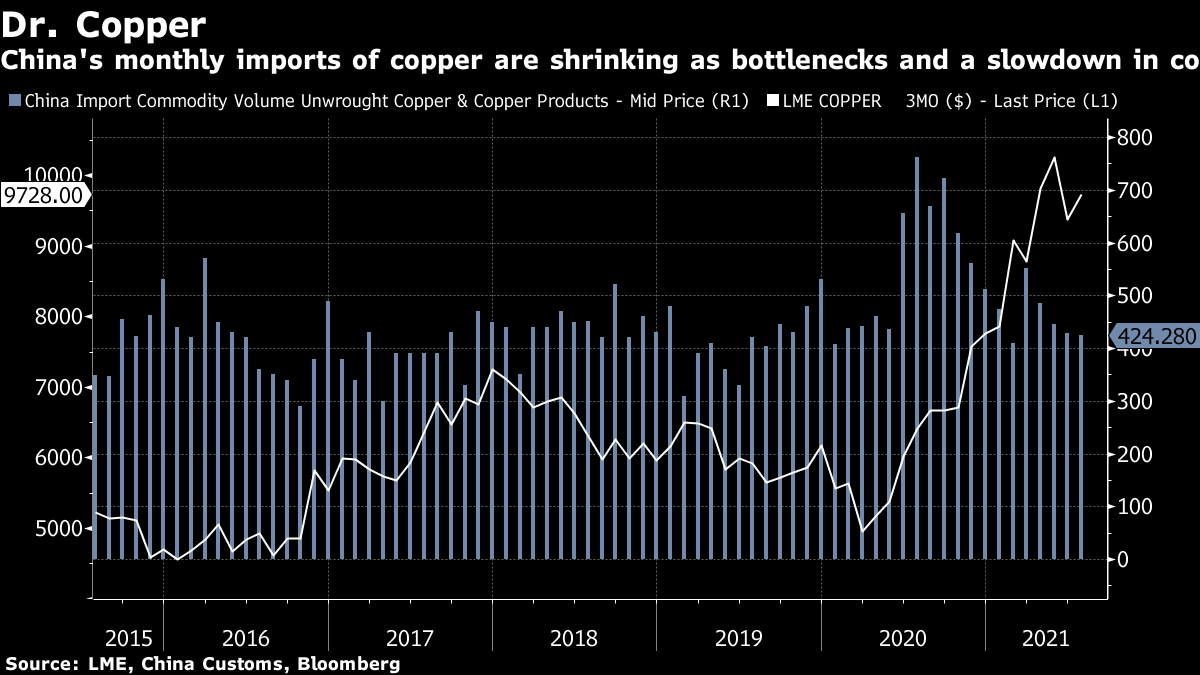 What gives? Like many appliances, refrigerators and air-conditioners appear to have been hit by transport snarls and other shortages, so much so that we can see it reflected in demand for copper — tubes of which are key components in their cooling systems. As Citi analysts put it: "Freight bottlenecks have hit these sectors disproportionately hard." In other words, Dr Copper is diagnosing the impact of supply shortages and shipping congestion in the world's second-biggest economy. It's a good reminder that the longer these issues go on, the more snarled global supply chains get and the greater potential there is for a bullwhip effect to come into play. - You can follow Tracy Alloway on Twitter at @tracyalloway.
- Correction: In yesterday's 5 Things newsletter, the paragraph on Tencent should have read: ADRs of Tencent fell as much as 3.3% in the U.S. on Monday, but that's a drop in the bucket compared to the 10% plunge seen in July.
| 





Post a Comment