| Alibaba misses revenue estimates. Tencent considers banning kids games. Delta pushes herd immunity threshold over 80%. Here's what you need to know this morning. Alibaba's revenue missed estimates for the first time in more than two years, underscoring how Beijing's months-long campaign against the internet sector is taking a toll. Growth slowed in most of Alibaba's major divisions from cloud to e-commerce, underlining fears that the mounting list of new government regulations is constraining expansion and increasing companies' burdens. Billionaire Jack Ma's fintech giant Ant saw profit slide 37% in the March quarter, amid China's latest crackdown. Meanwhile, Tencent is weighing a ban on letting kids play its games. The giant led a stocks rout, declining as much as 11%, after Chinese state media decried the "spiritual opium" of games, triggering fears that Beijing's next target could be the world's largest gaming arena. Asian stocks are set for a cautious open as China's clampdown on its tech giants and the spread of the delta strain subdue sentiment. Futures edged up in Japan, Australia and Hong Kong. U.S. equity contracts fluctuated in early Asian trading after generally favorable corporate earnings took the S&P 500 to another record close overnight. But Chinese stocks listed in the U.S. slid amid fears of a gaming crackdown. The benchmark 10-year U.S. Treasury yield held its recent retreat and oil dropped toward $70 a barrel. A gauge of the dollar inched lower. The spread of the delta coronavirus variant has pushed the threshold for herd immunity to well over 80% and potentially approaching 90%, according to a briefing by the Infectious Diseases Society of America. Elsewhere, the Chinese-made Sinopharm vaccine failed to produce sufficient antibodies in a quarter of elderly people who were voluntarily tested in Budapest; China's broadest Covid-19 outbreak since late 2019 is hampering tourism and spending during the peak summer holiday, adding another risk to the country's economy just as consumption was picking up; and the Reserve Bank of Australia said it will stick with its planned tapering of bond purchases, wagering that the economy will recover rapidly from a contraction this quarter driven by the spread of delta. Singapore Prime Minister Lee Hsien Loong again warned the U.S. and China to deescalate tensions, saying both powers presumed incorrectly they would win in any conflict. "The reality is, neither side can put the other one down," Lee said speaking by video link to the Aspen Security Forum. "I think that is a possible misunderstanding on both sides," Lee said. Meanwhile, Philippine President Rodrigo Duterte said he restored a key military deal with the U.S. thanks to a donation of vaccines, and China and India agreed to pull back troops from another friction point along their disputed Himalayan border after a weekend meeting of top military commanders. Growing geopolitical tensions and pulled initial public offerings have done little to dampen the appetite of Western banks for Hong Kong and China.
Standard Chartered CEO Bill Winters was the latest executive in recent weeks to signal that a sweeping Chinese government crackdown and rising geopolitical tensions between China and the U.S. won't derail his lender's focus and investment in the region, adding: "The opportunities for us in corporate banking and wealth management will be very, very substantial." His comments echo that of other firms such as Citigroup, HSBC and Credit Suisse, who all used earnings to underline it is business as usual in the Greater China region despite a wide-ranging crackdown by Beijing on industries from education to tech. This is what's caught our eye over the past 24 hours: Despite rising inflation and the rebound in the U.S. economy, talk of the Federal Reserve tapering and so on, yields on the benchmark 10-year U.S. Treasury are stuck around 1.1%. There are some pretty convoluted explanations for why bond yields remain very low. I won't name them all here but they include things like banking regulation, the inner workings of the Fed's easy money policy, demand from foreign investors, and so on. At times like this, it's sometimes useful to look at the simplest explanation, which I think is shown by the chart below. Treasury yields and airline stocks are still moving together, more than a year after the start of the pandemic. The question is what exactly are airline stocks reflecting? Clearly, they're a proxy for Covid-19 fears — as worries over a spread of delta cases go up, airline stocks go down. They could also reflect investors pricing in the overall direction of the U.S. economy given that airlines tend to be the most cyclical of stocks. 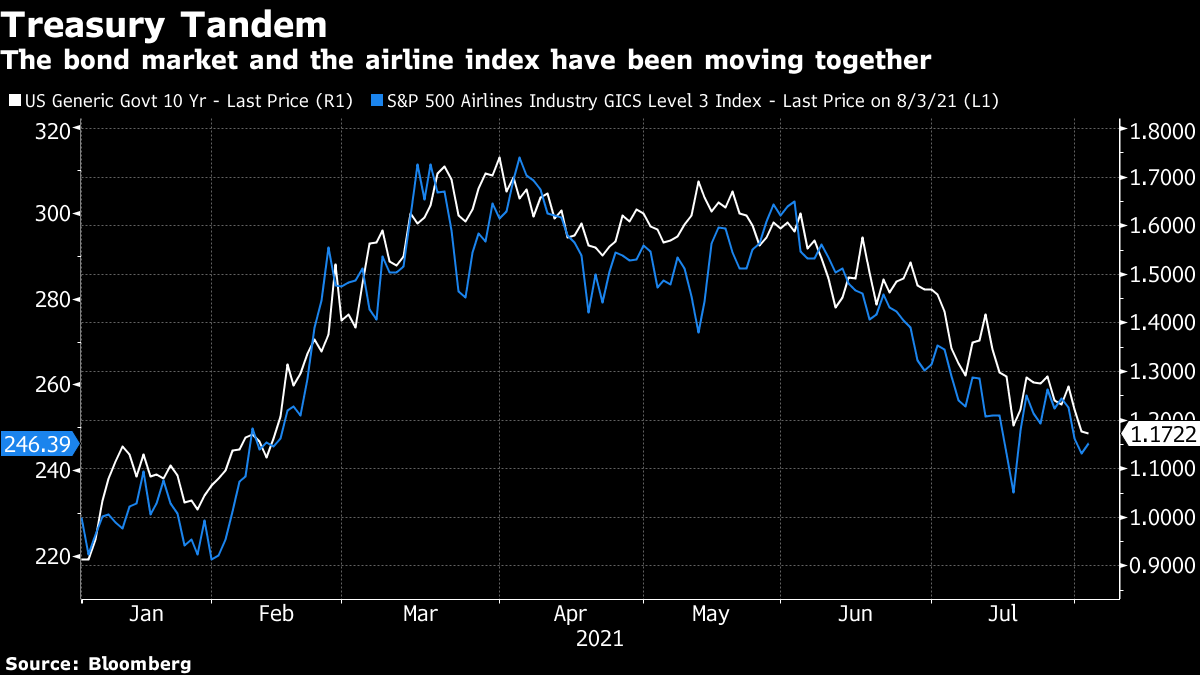 So measured in airline stocks — a proxy of Covid concern and future economic growth — bonds don't seem to be doing anything unusual. Yields are going down when these twin concerns accelerate, and then going up when these concerns recede. You can follow Tracy Alloway on Twitter at @tracyalloway. | 





Post a Comment