China hits U.S. officials with retaliatory sanctions. Lebanon's prime minister resigns. And Beijing welcomes a weaker yuan. Here are some of the things people in markets are talking about today. China says it will sanction 11 Americans in retaliation for similar measures imposed by the U.S. on Friday, but the list doesn't include any members of the Trump administration. Those sanctioned include Senators Marco Rubio, Ted Cruz, Tom Cotton and Pat Toomey, among others. "In response to the U.S.'s wrong behaviors, China has decided to impose sanctions on those individuals who behaved badly on Hong Kong-related issues," Chinese Foreign Ministry spokesman Zhao Lijian said. He did not specify what the sanctions would entail. The U.S. said Friday that it was placing sanctions on 11 Chinese officials and their allies in Hong Kong, including the city's Chief Executive Carrie Lam, over their roles in curtailing political freedoms there. Meanwhile, Citigroup and Standard Chartered are stepping up scrutiny of banking clients in the former British colony, in an attempt to avoid violating U.S. sanctions on those officials. Citigroup is already taking steps to suspend accounts linked to some of the targeted individuals, one person familiar with the matter said. Asian stocks looked set for a muted open Tuesday after a lackluster session on Wall Street. The dollar touched a one-week high. Futures were little changed in Japan, which reopens after a holiday Monday. Contracts were flat in Australia and edged higher in Hong Kong. The S&P 500 approached its all-time high from February, while the tech heavy Nasdaq 100 lost ground. Treasuries slipped, pushing yields to the highest in two weeks. The S&P 500 Total Return Index, which includes reinvested dividends, rose to an all-time high, exceeding its February peak. Elsewhere, oil gained the most in almost three weeks after Saudi Aramco said demand will continue to improve and traders bet on more U.S. stimulus. Turkey's lira was weaker even as the banking regulator moved to slow lending in an attempt to stabilize the currency. Lebanon's prime minister confirmed the resignation of his government as an outraged public demanded accountability for last week's explosion at Beirut's port, the biggest peacetime catastrophe in the nation's history. "The scope of this disaster is bigger than can be described," Prime Minister Hassan Diab said in a speech on Monday, after just seven months in office. He blamed a corrupt political elite for sabotaging his administration. Diab had failed to deliver on the demands of protesters, who have taken to the streets since October seeking change, nor had he advanced talks with donor countries and the International Monetary Fund for billions of dollars in aid that a country drowning in debt so badly needs. Several ministers had already quit in the aftermath of the disaster, including the finance and justice ministers earlier on Monday. In 2015, China's currency devaluation sparked market chaos. Today, the yuan is down more than 10% against both the dollar and a basket of trading partner currencies compared with the pre-devaluation level, and against the euro, the Chinese currency is near a six-year low. But gentle, steady depreciation has spurred less concern. Activity in the foreign-exchange market is calm: A gauge measuring expected swings in the yuan and an indicator for bearish options never reached the levels seen in the aftermath of Beijing's shock move. China welcomes a weaker currency, which makes the country's goods more appealing globally. Yet avoiding sharp depreciation has meant a trade-off between stability and encouraging the yuan to play a more significant role. The currency remains little used outside of China. China will resume issuing tourist visas for visitors to Macau, paving the way for the mass return of Chinese punters to the world's largest gaming hub after months of losses. Zhuhai city in neighboring Guangdong province will begin issuing tourist visas, including both individual and group tours, for mainland residents to travel to Macau again on Aug. 12. The move reverses a ban implemented in late January to contain the spread of the coronavirus. It nudges along a revival of the gambling enclave, whose revenue had been five times that of the Las Vegas Strip before the pandemic, driven largely by Chinese demand. What We've Been ReadingThis is what's caught our eye over the past 24 hours: And finally, here's what Tracy's interested in this morningIf you read one economic paper this week make it this. Isabel Cairo and Jae Sim pick up the mantle of Michael Kalecki to publish a new Federal Reserve working paper that finds increased corporate power can explain many of the most undesirable aspects of our economic and financial system of in the past few decades, including stagnant wages, rising inequality, the accumulation of household debt and the resulting financial instability. 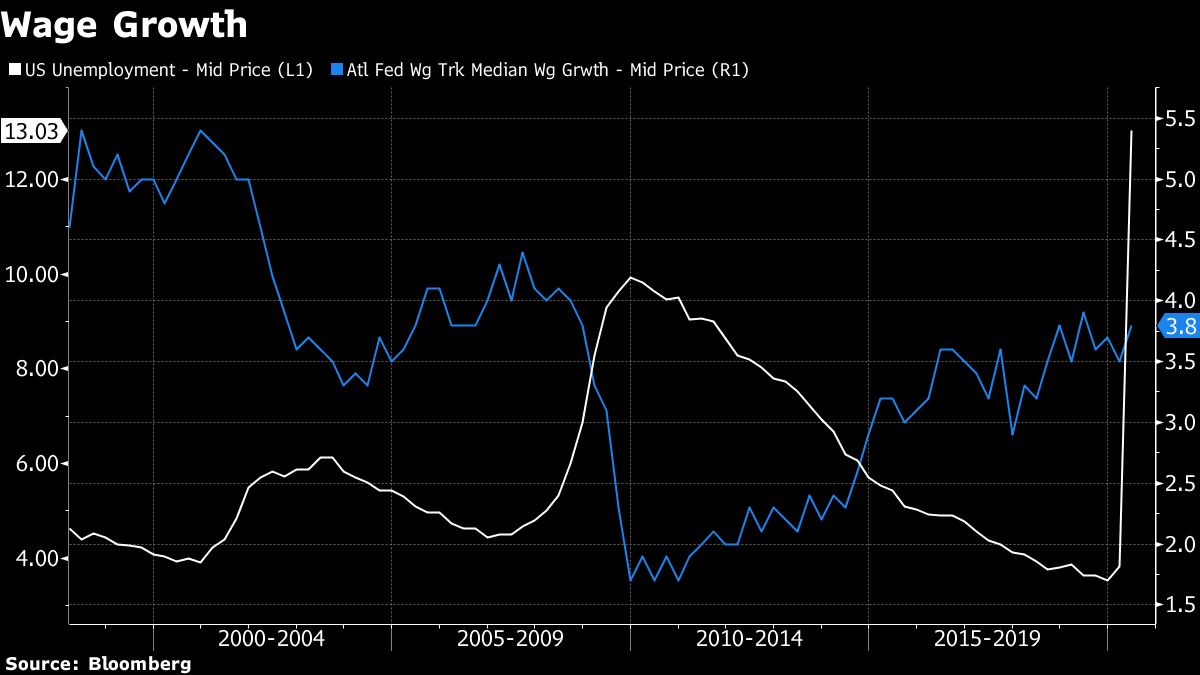 It's pretty unusual to see Fed board economists begin a paper with a quote from a Polish Marxist ("The degree of monopoly has a general tendency to increase in the long run and thus to depress the relative share of wages in income... although this tendency is much stronger in some periods than in others." — Kalecki, 1971), but the paper joins a growing body of research about the impact of monopsony on both product and labor markets. It's even more unusual to see Fed economists talk about the potential for redistributive taxation to reduce the risk of a financial crisis. But as Cairo and Sim conclude: "Our experiment suggests that if an important goal for public policy is to limit the probability of a tail event, such as a financial crisis, a powerful macroprudential policy may be a redistribution policy that moderates the rise in income inequality. We believe that more research is warranted in this area." You can follow Tracy Alloway on Twitter at @tracyalloway. | 


Post a Comment