| International leaders are pointing to Iran's involvement in Wednesday's Ukrainian plane crash, Chinese small caps are sending all the right messages going into 2020 and Uniqlo underperforms — by a lot. Here are some of the things people in markets are talking about today. The prime ministers of Canada and the U.K. said that a Ukrainian jet that crashed Wednesday near Tehran was probably brought down by an Iranian missile and called for an international probe of the disaster. "We have intelligence from multiple sources, including our allies and our own intelligence. The evidence indicates that the plane was shot down by an Iranian surface-to-air missile," Trudeau told reporters in Ottawa. "This may well have been unintentional." More than a third of the 176 people aboard Ukraine International Airlines Flight 752 were from Canada when it plunged from the sky about two minutes after a pre-dawn takeoff. The Boeing Co. 737-800 was on fire, according to witnesses on the ground and in other aircraft cited in a preliminary Iranian report on the crash. U.K. Prime Minister Boris Johnson issued a statement later Thursday saying there is evidence Flight 752 was shot down by an Iranian surface-to-air missile. U.S. President Donald Trump, speaking to reporters in Washington on Thursday, said, "I have my suspicions" about why the plane went down but said he didn't want to say what those suspicions are. Stocks in Asia are set for a mixed start as investors monitor an easing of geopolitical tension and await the latest reading on the U.S. labor market. U.S. equities earlier rose to all-time highs, futures edged up in Japan and Australia, while Hong Kong contracts dipped. The S&P 500 Index climbed to a fresh record Thursday and the yen dropped to a two-week low versus the dollar as tension in the Middle East ebbed. The greenback gained against major currencies for a third straight day after jobless claims fell by more than expected, adding to signs of economic strength ahead of the U.S. payrolls report Friday. Ten-year Treasury yields declined following a government auction. Elsewhere, oil traded close to the lowest level since mid-December amid the receding concerns about U.S.-Iran conflict and gold edged lower. In China's stock market, a rally in small caps rarely lasts and typically marks the start of excessive risk taking. This time, it's signaling optimism about the economy. The outperformance of the ChiNext Index relative to benchmarks of larger companies has already held for six consecutive months, a feat not seen since 2013. It's continued to start this year. The advance is partly due to a global risk-on rally sparked by easing trade tensions between China and the U.S. Mainland investors are also hopeful about an economic recovery after some initial signs of stabilization and an easing bias by the central bank. The result has been steady buying of small caps, which are more sensitive to swings in market sentiment given their size. "It's an omen, "said Zhu Chaoping, a global market strategist with JPMorgan Asset Management. "Investors are pricing in expectations of a mild economic recovery in the first half" of 2020, and "more broad-based gains could be on the way once we see a more favorable economic environment." Political flare-ups in Asia are putting the brakes on Fast Retailing Co.'s overseas momentum, as the Uniqlo operator reported the worst quarterly revenue decline in a decade for its international segment. Asia's largest retailer has long counted on overseas expansion to power growth in the face of a weak Japanese market. Now that strategy is coming up against the political protests in Hong Kong as well as a trade spat between Japan and South Korea. Fast Retailing on Thursday reported a 3.6% drop in first-quarter sales for Uniqlo's international segment, citing "significant declines" in those two trouble spots. Except for a minuscule decrease of 0.2% in 2017, it's the first quarterly drop for the segment in 10 years, according to Bloomberg data. Operating profit for the international business fell 28%, for the first quarterly earnings decline since 2016. South Korean regulators, already moving to protect retail investors from risky hedge-fund investments and complex derivatives, are turning their sights to a fresh target: suspected fraudsters in the nation's small-cap stocks. In a scheme with parallels to the "pump-and-dump" practice for penny stocks made famous by the film "Wolf of Wall Street," ill-intentioned investors are suspected of taking majority shares of small firms. They then release news designed to inflate the share price, or pave the way for selling convertible bonds, by which the actors enrich themselves, according to the Financial Supervisory Service, South Korea's top financial watchdog. The perpetrators have been termed "company-hunters," and while the practice isn't new, it's surged lately, FSS figures show. The backdrop: frenzied appetite among retail investors for small-caps, especially those tied to biotechnology. The Kosdaq index, where mostly young tech companies are listed, has a market capitalization of about $200 billion, and trades at 190 times earnings, compared with 17 times for the big-board Kospi. What We've Been Reading This is what's caught our eye over the past 24 hours. And finally, here's what Tracy's interested in this morning We've spoken before about the rising number of Chinese bond defaults and what they might imply about the country's economy. On the one hand, a public jump in defaults could signal that authorities haven't been able to keep a weakening economy from seeping into the corporate sector. On the other hand, it could show that they're serious about modernizing their corporate bond market to introduce more nuanced pricing, stronger bankruptcy regimes, and generally shift it more towards global standards. 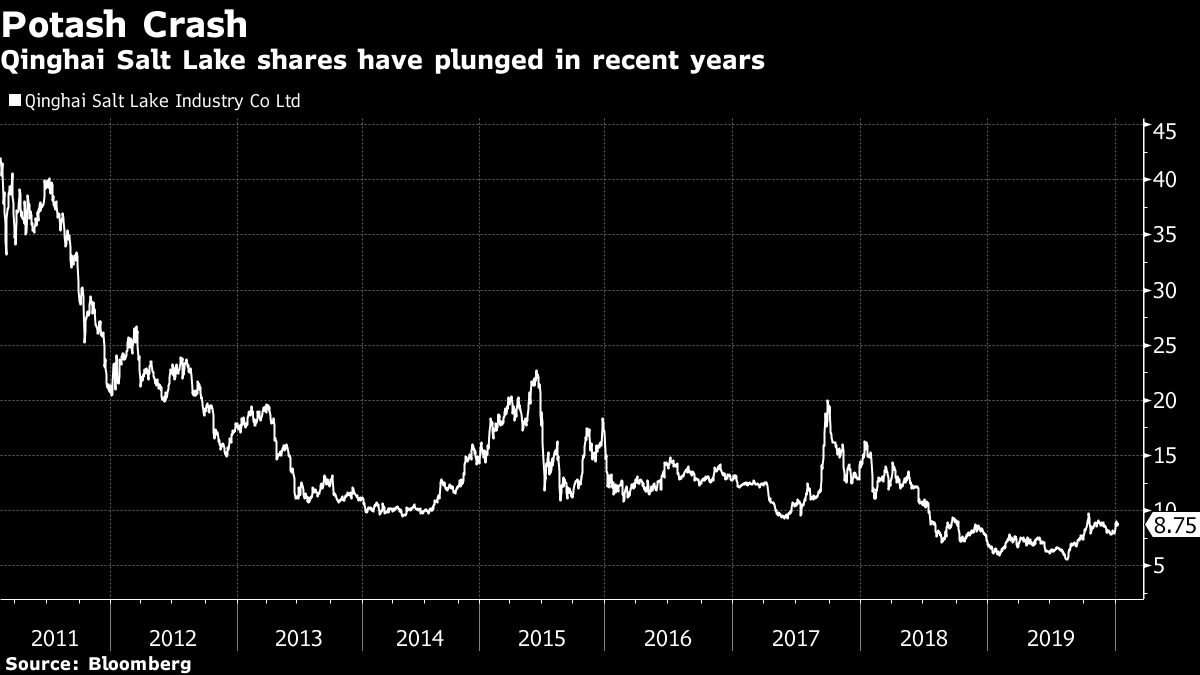 In the context of this debate, it's worth watching what happens to Qinghai Salt Lake Industry, a state-owned fertilizer firm. As Bloomberg reports, the company has defaulted on about $894 million worth of onshore debt and is now in a court-ordered bankruptcy process that includes a proposed debt restructuring — a rarity in China's market. A creditor meeting to approve the proposal is coming up on Jan. 17 and might provide valuable clues. You can follow Bloomberg's Tracy Alloway at @tracyalloway. The best in-depth reporting from Asia Pacific and beyond, delivered to your inbox every Friday. Sign up here for The Reading List, a new weekly email coming soon. | 


Post a Comment