| Evergrande owes a lot of people a lot of money. Some are sophisticated investment professionals who misjudged risk. Some are middle-class homebuyers who put their savings into an apartment that might now go unbuilt. Guess who Beijing cares more about. The answer to that question seemed rather clear this week when Evergrande missed making interest payments to some of its largest bank creditors. Most of the developer's available money had instead been set aside to construct as yet unfinished apartments, a fact that was notably first conveyed to those bankers not by Evergrande but by the Ministry of Housing and Urban-Rural Development. 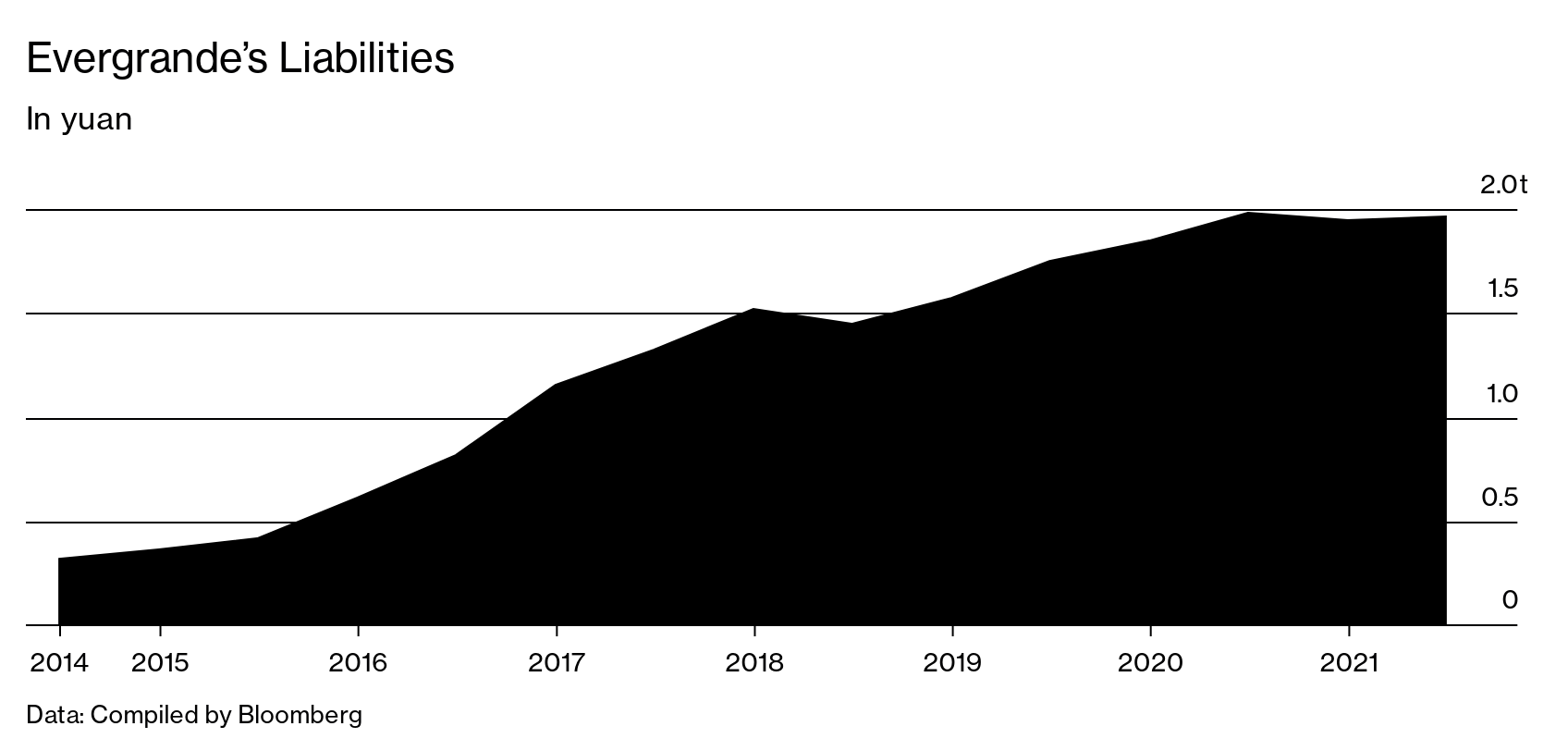 With "common prosperity" now the theme of the times, it makes sense the government would prioritize getting people their homes. That's especially true when there are 1.5 million buyers waiting for Evergrande to finish building and when protests have already erupted across the country. And Beijing doesn't just have the motivation, it also has the means. The dominance of state-owned firms in China's finance sector gives officials a lever that is unavailable in many other economies. During the height of China's Covid outbreak in early 2020, for example, the nation's financial industry was asked to perform its patriotic duty by sacrificing 1.5 trillion yuan, or about $211 billion at the time, of profit to help buoy the economy. Evergrande is not Covid, though if the situation continues to deteriorate, China may need to call on the patriotism of its banks once again. U.S. President Joe Biden is getting together with the leaders of Japan, Australia and India on Friday in Washington. This first in-person summit of the group known as the Quad comes as concerns a deal for the U.S. and U.K. to equip Australia with nuclear powered submarines could spark a new arms race in Asia. 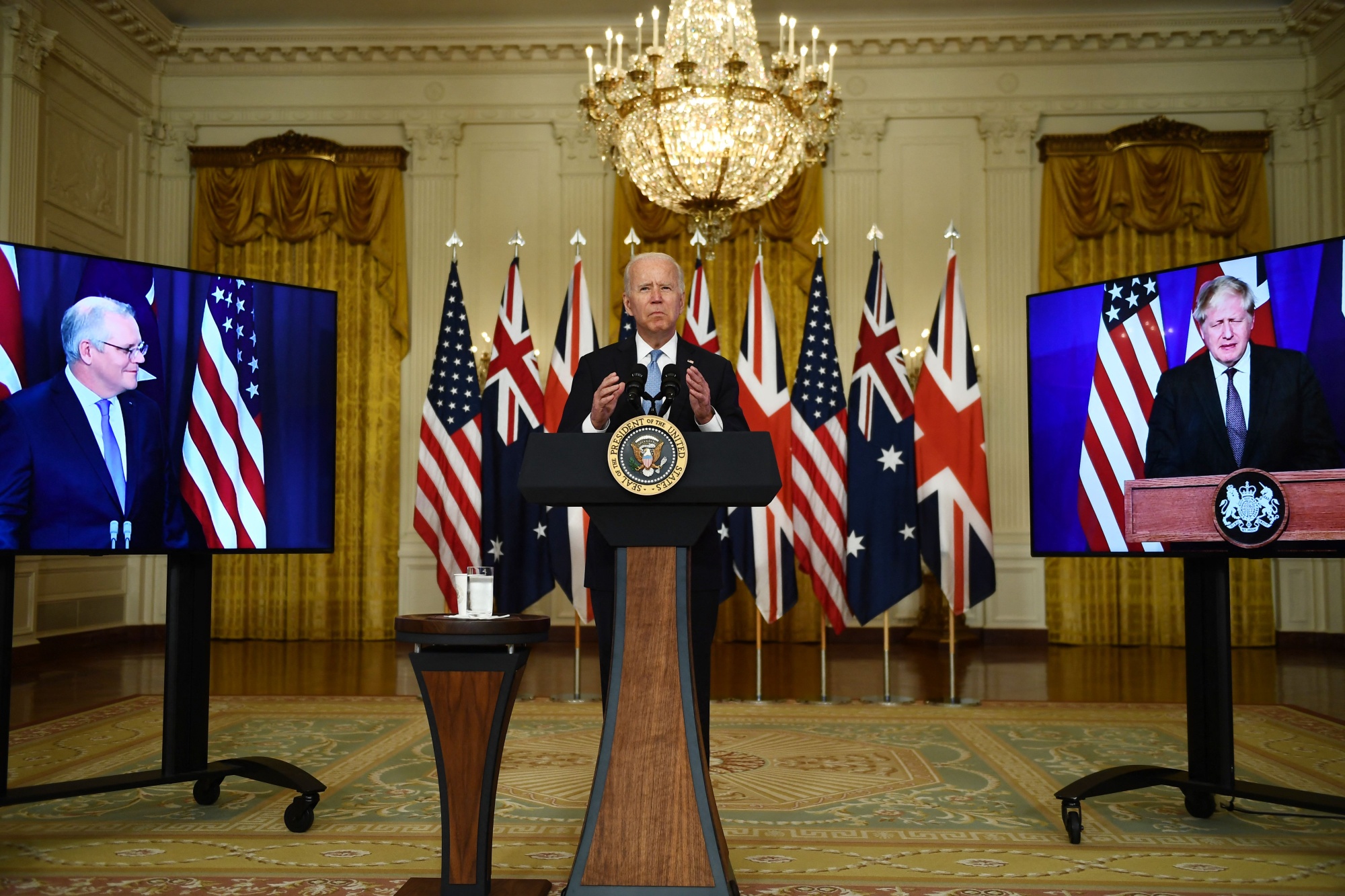 US President Joe Biden participates is a virtual press conference with British Prime Minister Boris Johnson (R) and Australian Prime Minister Scott Morrison on September 15, 2021. Photographer: BRENDAN SMIALOWSKI/AFP While the members of the Quad have tried to downplay their focus on China, their shared concern about Beijing's increasing influence has been an obvious unifying force. Japanese Prime Minister Yoshihide Suga spoke to that theme in an interview this week when he said China's growing military power was pushing Tokyo to strengthen its alliance with Washington as a deterrence. If Asia is headed toward a new arms race, it may be China that's put at a disadvantage. Minxin Pei, a professor of government at Claremont McKenna College, noted in a column this week that trying to reach near military parity with the U.S. alone would be challenging for Beijing, though not impossible. But engaging in an arms race against all four Quad nations combined, he writes, could put such a heavy burden on the Chinese economy as to be ruinous. In an address to the United Nations General Assembly this week, Xi announced his government will stop funding the construction of coal-fired power plants beyond its borders. That pledge came just hours after Biden vowed that the U.S. would double the amount of money it spends to help poorer nations fight climate change. While it's unclear what relationship – if any – there might have been between those two announcements, they are without doubt significant steps. Xi's pledge could be especially impactful, as more than 70% of all coal plants built today rely on Chinese funding. Not only will there be less money for coal, but Beijing's decision should also unlock financing for more renewable energy projects. The dual announcements from the world's foremost powers also throw attention forward to the UN's climate summit in Glasgow, Scotland, scheduled for late October and early November. As Natural Resources Defense Council President Manish Bapna explained, it opens the door to even bolder climate ambitions. 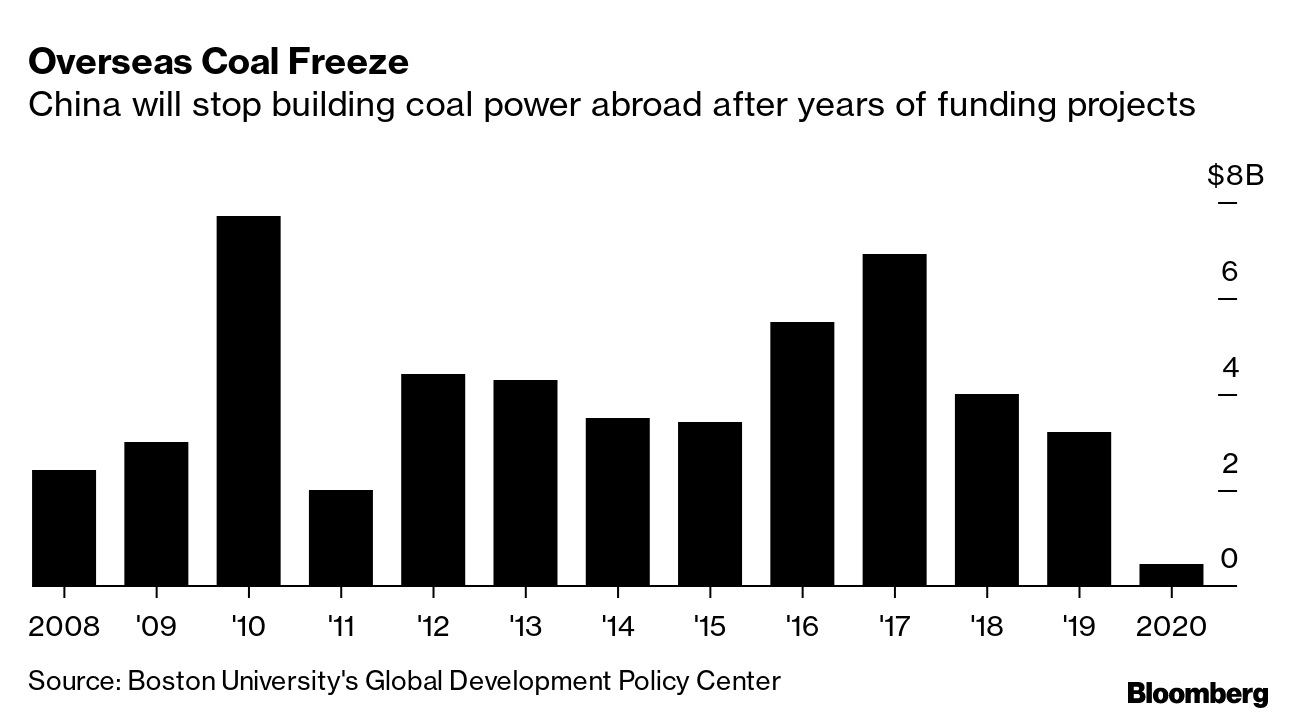 There was more evidence this week of the significant economic cost China is paying to keep Covid under control. Travel during the Mid-Autumn Festival, usually an ideal season for tourism with a public holiday and cooler weather, was just 87% of pre-pandemic levels. That's notably weaker than the Labor Day holidays in May, when the number of trips exceeded the volume recorded in 2019. The difference has been the delta variant, which in August fueled China's broadest outbreak of Covid since the country crushed the virus following its emergence in late 2019. To contain the highly contagious strain, Beijing imposed strict quarantine and travel restrictions that have left consumers wary of leaving home. The central government's decision to punish dozens of local officials for lapses in preventing infections has also led to more zealous execution around the country. That combination augurs poorly for the economy, especially with headwinds from the uncertainties around property, tech policy and ongoing tensions with Washington. And finally, a few other things that caught our attention: | 






Post a Comment