| Abortion fight | The U.S. Supreme Court refused to block a Texas law outlawing most abortions after six weeks of pregnancy, preserving a measure that went into effect yesterday as the strictest restriction in the nation. Voting 5-4, the justices spurned calls from abortion providers to halt a law at odds with Supreme Court precedents that protect abortion rights until much later in pregnancy. Countering Russia | President Joe Biden told Ukrainian President Volodymyr Zelenskiy that the U.S. would counter Russian hostility toward his country, without giving specifics. In their first meeting, Zelenskiy sought clarity on how Western allies will ensure Ukraine's security after Biden all but abandoned efforts by prior administrations to halt the Nord Stream 2 gas pipeline, the construction of which threatens vital revenue for Kyiv as a transit hub. 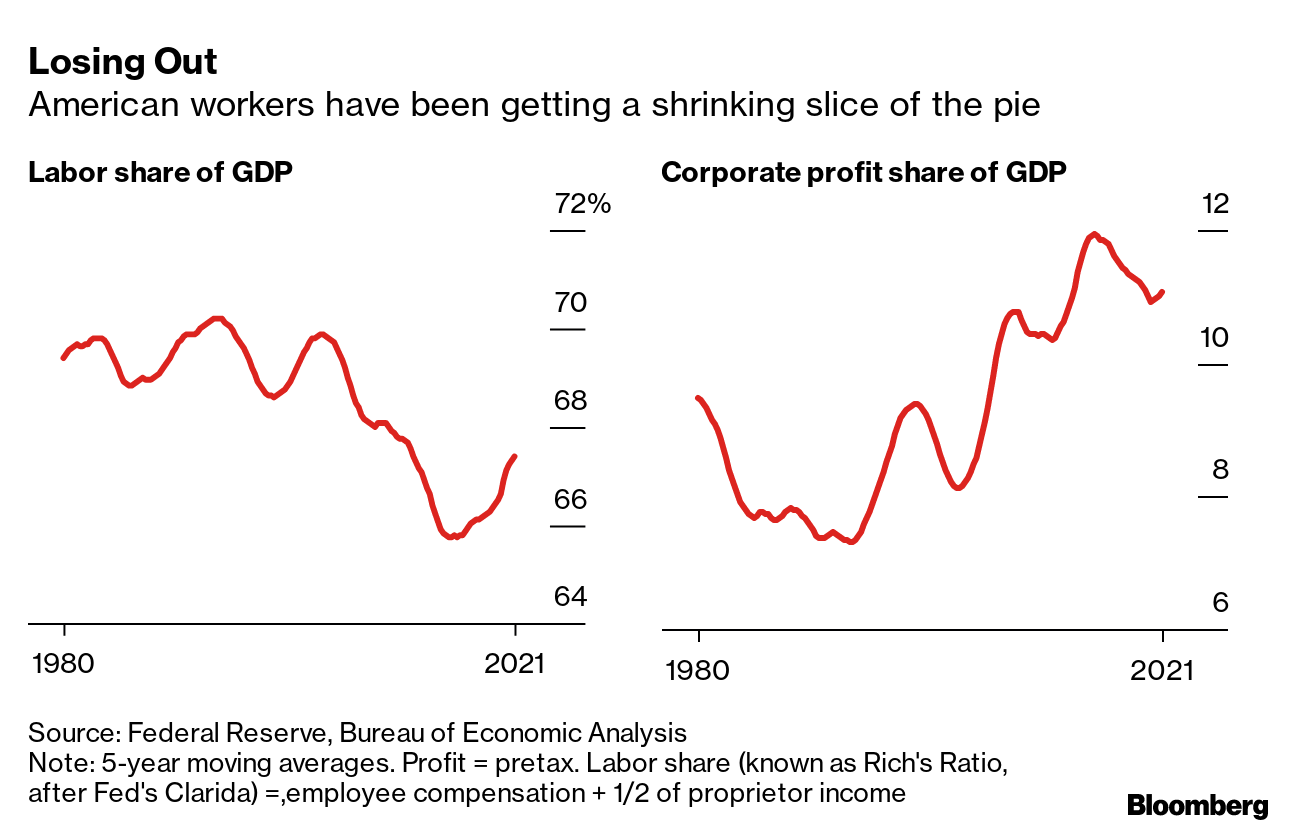 By the time the pandemic ends, American workers may be in their strongest position in decades. While big battles are coming, labor unions and economists say conditions are in place for employees to claw back some of the ground lost during the U.S. economy's four-decade-long slide into inequality during which wages lagged and corporate profits and stock markets soared. Price risks | The global food ecosystem is buckling due to a shortage of staff — from fruit pickers and truckers to warehouse workers and waiters — threatening to push up prices. Fabiana Batista, Megan Durisin and Sybilla Gross write that supplies are getting hit and some employers are being forced to raise wages at a double-digit pace. Best of Bloomberg OpinionTaiwan tangle | A European Parliament committee called on the bloc to strengthen ties with Taiwan, including beginning work on a bilateral investment pact and renaming its trade office in Taipei the "European Union Office in Taiwan." The support underscores an expanding united front of democracies against Beijing, which sees the island as part of its territory and regards any recognition of it as an independent nation as a threat to Chinese sovereignty. City revival | Conjured out of nothing and lived in by seemingly no one, China's so-called ghost cities became the subject of Western media fascination a decade ago. Now the empty apartment towers and boulevards meant to boost urbanization are coming to life. Yet the pace of building still often outstrips the rate at which newcomers move in, even with investors snapping up apartments as Chinese home prices rise. - China is using talks with climate envoy John Kerry to push the U.S. to improve the broader relationship, with one report saying he will meet Beijing's top diplomat during his visit to the port city of Tianjin.
- North Korea appears to be moving troops and vehicles to a Pyongyang staging area it uses to prepare for military parades, weeks ahead of a ruling party anniversary it has marked previously with displays of new weaponry.
- The remnants of Hurricane Ida ripped through New York and across the Northeast last night, triggering tornadoes, thunderstorms, and torrential rain that inundated streets and left rail services suspended.
- The U.K. plans to offer a third dose of Covid-19 vaccines to people 12 and older with severely weakened immune systems following a recommendation from a committee that advises the government.
- The Biden administration is considering a quota system as it prepares a proposal for the EU to resolve a dispute over steel and aluminum imported from the bloc.
And finally ... A U.S. judge approved a plan by Purdue Pharma to resolve thousands of opioid lawsuits that drove it to insolvency, allowing the Sackler family to quit the drug business while preserving the bulk of their estimated $11 billion fortune. The settlement forces the Sacklers to contribute about $4.5 billion in exchange for lifetime immunity from civil liability over their role in a crisis that killed almost 250,000 Americans over the past two decades.  An employee removes letters from a sign featuring the Sackler family name at Tufts University in Boston, Massachussets. Photographer: David L. Ryan/The Boston Globe/Getty Images | 




Post a Comment