| Last year, for the first time in Alabama history, more people died than were born. Eleven percent of the 64,714 deaths were officially attributed to Covid-19 although others may have been indirect casualties; the state has at times had more patients in need of intensive care than available ICU beds. Last month, for example, a 73-year-old man suffering a cardiac emergency was rejected from 43 hospitals in three states before his local hospital found an unoccupied ICU bed 200 miles away in Mississippi. He didn't survive. A slow roll-out of the vaccine coupled with disinformation about supposed alternative treatments and a politicization of the pandemic has left Alabama tied with Idaho for the third-lowest vaccination rate in the U.S.: only 41% of Alabama residents are vaccinated. Interestingly, the national vaccination rate for Black people is lower than White people, but in Alabama it's roughly equal, in large part because of staunch vaccine refusal among the state's White Republicans. In May, Alabama's Republican governor, Kay Ivy, signed a law that barred both private businesses and public institutions from requiring customers to be vaccinated. Less than a third of Alabama public schools require students to wear masks and in August a state representative, Andrew Sorrell, proposed legislation that would have prohibited school mask mandates all together. According to Johns Hopkins University's COVID-19 tracker, the state's positivity rate was 27% last week, compared with 3% in New York, a state with nearly two-thirds of its population vaccinated, statewide school mask mandates, and, in New York City at least, a vaccination requirement for indoor activities such as dining and live entertainment. 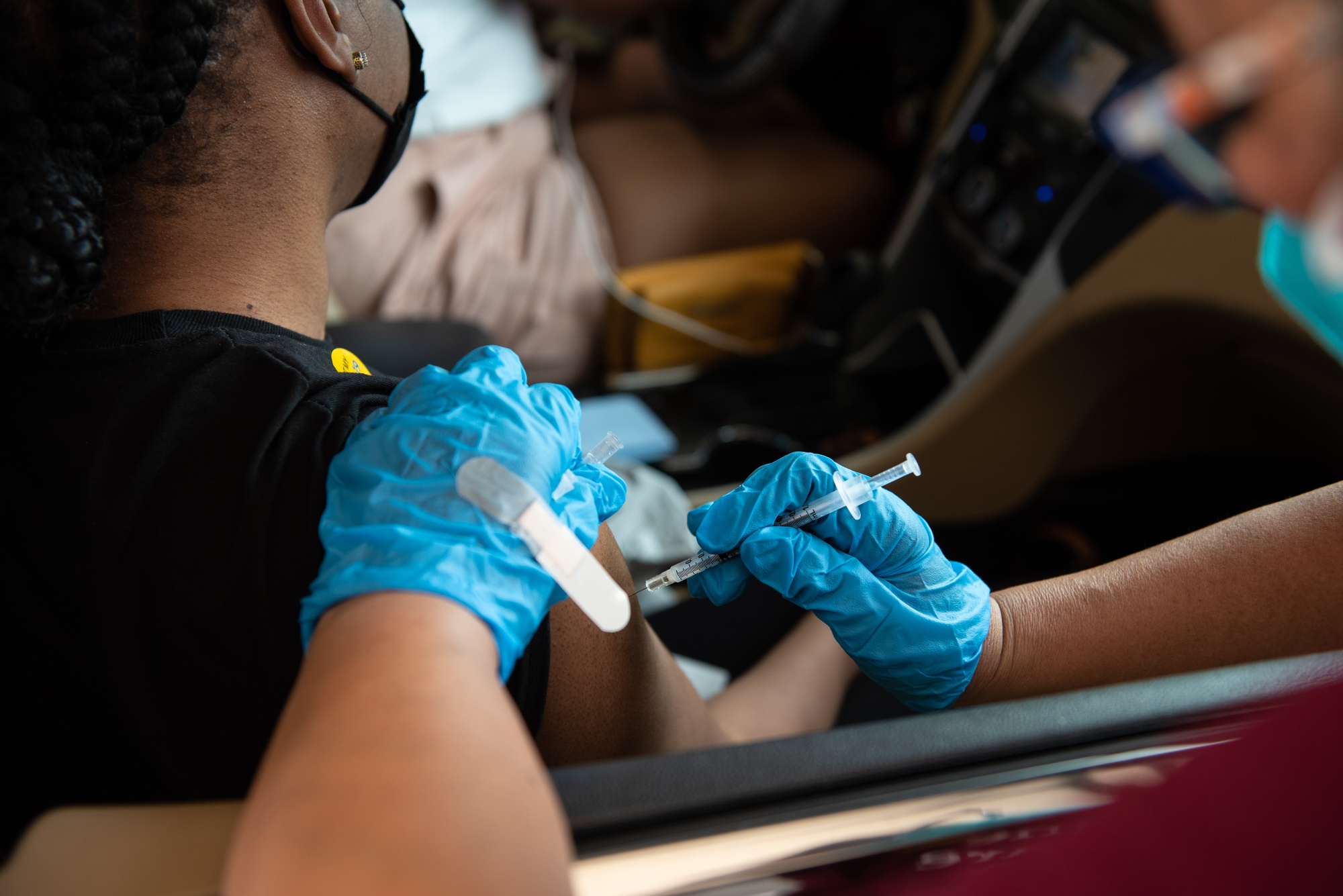 A healthcare worker administers Covid-19 in Birmingham, Alabama. Photographer: Andi Rice/Bloomberg Schools that follow Covid-19 prevention guidelines from the Centers for Disease Control and Prevention and the American Academy of Pediatrics — like universal masking for teachers and students, physical distancing and contact tracing — have largely been able to return to in-person learning. But without those precautions, children and their teachers have started to fall ill. Last month, Children's of Alabama Hospital reported that five times as many children between ages 5 and 17 were being diagnosed with the virus as last year and that it regularly had between one and four children on a ventilator at any given time. (Things have improved slightly; on Monday the hospital said no children were currently on ventilators.) According to modeling data compiled by North Carolina State University and Georgia Tech, schools that forgo both masks and regular testing may see up to 90% of their students infected by the end of the fall semester. Nationwide, parents of unvaccinated children must weigh their educational needs against the likelihood of infection, but that decision is harder in places like Alabama. It all goes to show that the U.S.'s unequal recovery from the pandemic is determined as much by traditional socioeconomic factors as where in the country someone lives.
-- Claire Suddath | 









Post a Comment