| Rattled investors look to offload stakes in Chinese tech giant ByteDance. Covid-19 has broken through China's tough virus defenses. Japanese calls for supporting Taiwan are getting louder. Here's what you need to know this morning. A handful of investors rattled by China's sweeping regulatory changes are looking to offload private stakes in TikTok parent company, ByteDance. "People are seeing there is increased risk with China right now, especially if the regulations mean companies can't IPO when they want," said Prab Rattan, vice president at Setter Capital. Meanwhile, listening to the chatter among China traders, the central bank is moving ever closer to another round of easing. Investors are boosting wagers on lower borrowing costs in both the rates and derivatives markets after a key factory gauge fell in July and virus cases spiked. On Monday, Chinese equities rallied by the most in ten weeks, the benchmark CSI 300 Index rose 2.6%, its best day since May 25. Asian stocks look set to slip after U.S. equities turned lower, Treasury yields tumbled and oil slid on concerns the economic recovery from the pandemic is losing momentum. Futures fell in Japan and Australia and were little changed in Hong Kong. The S&P 500 ended with a modest drop and the 10-year U.S. Treasury yield fell as low as 1.15% as the fast-spreading delta Covid-19 variant and signs of robust but softer U.S. manufacturing growth soured sentiment. U.S. equity contracts were steady in early Asia trading. Oil plunged the most in two weeks and the dollar dipped. Former Japanese prime minister, Shinzo Abe has joined the growing chorus calling for greater support for Taiwan. He was among a group of Japanese lawmakers who gathered in Tokyo last week for a video conference with counterparts from Taiwan and the U.S. to discuss shared concerns. Abe said Japan couldn't allow what happened in Hong Kong to befall Taiwan. Abe's embrace of a more supportive policy toward Taipei is emblematic of a broader shift across the Japanese government in response to Xi Jinping's crackdown on Hong Kong and increased military activities in the Taiwan Strait. Deputy Prime Minister Taro Aso sparked a rebuke from Beijing last month after he told a gathering that Japan would have to work with the U.S. to defend Taiwan in the event of a crisis. China is confronting its broadest Covid-19 outbreak since coronavirus first emerged there in late 2019, after the delta variant broke through some of the world's strictest virus defenses. Meanwhile a surge in cases across the U.S., fueled by the delta variant, is increasing pressure on regulators to fully approve Pfizer's vaccine. In the U.S. 70% of adults have received at least one dose of a vaccine, a key milestone in the fight against the pandemic. And Tokyo is experiencing a record surge in Covid cases during the Olympic Games, though contagion among those linked to the event appears to be relatively contained. The Monetary Authority of Singapore has granted an "in-principle approval" under the Payment Services Act to cryptocurrency exchange Independent Reserve, allowing it to operate as a regulated provider for Digital Payment Token services. It's one of the first virtual asset service providers to obtain an in-principle approval letter for a Major Payment Institution License in Singapore, according to a statement from the company. Applicants will be "subject to close scrutiny in the licensing process and ongoing supervision by MAS," the regulator said in response to queries from Bloomberg some weeks ago. This is what's caught our eye over the past 24 hours: We spoke last week about how tight inventories were hitting the U.S. economy. On Monday, we had another sign of the effects of strained supply chains, with the July manufacturing ISM falling to 59.5 compared to 60.6 in June. That was a miss against expectations of an increase to 61.0. Notably, the ISM also hit a fresh record low for customer inventories with the gauge falling from 30.8 to 25.0. A key question for the U.S. economy is now whether these tight inventories continue to be a drag on growth or at some point start adding to the expansion through a massive restocking cycle. On that note, it's worth listening to the latest episode of Odd Lots, which features Gene Seroka, the executive director of the Port of Los Angeles, America's biggest port. In it, he talks about the current situation in transportation gridlock and how long it might continue. 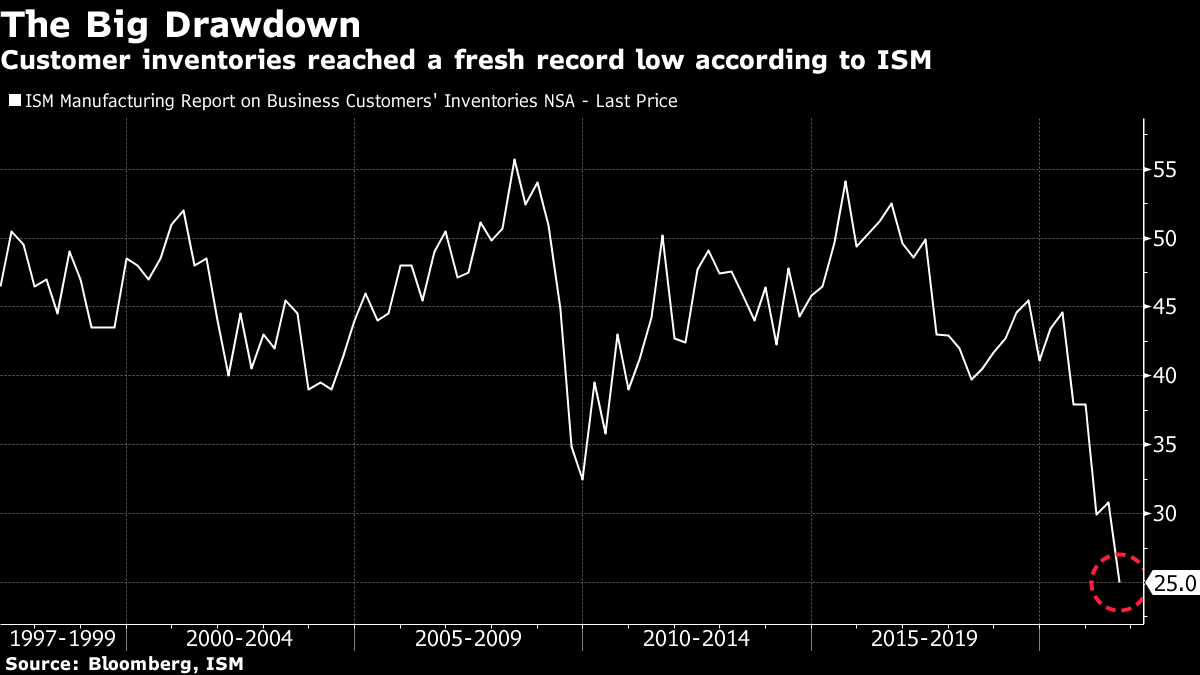 As he puts it: "There was a major retailer that told me that their inventory system — nationwide retailer with over 3,000 stores — said their inventory right now is at about 48% of an acceptable level. So even as we pass through these seasonal effects that I just mentioned, these guys are going to keep buying and buying and buying." The whole thing is well worth a listen for anyone interested in supply chain issues and how they're affecting the economy. You can follow Tracy Alloway on Twitter at @tracyalloway. | 





Post a Comment