A Dose of RationalityWednesday was a colossally boring day in markets. There was a big exception which I'll come to, but let's start with the broader picture. The U.S. and global stock markets have been stuck in a very tight range for more than a month now, and that continues to be the case. Not only that, but the dramatic gains of the last 12 months can be accounted for almost entirely in terms of rising earnings expectations, which is exactly what all the textbooks say should happen. Jonathan Golub of Credit Suisse Group AG produced this spectacular chart of the rise in the S&P 500 over the last 12 months, compared with expected earnings for the next 12 months, and with the multiple paid for those earnings. Markets seldom behave so perfectly in line with theory as they have done over the last year: 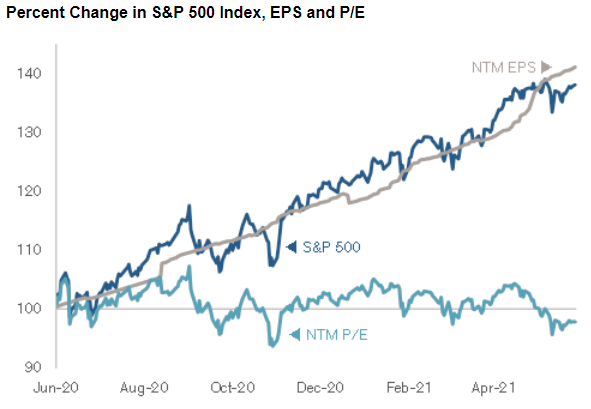 We can ask a lot of legitimate questions about the level at which price-earnings multiples started 12 months ago, and about the robustness of those expectations, but there is something very reassuring about a market behaving exactly the way it is supposed to do. Much as when you are dealing with a small child however, an outbreak of good behavior can arouse suspicions that something is up. When we look at how much companies have managed to surprise on their actual results over the last four quarters, there does seem to be good reason to push up estimates for the future. It looks like analysts underestimated their underlying profitability. As this chart from Mike Wilson of Morgan Stanley shows, earnings surprises in aggregate have been higher than ever before over this period: 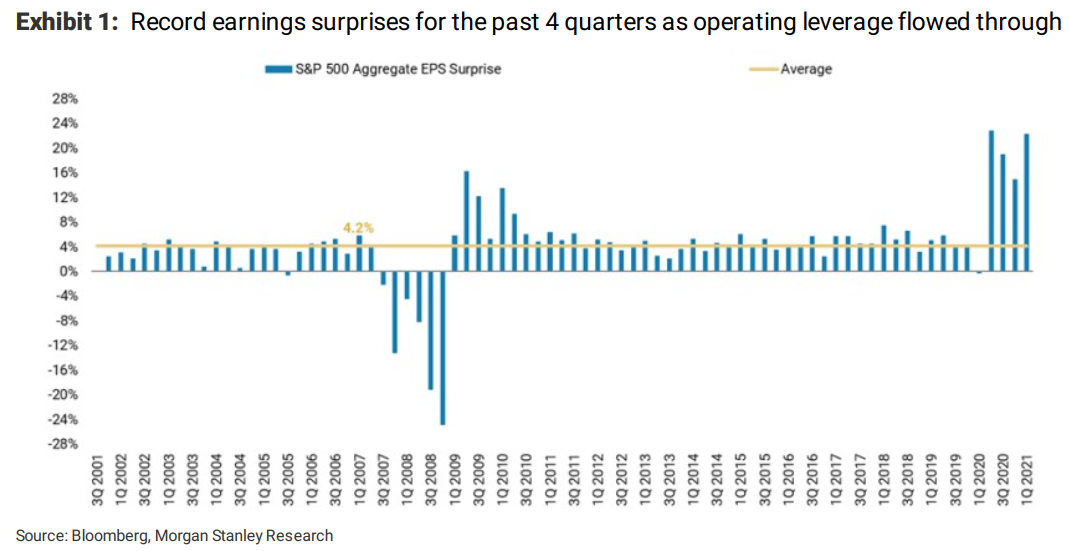 The extent of that surprise owes much to the extraordinary profitability of the big internet platform groups, who managed to prosper during the pandemic lockdown. But even if we look at the proportion of companies managing to beat expectations, these are also at a record, as this chart from Bianco Research LLC demonstrates: 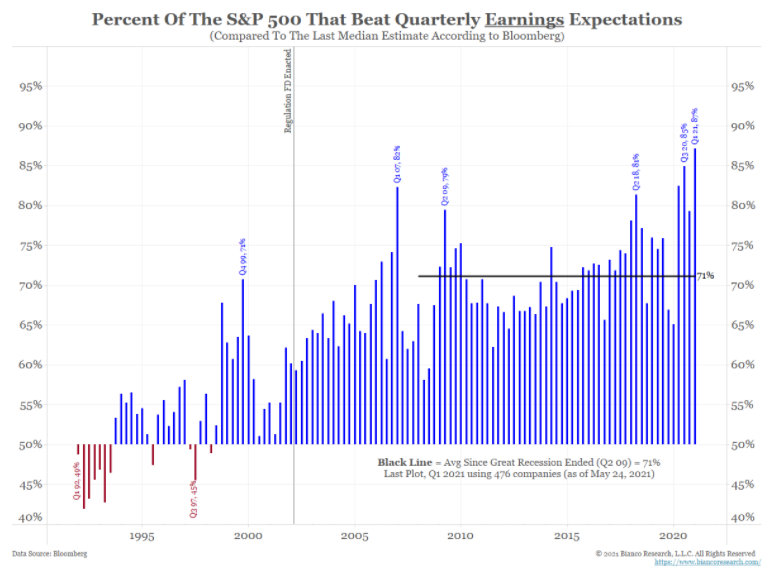 So it's understandable that brokers have pushed up their estimates for the future, and share prices have done exactly what they are supposed to do by following the expectations higher. But if we look at the gap between earnings over the last 12 months, or LTM in this Morgan Stanley chart, and estimates for the next 12 months, or NTM, it looks infeasibly large: 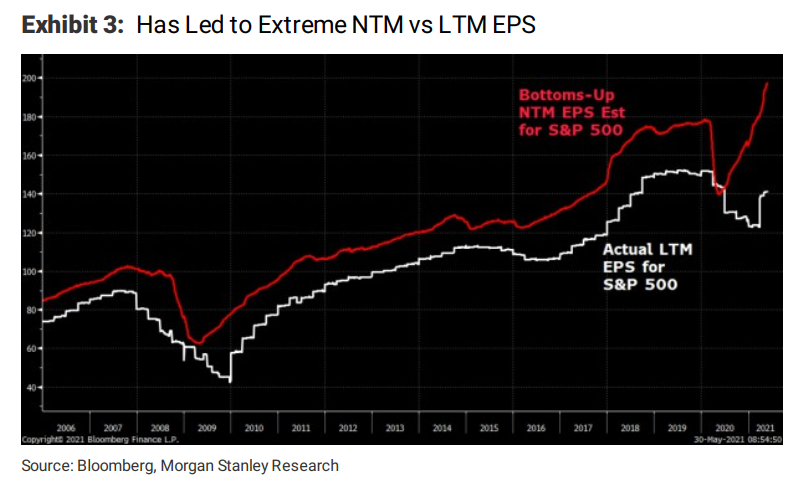 This is where some of the comfort from the forecast increase in earnings begins to dissipate. You might have heard that a lot of people are worried about inflation at present. Those worries rose a little more on Wednesday after the Federal Reserve's subjective "Beige Book" report said that "looking forward, contacts anticipate facing cost increases and charging higher prices in coming months." These worries might prove overblown, but on the face of it they aren't consistent with rising profits on this scale. Companies will find it difficult to pass on all their costs to consumers, and they may also find they have to pay more in debt servicing if interest rates rise. Supply constraints, detailed in yesterday's Points of Return, suggest that it will be hard to maintain profits at this kind of level, according to Wilson. He adds that we should expect higher corporate taxes next year. The chances remain high that the Biden administration will be able to push through tax increases to pay for its infrastructure plans. This will be bad for next year's earnings per share. So we should be concerned about the level of the market. For the time being, however, the focus has been on the sharing of the spoils within the market. The FANG internet platform companies shot for the moon last year on the assumption that growth was scarce, and it was worth paying up for those that could provide it. Even if forecasts for the next year are now too positive, we can see that profit growth is much less scarce than it appeared to be a year ago. That means an epic correction for growth stocks, and a rally for value stocks. Last month this trend was mighty impressive everywhere, but especially in the U.S. where the FANGs ensured that there was a lot of growth to correct. The following chart is from Andrew Lapthorne, chief quantitative strategist at Societe Generale SA: 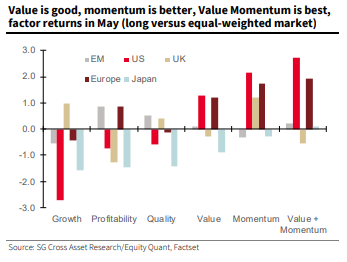 As the momentum has now decisively switched to value stocks, and away from growth, this also means that momentum has started to look much more appealing, as these portfolios now have a lot of value stocks. As Lapthorne shows, relative valuations make it look as though the rotation away from growth has further to go: 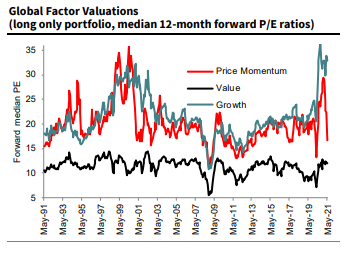 All of this makes pleasingly logical sense. That was expressed in the aggregate by a delightfully dull day; the S&P 500 gained 0.14%, while FTSE's index of all world stocks rose 0.1%. That is the overall picture; surprising earnings trigger a gain in stocks, and a shift away from growth to value companies, with more defensible P/E multiples. That wasn't the headline for the day though. That would belong to the flood of money into a stock that doesn't have a P/E because it is loss-making, and which has gained 2,850% so far this year. Reader, read on: AMC: Planet of the Apes, or Zombie Apocalypse?If there is any single chart that sums up what is most disquieting about what is going on in markets, it might be this one. After rallying another 28% early Wednesday, stock in AMC Entertainment Holdings Inc., the largest U.S. cinema chain, surpassed the performance of Zoom Video Communications Inc., whose video-conferencing technology became ubiquitous during the pandemic, since the beginning of last year. (AMC finished the day with a gain of 95%.) This chart of extraordinary behavior in two share prices tells us a lot about the madness and anger induced by the unnatural conditions of the last 17 months: 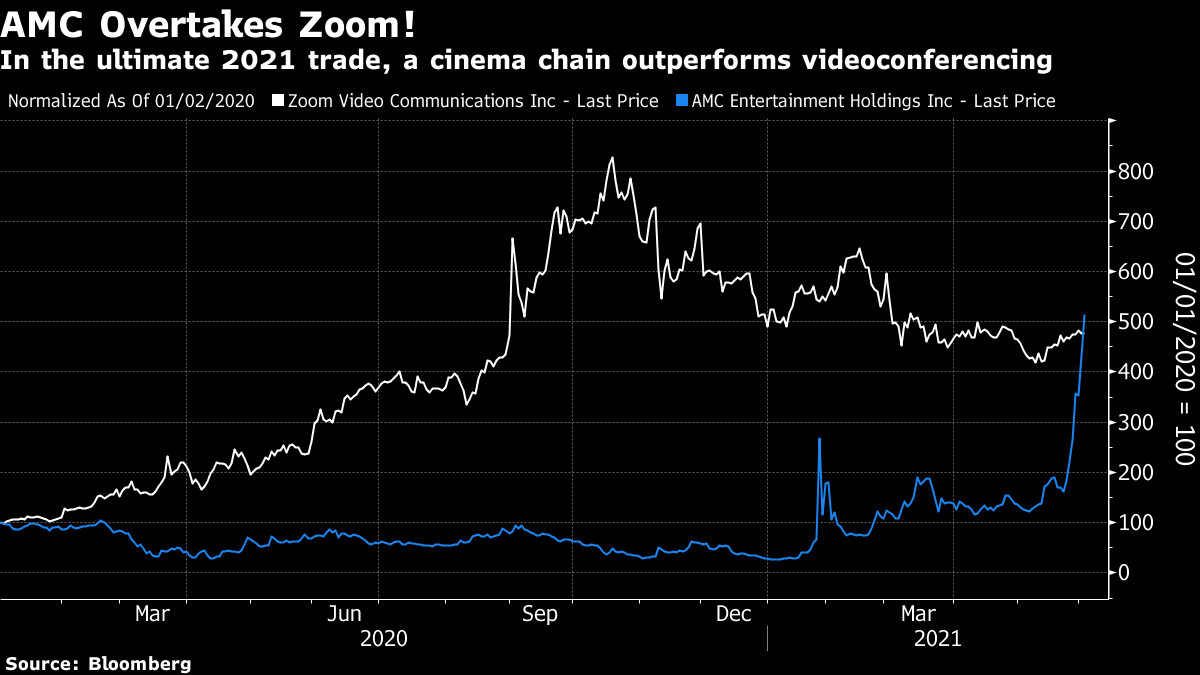 However, this chart, which I merrily tweeted during morning trading, understated the position. I had forgotten that AMC had taken advantage of the excitement surrounding it to issue new stock. If we compare the increase in the two companies' market capitalizations since the beginning of last year, the picture becomes disorienting. Zoom is up 400% in round numbers since then, and AMC is up 2,400%: 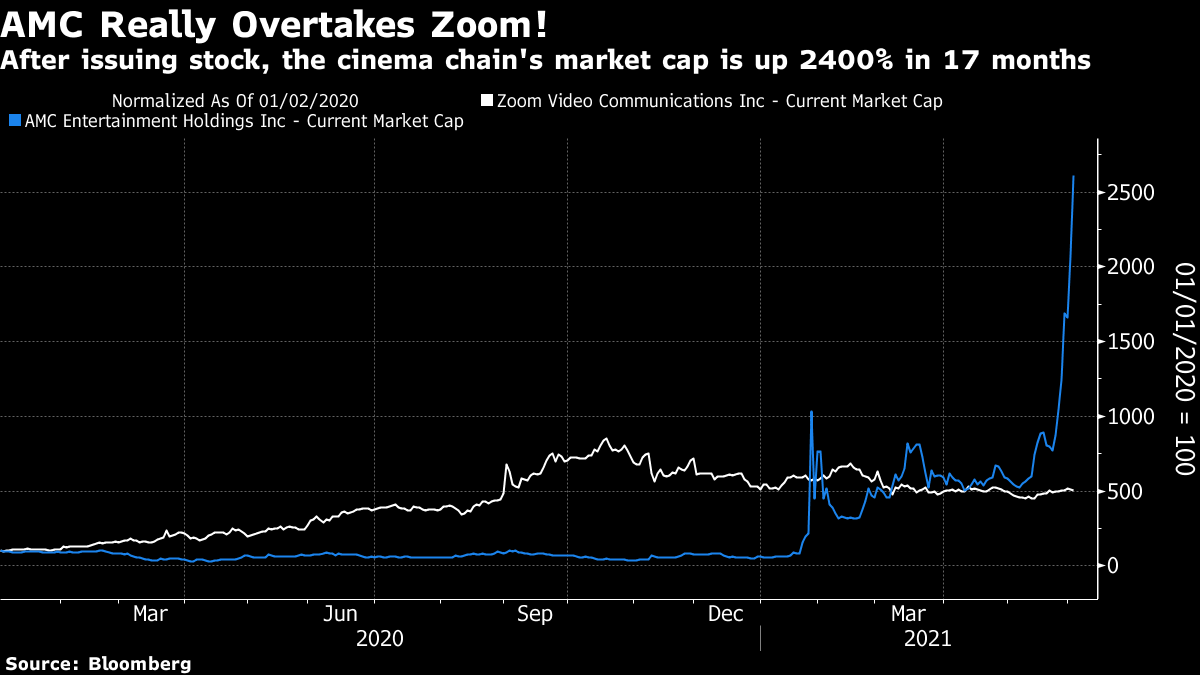 AMC has even overtaken the other great meme stock of 2021, GameStop Corp. You might remember the excitement around GameStop at the end of January. These numbers, showing AMC well ahead for this year, suggest something amiss: 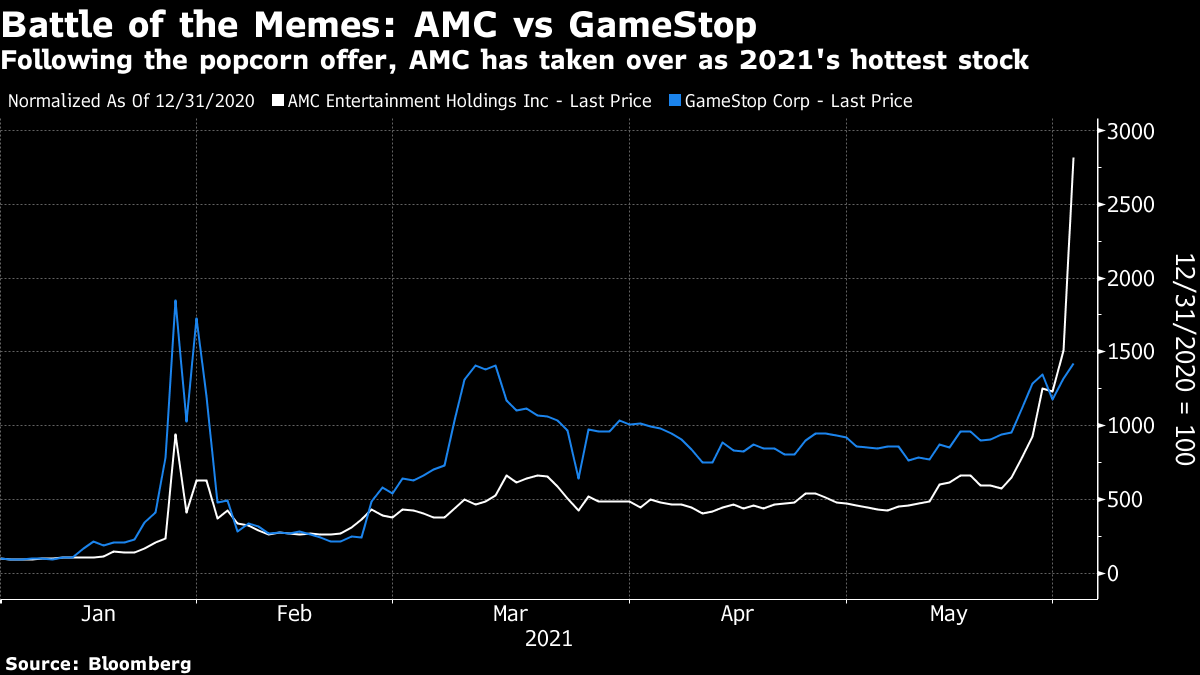 Anyone who followed GameStop (whose investors are still sitting on enormous gains for the year) knows the general outlines of what is afoot at AMC. A group of keen retail investors, communicating primarily through Reddit, spotted an old-line company with a famous name that had fallen on hard times, and bought in unison, in an attempt to force up the price. They helped it avoid bankruptcy and raise equity, and after much patience, they are now seeing massive gains. As with GameStop, this involves a squeeze on short-sellers, who are hugely unpopular among the Redditors. But only about 19% of AMC's shares are currently sold short; it hasn't seen anything like the excessive shorting that marked GameStop. AMC's management has cheerfully encouraged its new investors, and announced in the morning that shareholders would be entitled to a free big popcorn on their return to the movies. But it is impossible to find any sensible rationale for picking on AMC as a target. Cinemas will survive despite the rise of home-streaming, but the industry will need to do some drastic rethinking of its offer. Even at its lowest, it's not clear that AMC was too cheap, or that it might not have been best served by a period in bankruptcy. Narrative EconomicsSo how do we account for what is happening? Realistically, it can only be done with the aid of narratives, of the kind that AMC's cinemas show on their screens. And this is a cue for everyone to finish reading Narrative Economics, by the Nobel laureate economist Robert Shiller, which we will be discussing with the author in a live blog for the book club on Tuesday. His argument is that people often think in terms of narratives, which can become self-fulfilling, and we need to approach economics in that light. The meme-stock phenomenon deserves a chapter on its own in any second edition. Here are the rival narratives. For the new army of investors, who call themselves "apes," this is like Planet of the Apes, or Robin Hood. This is a mission to stick it to Wall Street and the hedgies, and to reverse inequality by redistributing money from rich to poor. Plenty of the people joining in with the squeeze believe this. My personal fear is that this will be less Robin Hood than Monty Python's Dennis Moore (who stole from the poor and gave to the rich). It doesn't seem to have bothered the Redditors that AMC announced a sale of stock to Mudrick Capital Management, on Tuesday, only to see this large fund immediately sell for a profit, saying that the company was overvalued. In this case, the apes helped someone already rich to make a quick buck. And the fact remains that the huge paper gains can only be made real by selling the shares — which will require someone to buy them. The likelihood is that the AMC saga will end by making a bunch of poor people even poorer, having paid fees and commissions to some rich people along the way. As for the notion that this escapade is about justice and making capitalism fairer, the appropriate narrative might instead be Zombie Apocalypse Propping up the share price of companies that are unable to make a profit ultimately means that capital is tied up where it cannot be used productively. Spotting companies that are undervalued and giving them a chance is one thing; piling in to double the price of AMC at the kind of level it had reached Wednesday is something completely different. Judging by my Twitter feed, the people piling into AMC sincerely believe they are doing something righteous and egalitarian, and are convinced that those who doubt them (like me) are corruptly trying to prop up the wealthy oligarchy. They are fueled by rage rather than greed. My counter-narrative is that these people have much to be angry about, and are desperate to get one over on the powers that be, but haven't worked out that this isn't a way to achieve it. There is one important difference with the GameStop imbroglio. As that drama played out four months ago, other investors were alarmed. The S&P 500 dropped almost 5% during the days when GameStop became headline news. This time around, as I said earlier, the AMC excitement has played out in a vacuum. Bitcoin had a good day but it is now trading in a range significantly below its peak; it was at all-time highs at the end of January. By comparison with GameStop, AMC hasn't so far had any repercussions in other markets. As far as the rest of the Wall Street is concerned, they've seen this show before, and they're getting bored.
That might be unwise. Meanwhile, it's worth reading Shiller's Narrative Economics before we discuss it next Tuesday.
Survival TipsFor further reading on Shiller, he's interviewed for a piece on the SPAC phenomenon and Chamath Palihapitiya in the latest New Yorker. And if you want some inspiration, Wednesday was Lou Gehrig Day. For non-Americans, Gehrig was one of the greatest baseball players who ever lived, who was stricken by ALS (amyotrophic lateral sclerosis) at the age of 36 and died two years later. The horrible wasting disease now bears his name. His farewell speech in 1939, in which he told a packed Yankee Stadium that he considered himself "the luckiest man on the face of the earth" is one of the most famous moments in American oratory. He's an inspiration to us all. Like Bloomberg's Points of Return? Subscribe for unlimited access to trusted, data-based journalism in 120 countries around the world and gain expert analysis from exclusive daily newsletters, The Bloomberg Open and The Bloomberg Close. | 


Post a Comment