| Biden to amend Trump's China blacklist. Meme stock frenzy returns. Hedge funds get some work flexibility. Here's what you need to know to start your day. President Joe Biden plans to amend a U.S. ban on investments in companies linked to China's military this week, after the Trump-era policy was challenged in court and left investors confused about the extent of its reach to subsidiary firms. Under Biden's amended order, the Treasury Department will create a list of companies that could face financial penalties for their connection to China's defense and surveillance technology sectors. Until now, the financial sanctions and selection of targeted companies were tied to a congressionally-mandated Defense Department report. Asian stocks look set for a mixed start after U.S. equities trimmed gains as traders weigh the latest comments from Federal Reserve officials for clues about a prospective reduction in stimulus support. Futures pointed lower in Japan and edged higher in Australia and Hong Kong after the S&P 500 and Nasdaq 100 faded from early gains. Investors are looking ahead to Friday's U.S. jobs report for the latest insight into the economic recovery from the pandemic and inflation risks. Treasuries rose and the U.S. dollar erased gains. Of all the issues that have roiled ties between China and the West since the pandemic emerged, none has been more sensitive in Beijing than questions about the origin of Covid-19. U.S. President Joe Biden revived the lab theory last week by giving intelligence agencies 90 days to get closer to a definitive conclusion on the origin of the coronavirus. It comes at a sensitive time in U.S.-China relations, with both governments showing signs they want to move beyond the vitriol that marked the last year of Donald Trump's presidency. Here's where we are in the hunt for Covid-19's origin right now. AMC Entertainment skyrocketed to an all-time high in a wild trading session as the Reddit retail-trading army came back in force, leaving many Wall Street pros wondering, yet again, what on Earth has become of the U.S. stock market. The money-losing movie-theater rose 95% and closed at a record high at $62.55. At one point the stock rose as much as 127%, pushing its total gains for the year to 3,000% as its market value briefly soared past the $33 billion mark. Most U.S. hedge funds plan to let their employees work remotely at least one day a week starting in September — a more flexible approach than Wall Street banks that are already summoning staff back to the office. What many senior managers aren't saying openly is that such accommodations may not last. Meanwhile, Deutsche Bank has joined companies including Goldman Sachs and JPMorgan in asking employees to prepare to return in coming weeks. What We've Been ReadingThis is what's caught our eye over the past 24 hours: And finally, here's what Tracy's interested in todayIn the immortal words of Poltergeist, they're baaa-aaack. The meme stock phenomenon is underway once again, with an astonishing rally in shares of AMC (which closed up 95% on Wednesday alone) having pushed its market value above GameStop's. Those who dismissed social media-driven swarm trading as a short-term phenomenon, are once again witnessing a crazy move in a stock that is trading more like a token than a company. Some see this as a negative for the overall stock market, with New York Times columnist Andrew Ross Sorkin tweeting that the long-term impact of AMC and GameStop "is about the public, which views the stock market (and economy) as something that is manipulated and not trusted." 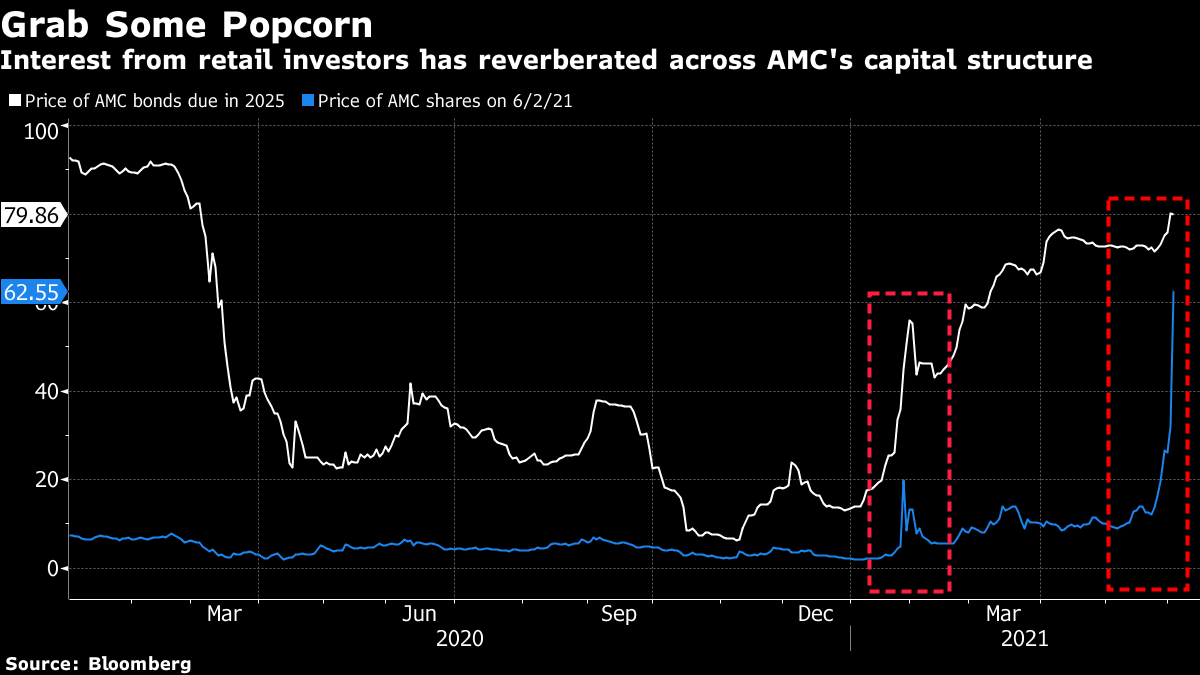 I'm not sure I agree. Back in January, at the height of GameStop's wild ride, and when AMC was starting to draw some attention, I wrote that it's tempting to view what's going on as an irrelevant "gamifaction" of stock trading, but it's harder to make that case when it's impacting the allocation of actual capital. AMC is now the ultimate icon of that dynamic, with its CEO Adam Aron embracing enthusiastic retail investors (who could perhaps more appropriately be called investor-fans) and even offering them popcorn. The company's been able to avoid bankruptcy thanks to the surge in its stock price. It's been able to raise new money, and prices for its junk-rated bonds have been rising. To quote myself once again: "Moves that started on r/wallstreetbets are now rippling across AMC's entire capital structure... In other words, fake internet memes can have an impact on real money. LARPing in markets can lead to changes in the real world." While there's certainly an element of gaming the system involved in the AMC trade (we know that r/wallstreetbets tends to identify stocks with high short interest and where call options can make the most impact), the outcome here is a desirable one for retail investors. Their stock trading achieved something good; it helped save a struggling movie chain and they had lots of fun and many of them made lots of money while doing it. You can follow Tracy Alloway on Twitter at @tracyalloway. | 


Post a Comment