| In the closing decades of the 20th century, the prevailing wisdom among Western economists was that post-Communist countries should hasten their transformation into market economies by pushing "Big Bang" price reforms. Had China listened to that advice, it may well have ended up like Russia— an economic disaster, argues Isabella Weber, the author of the new book, "How China Escaped Shock Therapy: The Market Reform Debate." Instead, China opted for gradual change, a cautious and pragmatic approach that came to be known as "crossing the river by feeling for the stones." But this decision came only after a fierce internal debate that, as Weber shows in her gripping narrative, could have gone either way. A decisive moment was the Tiananmen Square protests, fueled by rising inflation, that ended in mass bloodshed. 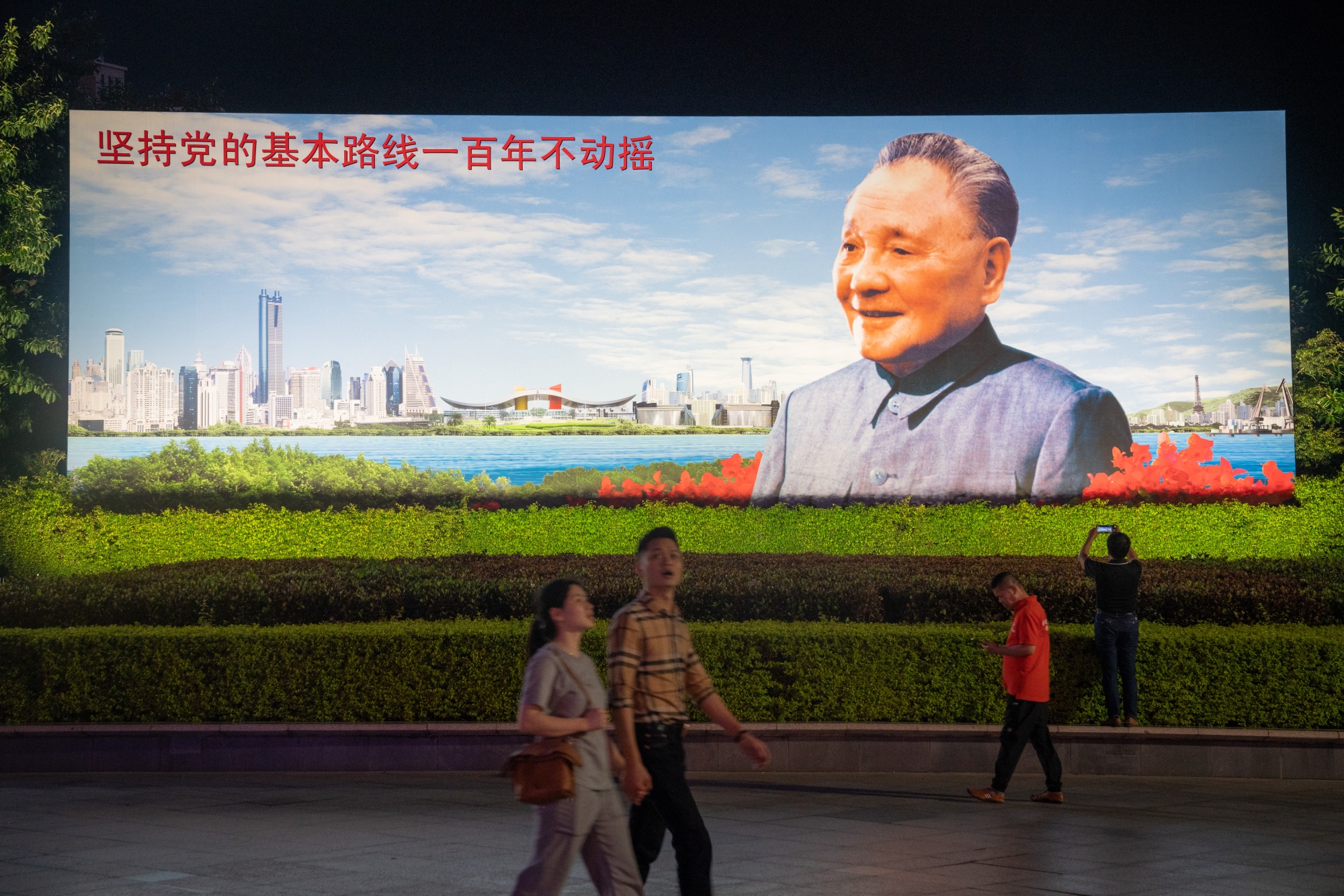 Deng Xiaoping Portrait Square in Shenzhen, China Photographer: Yan Cong/Bloomberg This week in the New EconomyI asked Weber how those momentous events shape China's approach to the world today. Andrew Browne: You argue that China became a global economic juggernaut in large part by ignoring the advice of most Western economists. Does this experience make China less inclined to bend to Western pressure today to open its economy? Isabella Weber: This is not about Western versus Chinese economics per se, but more about free markets versus markets with active state participation. Chinese and Western economists took both sides of the debate, some arguing for radical, shock-like liberalization and others for a more pragmatic approach that started with experimentation on the margins. Reform economists were often inspired by the experience of the transitions from a war economy after World War II—a transition that is relevant today as the U.S. prepares to transition out of the Covid-19 pandemic with war-time level government spending. Browne: Deng Xiaoping did, in fact, briefly try "Big Bang" overhauls, which led to corruption, inflation and mass protests on Tiananmen Square that almost cost the Communist Party its grip on power. Is this how we should understand China's rejection of neoliberalism? Weber: Toward the end of the 1980s, agricultural reforms had unleashed an enormous amount of productivity. But resistance to further marketization increased when it became clear that not everyone stood to benefit. In this context, the idea of big bang price liberalization became appealing to Deng. The reaction to announcements on state TV of comprehensive price reform was panic, bank runs and hoarding of durable goods. Deng was prepared to make great sacrifices in the name of market reforms and economic progress, but he was not willing to risk social and political stability, and ultimately the communist state. So attempts to push through radical price liberalization stalled. This is not to say that there were no neoliberal reforms in China after 1988. In fact, the 1990s and early 2000s were the most neoliberal era in China, but there was no attempt at an overnight overhaul of the system as a whole.  Isabella M. Weber Source: Isabella M. Weber Browne: Was there an alternative path? Couldn't China have ended up more like Poland, which embraced both markets and democracy? Weber: In comparing, say, Poland with China, we have to remember that China was still a very, very poor country at the beginning of reform. In 1980, China's GDP per capita was still less than that of Haiti or Sudan. It faced a challenge of industrialization and development, not simply marketization. Had the country undergone a recession anything like that in Russia, it could have been a disaster of proportions that are hard to estimate. In Russia, almost every indicator of human well-being declined sharply—but starting from much higher levels than in China. It is sad to say, but unfortunately democracy also does not seem to be a very stable outcome in several of the transition economies that have undergone forms of shock therapy. Browne: The approach that China ultimately adopted left the state at the core of the economy. In a way, didn't that set up the conflict we see today between Western economies and so-called Chinese "state capitalism?" Weber: What puzzles me about the idea that the problem lies in Chinese "state capitalism" or China's active state participation in the market is that this is not unique to China. Other states also have historically had quite extensive industrial policy and state engagement. It seems that the tensions between China and the West have been mounting since China moved from being the workshop for companies headquartered in the West toward trying to establish its own companies that can reach the technological frontier. That of course required the state, as China was starting from a position of relative technological under-development. Browne: Local experimentation accounts for much of China's early economic success. But these days, the approach is more top-down. Is that a problem? Weber: First of all, I think we have to recognize that the 1980s is really this moment of great openness before a new paradigm has settled. This is a little bit like what we might be observing right now in the U.S. context, where suddenly all of the premises that we used to have in economics, especially in economic policymaking, seem to be up for debate. Obviously, this moment of openness cannot last forever. Eventually the mist settles, and you get a new, more consolidated system.
The fourth annual Bloomberg New Economy Forum will convene the world's most influential leaders in Singapore on Nov. 16-19 to mobilize behind the effort to build a sustainable and inclusive global economy. Learn more here.
__________________________________________________________ The Qatar Economic Forum, Powered by Bloomberg: Join the world's top policymakers and business leaders June 21-23 as they lay out a blueprint for the next stage of global growth. This virtual event centered on Doha will feature more than 100 decisionmakers, including H.E. Akbar Al-Baker, Group CEO of Qatar Airways; Clare Akamanzi, CEO of the Rwanda Development Board; and Stephen Schwarzman, co-founder of The Blackstone Group. Register here with code BNEWS Download the Bloomberg app: It's available for iOS and Android. Before it's here, it's on the Bloomberg Terminal. Find out more about how the Terminal delivers information and analysis that financial professionals can't find anywhere else. Learn more. | 


Post a Comment