| Good morning. New vaccine worries, surging luxury goods sales and a big day for cryptocurrencies. Here's what's moving markets. Clot JittersMore concerns about links to cases of clotting caused the U.S. to pause the Johnson & Johnson Covid-19 vaccine roll out on Tuesday, with the company then deciding to delay the launch in Europe too. The U.S. sought to reassure that it has ample supplies even without the J&J shot, but the decision could create new obstacles in a vaccination program already contending with wider hesitancy and skepticism. It also puts the focus back on these extremely rare instances of immune reaction. For Europe, the delay further complicates its own inoculation campaign, just as it was picking up speed after a faltering start. Booming LuxuryLuxury goods giant LVMH, the owner of Louis Vuitton and jeweler Tiffany, set a very positive tone as earnings season slowly gets into gear in Europe. The group said its first-quarter sales soared more than had been expected, defying any pandemic-related gloom for the sector. Elsewhere, German software giant SAP raised the lower end of its guidance in a sign that customers are starting to pick up IT spending again. Also ahead on Wednesday, U.K. grocer Tesco will report results before attention turns to the first flurry of bank earnings from the U.S., with JPMorgan Chase, Goldman Sachs and Wells Fargo stepping up to the plate. Recovery PlansThe European Union is set to lay out a five-year, $1 trillion debt plan as it works to fund its recovery from the pandemic, replete with a "state of the art" platform to sell bonds and bills via a network of primary dealers by September. EU governments are also seeking to hammer out an agreement on the technical specifications for so-called virus passports, an attempt to salvage the summer tourism season. In Germany, meanwhile, the contest to replace Angela Merkel is getting increasingly nasty with the conservative bloc hoping to wrap the situation up by week's end. Speculative CornersThere's much to pore over this week for watchers of two of the most speculative corners of the market: cryptocurrencies and blank-check companies. Crypto exchange Coinbase is set to go public on Wednesday with talk of a valuation in the $100 billion range and will do so with Bitcoin having hoisted itself to another record high. Meanwhile, the fervor around blank-check companies, or SPACs, may be showing signs of cooling. The biggest such deal thus far, involving Singapore-based ride-hailing group Grab, got a lackluster response in the wake of a new crackdown on the sector by U.S. regulators. Coming Up…European stock-futures are trending slightly higher, following from gains in Asia as investors shrugged off a rise in U.S. inflation. Italian Prime Minister Mario Draghi's government submits economic and budget forecasts, while European Central President Christine Lagarde and Federal Reserve Chair Jerome Powell are both due to speak at different events. Meanwhile, oil prices are higher amid continued signs of fuel demand re-emerging and aluminum prices hit the highest since 2018. What We've Been ReadingThis is what's caught our eye over the past 24 hours. And finally, here's what Cormac Mullen is interested in this morningIn the bond market, traders are not reacting to signs of inflation as one might expect. On Tuesday, data showed U.S. consumer prices climbed in March by the most in nearly nine years -- beating expectations -- yet 10-year Treasury yields fell five basis points to their lowest in three weeks. The decline is another sign of investors reining in their enthusiasm for bets linked to the reflation trade. The S&P 500 Value Index has lagged its growth counterpart by almost 10 percentage points since March 8 and five-year U.S. breakevens-- a measure of inflation expectations -- have treaded water since hitting their highest since 2008 last month. Of course it's still too early to really get a sense of where prices will settle post the pandemic -- the U.S. data was distorted by last year's decline. That makes the more immediate question how long this period of limbo will last. In the meantime, some investors are taking the opportunity to get back into longer-dated bonds. A gauge of institutional demand for Tuesday's 30-year Treasury auction -- so-called direct-bidder participation -- rose to its highest since 2014. 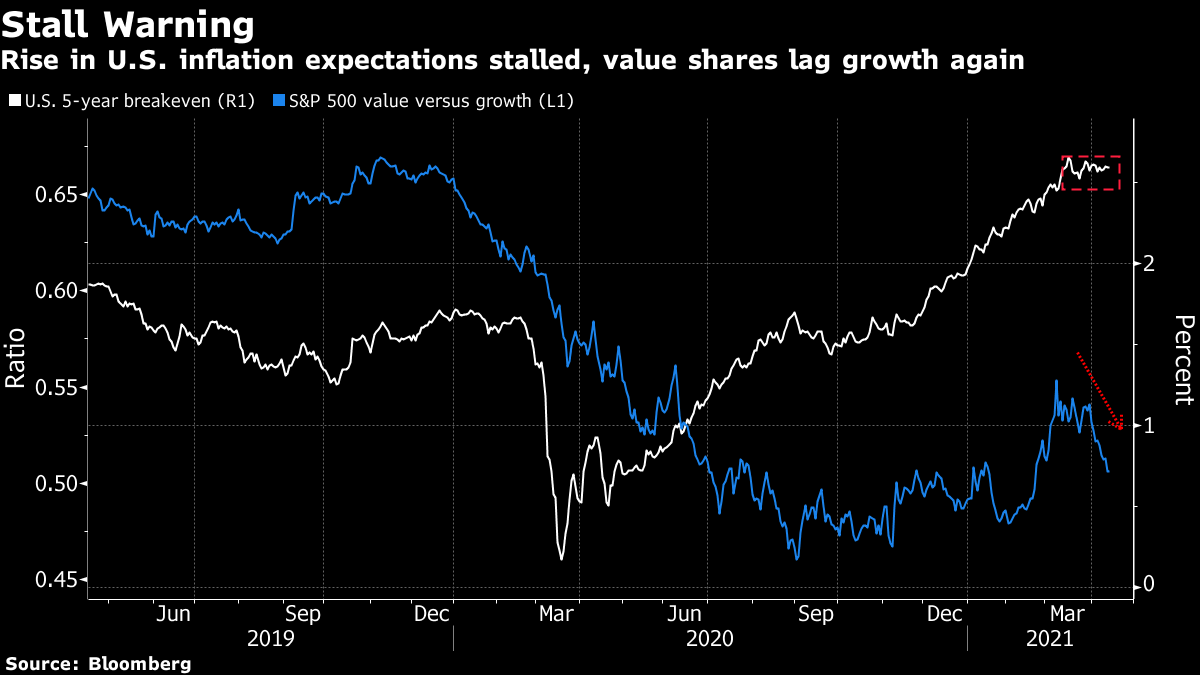 Cormac Mullen is a cross-asset reporter and editor for Bloomberg News in Tokyo. Like Bloomberg's Five Things? Subscribe for unlimited access to trusted, data-based journalism in 120 countries around the world and gain expert analysis from exclusive daily newsletters, The Bloomberg Open and The Bloomberg Close. | 


Post a Comment