| Technology shares are pummeled. Xi Jinping's crackdown on Jack Ma risks backfiring. Janet Yellen dismisses inflation fears. Here's what people in markets are talking about today. Asian stocks looked poised for a muted open after a rotation out of growth stocks drove the Nasdaq 100 Index into a technical correction. Treasury yields rose and the dollar strengthened. The U.S. tech benchmark tumbled almost 3% Tuesday to its lowest close since November, and is now down 11% from an all-time high in February. The retreat in stocks with high valuations offset a rise in financial and materials shares, erasing the S&P 500 Index's earlier gains. The Dow Jones Industrial Average hit an all-time high before settling up 1%. Futures pointed to modest gains in Japan, Australia and Hong Kong after Monday's selloff in Asia. Ten-year Treasury yields climbed to just under 1.6% and equivalent real yields also rose. Brent crude briefly traded near $70 a barrel before pulling back. Gold slumped and Bitcoin traded above $51,000. The U.S. and China are pursuing divergent economic policies in the aftermath of the coronavirus recession in a role reversal from last time the world economy was recovering from a shock. One of the takeaways from the annual National People's Congress under way in Beijing is a conservative growth goal, with a tighter fiscal-deficit target and restrained monetary settings. That's a big contrast with Washington, where President Joe Biden is preparing a second major fiscal package after he gets final approval for his $1.9 trillion stimulus. The widening policy divergence is putting strains on exchange rates and could potentially reshape global capital flows. U.S. Treasury Secretary Janet Yellen dismissed fears that President Joe Biden's $1.9 trillion pandemic-relief bill is so big that it will cause an inflation problem, as she seeks to push the recovery deeper into the U.S. labor market to address long-standing economic disparities. Yellen called the impact on women and minorities from Covid-19 "absolutely tragic." She has repeatedly rejected concerns that Biden's stimulus is excessive given the economy's signs of recovery, and that run-away inflation could damage the economy. African swine fever is re-emerging in Asia, threatening to upend efforts to replenish national herds after the virus killed tens of millions of pigs in the region and created a huge shortage of meat protein. Fresh outbreaks have been reported in China and Vietnam this year, and the disease has even landed on Malaysia's shores, putting governments on notice that the virus is alive and well and there could be dire consequences if it's not kept under control. With no commercial vaccine available yet, authorities are relying on strict biosecurity measures and the culling of susceptible animals to keep the disease in check. Here's a breakdown of the latest situation by country. In barely 40 years, China has dramatically opened up its economy and become one of the world's primary growth engines. Now, President Xi Jinping is making ambitious plans to pull ahead of rivals by turning his country into a digital powerhouse. But Xi's drive toward tech dominance is being threatened by an unexpected speed bump: China's forceful crackdown on Jack Ma's business empire. What We've Been ReadingThis is what's caught our eye over the past 24 hours: And finally, here's what Tracy's interested in todayI'm selling one of my tweets. This one to be exact. Actually I will sell any of my tweets, so just make me an offer if you're interested. What's going on, you ask? Non-fungible tokens, or NFTs, are pretty much all anyone can talk about right now. They're digital collectibles, typically tied to a piece of online art or ephemera, but I like to think of them more like digital bragging rights. You get to be the person who bought Nyan Cat for $590,000. (there's a big assumption embedded in that statement that you would actually want to be the person who bought an animated GIF of a pixelated Pop-Tart-cat-hybrid soaring through the sky on its own rainbow farts for $590,000) or the person who has bid $2.5 million for Jack Dorsey's first tweet. So as I said, I'm selling one of my tweets as an NFT. The tweet will remain on my Twitter account, and I'll still hold whatever copyright one might attach to it. But someone will get to own the bragging rights to the tweet, and they will be the only bragging rights tied to that tweet courtesy of the tokenization process. This is the non-fungible part of NFTs, though I think the possibility of making money off of work I've already done is actually pretty fun indeed. So far the highest bid for my tweet is $42. I'm selling it on the Valuables platform in case you're curious. 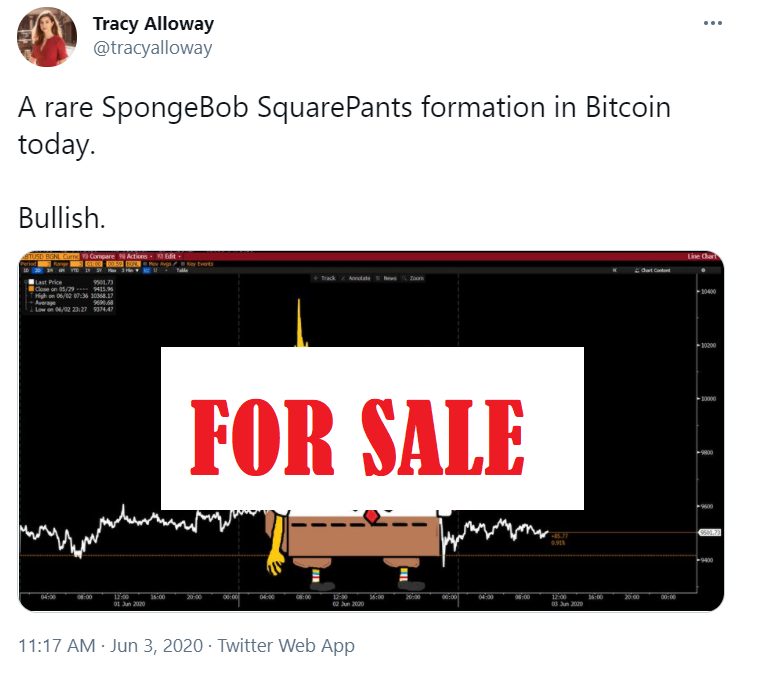 Bloomberg Bloomberg By my calculations, I have a total 17,300 tweets and if each of them is valued at $42, I stand to make $726,600. This is unlikely to be the case of course, there are a lot of retweets (although, one must ask, is it possible to tokenize a retweet of someone else's tweet?), but even a lower amount would be very much welcome. (It would still need to be six figures though, lest I fear my intellectual property be compared unfavorably to a Pop-Tart cat). You can see why people are calling NFTs a new speculative mania. People often categorize bubbles into productive and unproductive assets. A productive bubble might be something like railways or Canal Mania. An unproductive bubble could be classified as something more akin to collectibles. There are a surprising number of those throughout history. Tulips might be the most famous, but there's also the 1990s bubble in Beanie Babies and baseball cards. In the 1800s, Japan went crazy for collecting rabbits, of all things. Around the same time, Victorian England was going gaga for fancy chickens (though, you could argue that particular speculative craze ended up being surprisingly productive from a scientific standpoint). So are NFTs productive or unproductive? It would be easy to argue that they're massively wasteful given that the process of tokenization runs on blockchain and large computer networks that need lots of electricity. They're also funneling money into digital artworks that no one really needs. On the other hand, they could certainly help my personal productivity by encouraging me to spend more time producing masterpieces with MS Paint for the purposes of selling them. So, yes. This tweet. What am I bid? You can follow Tracy Alloway on Twitter at @tracyalloway. | 


Post a Comment