| Stimulus package to easily pass House, bond market remains jumpy, and attack on Saudi facility roils crude. House vote President Joe Biden's $1.9 trillion package will easily pass a vote in the House after it is taken up tomorrow, according to leading Democrats. Economists have already factored the mammoth spending bill into their calculations for the year, with Goldman Sachs Group Inc. seeing the unemployment rate tumbling to 4.2% by year end. Should everything go smoothly in the House, Biden will sign the measures into law before the aid from the previous package runs out on March 14. Treasuries The size of the stimulus deal is keeping the Treasury market on its toes, with short positions on the securities hitting a record level last week. The yield on the 10-year Treasury was holding around 1.6% this morning on continued bets that extra government spending could overheat the economy. Aside from fiscal matters, investors will also have to digest decisions from the world's major central banks in the next 10 days. Another attack Tensions are rising in the Middle East after a drone attack on Saudi Arabian oil installations over the weekend by Iran-backed Houthi rebels over the weekend. The attacks caused no injuries or loss of property, according to a spokesman for the Saudi Energy ministry. Brent crude rose as much as 2.9% to $71.38 a barrel in early trading this morning, before giving up those gains. The assurances that supply was not disrupted by the attack and this morning's dollar strength seem to have helped reverse the surge in prices at the highest level since January 2020. Markets mixedRising bond yields continue to be the driving factor for global equities, with tech stocks getting hardest hit as investors reassess companies with lofty valuations. Overnight the MSCI Asia Pacific Index dropped 1.2% while Japan's Topix index closed down 0.2%. In Europe, the Stoxx 600 Index was 0.8% higher at 5:50 a.m. Eastern Time with the region's banks the best performers. S&P 500 futures pointed to a lower open, with Nasdaq 100 futures dropping as much as 2%. Coming up... Treasury Secretary Janet Yellen speaks at an IMF event at 10:00 a.m. U.S. wholesale inventories data for January is also at that time. Biden will sign executive orders on gender equality and economic opportunity for women. Today is International Women's Day. What we've been readingThis is what's caught our eye over the weekend. And finally, here's what Joe's interested in this morningThe Senate's passage of the $1.9 trillion stimulus is a good reminder of just how consequential that Georgia runoff election was in January. Without the Democrats winning both seats, there's zero chance that we would have gotten fiscal expansion on this scale. There's a good chance, in fact, that there wouldn't have been any stimulus at all. The bill is large enough that Andrew Husby of Bloomberg Economics predicts that by the middle of this year, U.S. GDP will have returned to its pre-pandemic trend, completely erasing the gap. 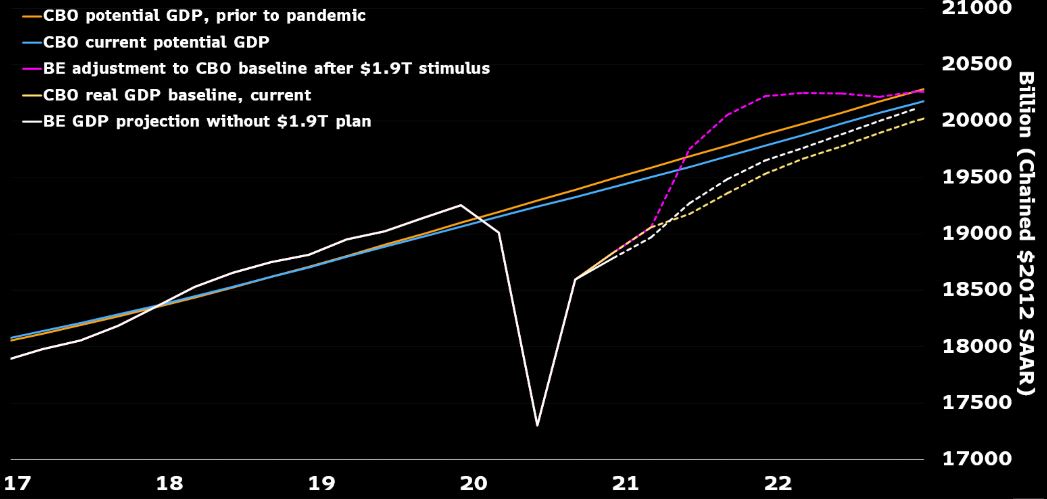 Of course, the huge fiscal ramifications of the Georgia runoff have been appreciated for awhile. The Bloomberg Dollar Index bottomed January 6, the day after the vote. 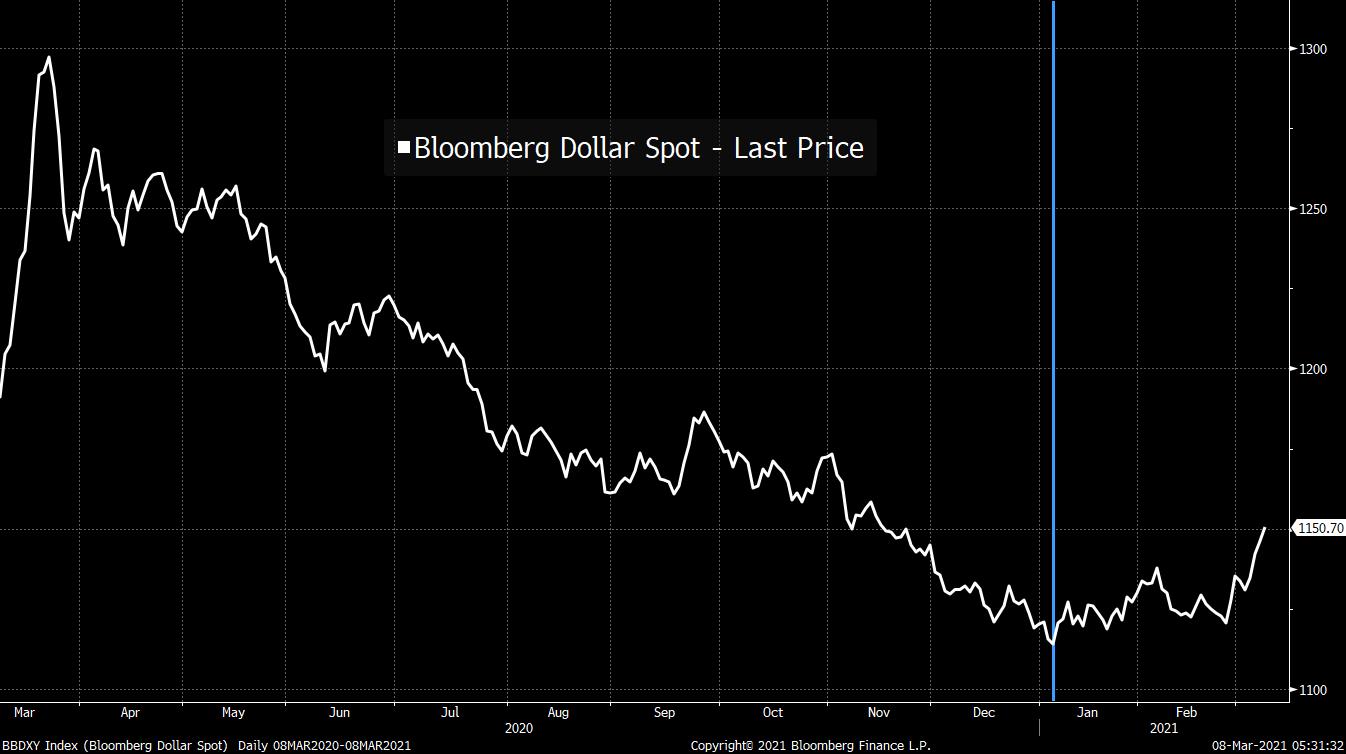 Less appreciated, perhaps, are the monetary implications of the Georgia vote. One thing that we've learned in the wake of the Great Financial Crisis is that the Fed doesn't have much power to generate inflation or rapid growth. It can do all the QE in the world and the effect is pretty modest. What it can do, however, is tap the breaks on inflation and slow things down by raising rates.
Last summer the Fed announced a rethink of its strategy, and the best way to understand its new approach is not that it's promising to do something new, but rather it's promising *not* to tap the breaks as early as it did in the past. The Fed can't guarantee or generate 2% inflation, but it can say that if inflation is below 2% and employment is still not at full potential that it won't tap the brakes. In other words, Georgia, by opening up the door to this aggressive stimulus, basically engaged the Fed's new framework. What was strictly a theoretical statement last summer -- "we won't raise rates to prematurely snuff out a fast recovery" -- can now be put into practice. A new fiscal and a new monetary regime were both put in place by that vote.
Joe Weisenthal is an editor at Bloomberg. Like Bloomberg's Five Things? Subscribe for unlimited access to trusted, data-based journalism in 120 countries around the world and gain expert analysis from exclusive daily newsletters, The Bloomberg Open and The Bloomberg Close. | 


Post a Comment