| Good morning. Oil rally, China congress, payrolls and Powell. Here's what's moving markets. Dry PowderBrent crude oil holds onto a two-day gain of about 5% after rallying Thursday afternoon on headlines coming from the OPEC+ production talks. In a surprise move, the alliance agreed to hold output steady in April, while Saudi Arabia said that it will maintain its one million barrel-a-day voluntary production cut. Goldman Sachs and JPMorgan were among those boosting their price forecasts after the decision that was spurred Saudi Prince Abdulaziz bin Salman urging the group to "keep our powder dry." Elsewhere in markets, the Nasdaq Composite wiped its 2021 gain as Tesla and a number of lockdown winners dropped. European equity futures are slipping this morning. China CongressChina opened its annual National People's Congress by setting a conservative economic growth target that signals more restrained monetary and fiscal policies this year. The country did, however, pledge to boost spending on research into cutting-edge chips and artificial intelligence as it laid out a blueprint to vie for global technological influence with the U.S. It also projected significant growth in defense spending amid criticism over it curbing democracy in Hong Kong elections. The U.S. also vowed Thursday to hold China to account for anti-competitive behavior and "horrific" human-rights abuses. France ControlsFrance plans to tighten Covid-19 restrictions, with the Pas-de-Calais department on the northern coast of France put under a weekend lockdown as of Saturday. The country also strengthened mask-wearing rules in the most affected areas and closed large shopping centers. Elsewhere, Italy risked a global backlash by making use of new European Union legislation that allows a country to block vaccine exports heading outside of the bloc. The 250,000 doses had been headed for Australia, but Italy acted after maker AstraZeneca informed the EU that it was unable to meet its commitments under an advance purchase agreement. Tsunami Risk FadesNew Zealand downgraded a tsunami warning Friday, allowing thousands who evacuated coastal areas in the north of its North Island to return home. The nation had been on tsunami alert all morning after a powerful magnitude 8.1 earthquake struck. It was the third large quake recorded north of New Zealand in a matter of hours. The country sits on the Ring of Fire, a belt of volcanic and seismic activity that rings the Pacific Ocean Coming Up…It's a nonfarm Friday so watch out for the U.S. jobs report this afternoon following a weaker than expected report from ADP on Wednesday, and after Federal Reserve boss Jerome Powell tried to reassured markets that monetary support will be maintained. Ten-year yields climbed again as Powell gave just a minor nod to the recent, abrupt surge in long-term borrowing costs. In Europe, the main data point is German factory orders. Elsewhere, London Stock Exchange Group and Dassault Aviation provide earnings. What We've Been ReadingThis is what's caught our eye over the past 24 hours. And finally, here's what Cormac Mullen is interested in this morningFed Chair Jerome Powell didn't exactly ride to the rescue of global bond investors Thursday, suggesting he would only be concerned by disorderly conditions in markets. But a quick look at Treasuries suggests that not everything is really in order. Huge demand from traders looking to bet on higher yields has sent the overnight borrowing cost on 10-year Treasuries -- their repo rate -- to as low as minus 4% this week. That means the investor lending out cash for the bonds ends up having to pay, instead of getting compensated, and compares with a general repo rate of 0.03%. With minus 3% the the threshold below which it's cheaper to pay a regulatory fine than to complete a transaction, failed trades are soaring. Daily Treasury repo fails -- where a trader promises to hand over bonds but doesn't -- surged to $64 billion as of March 3, the highest in four months, according to DTCC. As my colleague Stephen Spratt pointed out Thursday, Japanese investors have been adding to the crunch. Despite hopes in some circles they would step in to buy Treasuries and arrest the rise in yields, it turns out they have been furious sellers. The net result is gummed up plumbing in the Treasuries market and a dearth of liquidity. If not fixed, the situation only increases the possibility Powell will get some disorderly conditions and heightens the chances of a sharp move in yields. 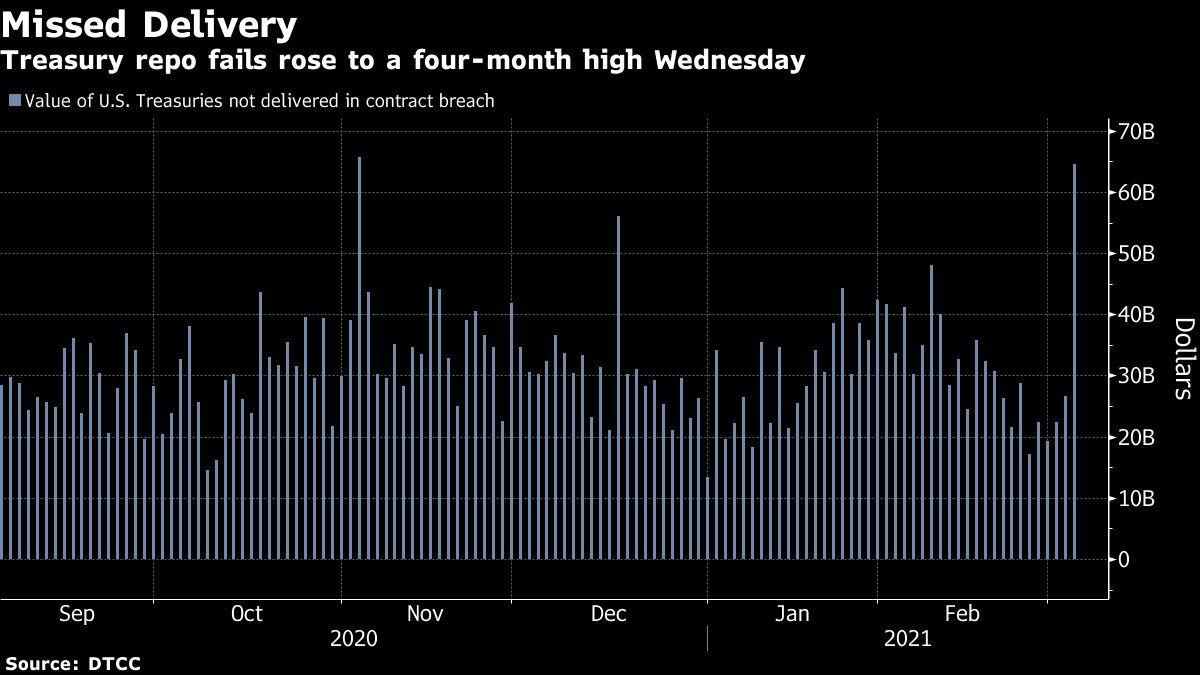 Cormac Mullen is a cross-asset reporter and editor for Bloomberg News in Tokyo. Like Bloomberg's Five Things? Subscribe for unlimited access to trusted, data-based journalism in 120 countries around the world and gain expert analysis from exclusive daily newsletters, The Bloomberg Open and The Bloomberg Close. | 


Post a Comment