| The U.S. may be weeks away from the first Covid-19 vaccines. Blackstone doubles down on Asia. Australia's housing market defies the bears. Vaccinations against Covid-19 in the U.S. will "hopefully" start in less than three weeks, according to the head of the federal government's program to accelerate a vaccine. On Dec. 11 or 12, the first people will hopefully be immunized across the U.S., according to Moncef Slaoui, head of the government's Operation Warp Speed. While an effective vaccine is expected to be widely distributed in the U.S. in 2021, hurdles remain. An advisory panel of the Food and Drug Administration is meeting on Dec. 10 to discuss emergency use authorization for a vaccine candidate. Pfizer and BioNTech have requested that authorization for their product. Here's how the vaccine race is shaping up. Stocks looked set for a cautious start to the week as traders monitored developments on progress toward a vaccine. The pound ticked higher. Global equities remain within a whisker of the record high set earlier this month, with futures in Hong Kong and Australia on Friday indicating small gains when the trading week begins. Japan is shut for a holiday and Treasuries won't trade until the London open. U.S. stocks extended a weekly decline Friday as traders weighed a conflict between the White House and Federal Reserve over emergency lending programs. Two companies backed by local governments in Guangdong province have stepped in to provide a lifeline for beleaguered developer China Evergrande Group after a key strategic investor demanded an exit, according to a person familiar with the matter. They will buy equity worth 30 billion yuan ($4.6 billion) from existing investors in Hengda Real Estate, a unit that holds Evergrande's main property assets in China, the person said, asking not to be identified as the information isn't public. Shenzhen-based Evergrande has come under intense scrutiny after fears of a cash crunch triggered a sell-off in the company's bonds and shares in late September. Blackstone Group is doubling down on Asia, seeking to raise at least $5 billion for its second private equity fund focused on the region, people familiar with the matter said. The U.S. investment firm has started marketing the new vehicle to potential investors, according to the people. It's targeting more than double the size of its first Asia buyout fund, which closed at about $2.3 billion in 2018. Blackstone is raising ever-larger pools of capital as dislocations from the coronavirus pandemic offer up more deal opportunities. Australia's A$7.1 trillion ($5.2 trillion) housing market is facing the ultimate stress test — the first recession in almost three decades — and for now, passing with flying colors for now. Economists are predicting house price gains of 5-15% in the next couple of years, fueled by low interest rates. While the housing strength is good news for the economy's recovery, housing bears say further gains risk fueling a bubble that is destined to pop one day, leaving a trail of bad debts. Australia's banks are among the world's most exposed to mortgages, with housing loans at the major four banks equating to about 75% of the nation's approximately A$2 trillion GDP. What We've Been ReadingThis is what's caught our eye over the past 24 hours: And finally, here's what Tracy's interested in todayTechnical analysis tends to catch a lot of flak but there's one area where it can arguably be quite useful and that is in Bitcoin. If you agree that Bitcoin is being driven by sentiment (hopes and dreams) rather than fundamentals then measuring the flow of that sentiment through technical analysis arguably makes some sense. So it's worth taking a look at an argument made by Citigroup's Chief Technical FX Strategist Tom Fitzpatrick. He points out that Bitcoin's price action over the 12 years or so of its existence has followed a pattern: intense rallies pursued by bear markets. But those rallies are getting longer each time — 10 months to the big drop in 2011, two years to the fall in 2013, and three years to the one in 2018. 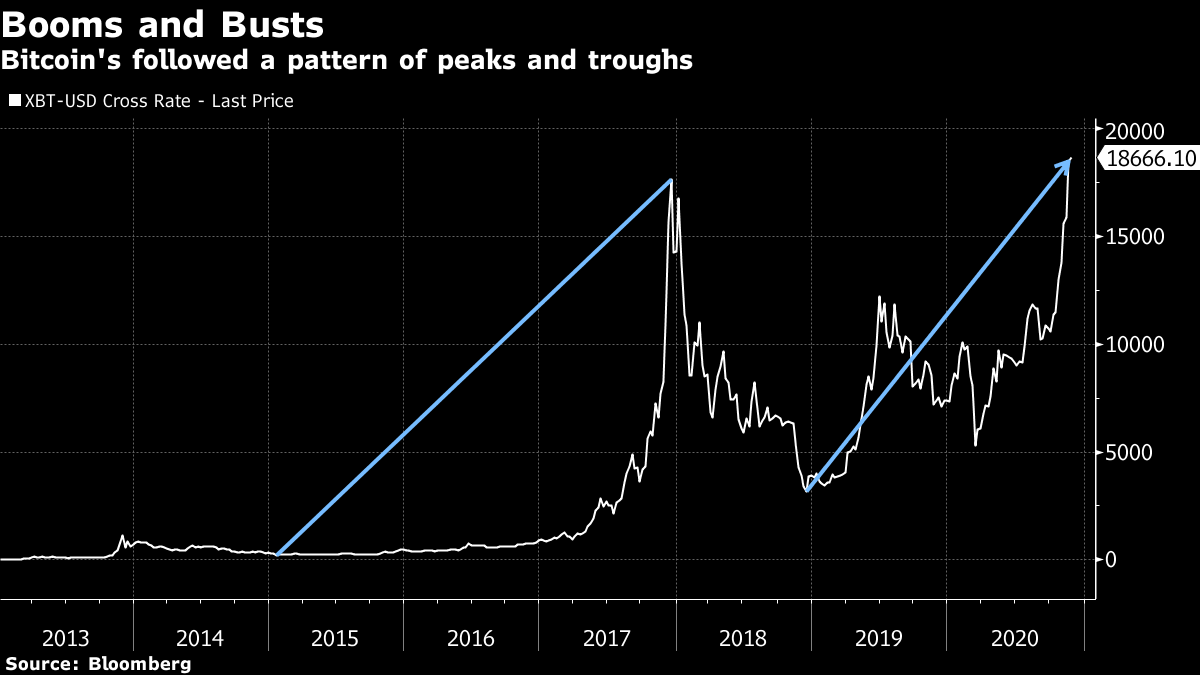 Following that pattern would suggest the current rally could extend for four years, which would imply a peak price for Bitcoin of as much as $318,000 sometime towards the end of 2022. That's a huge number of course, but as Fitzpatrick points out, it would also be Bitcoin's weakest rally ever in percentage terms. You can follow Tracy Alloway on Twitter at @tracyalloway. | 


Post a Comment