Russia registers a coronavirus vaccine, Trump "seriously" considering capital gains tax cut, and stimulus talks remain stalled in Congress. Vaccine?President Vladimir Putin said that Russia has registered an effective coronavirus vaccine that forms immunity and that one of his daughters has already received it. Health Minister Mikhail Murashko said that trials will continue while production gets underway at two plants. It comes amid news of positive developments on the pandemic in some hot spots, with Hong Kong reporting a fall in new cases, Texas hospitalizations at the lowest since early July and California Governor Gavin Newsom saying there were "encouraging signs" in the latest data. Another look After deciding against the measure almost a year ago, President Donald Trump said yesterday that he is "very seriously" considering a capital gains tax cut. While the president can't cut the rate without Congress, he could issue an executive order that reduces taxable gains by the rate of inflation. While any move on capital gains tax would mostly benefit high-income households, Trump also said he wanted a "middle-income tax cut," something Congress would be unlikely to pass by year-end. Democratic presidential nominee Joe Biden has previously said he would double capital gains tax for higher earners. Meanwhile, in CongressPresident Trump's weekend set of executive actions aimed at shoring up the U.S. economy while stimulus talks remain stalled in Congress seems to have done little to add urgency to the negotiations. Senate Majority Leader Mitch McConnell and Senate Democratic leader Chuck Schumer exchanged blame for the deadlock yesterday, while offering little in the way of new ideas. McConnell's insistence that any bill include legal liability protection for businesses, schools and colleges has become a major sticking point for Democrats. Markets riseGlobal equity markets are showing significant gains this morning, as investors welcome good news on the virus, possible tax cuts and surprisingly high German confidence. Overnight, the MSCI Asia Pacific Index added 1.1% while Japan's Topix index closed 2.5% higher. In Europe, the Stoxx 600 Index had gained 2.1% by 5:50 a.m. Eastern Time, with travel stocks the best performers as every industry sector rose. S&P 500 futures pointed to a strong open, the 10-year Treasury yield was at 0.6% and gold dropped under $2,000 an ounce. Coming up...U.S. PPI for July is at 8:30 a.m. Richmond Fed President Thomas Barkin and San Francisco Fed President Mary Daly speak later. Georgia, Connecticut, Wisconsin, Minnesota and Vermont hold primaries and runoffs. Canada Goose Holdings Inc. reports earnings. What we've been readingThis is what's caught our eye over the weekend. And finally, here's what Justina's interested in this morningThe past year has been one of many false dawns for the value strategy: September's mini quant quake and then the post-March revival. None of them has turned out to be the real deal. There's been a rotation of that sort lately too: Value's bouncing back. Growth and momentum are down. Small-caps are outperforming. The thing about being a value investor is that after shouting "focus on the long-term!" for many years, you can't exactly gloat about a brief revival, and that is probably a good thing. Equity factors have become more volatile this year, and one reason, as Bernstein's quant strategists explain, is that the correlations between them have shot up. Quality, momentum, growth and low volatility have converged into one trade with a negative relationship to value. 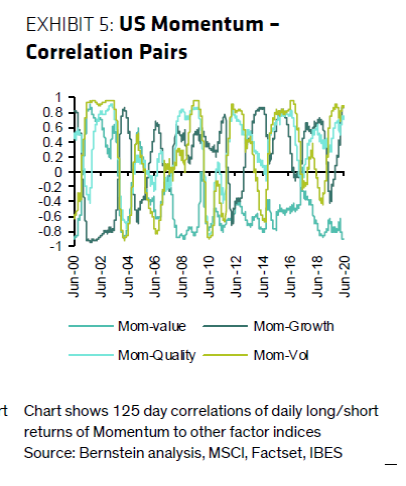 Bernstein Bernstein That means when there's good news -- better-than-expected economic growth, vaccine progress, falling infection rates -- value gets a chance, but most of the time, low rates favor the opposite. The problem for quants is that those factors are supposed to be diversifying, and that is why many fund managers invest based on a multifactor model without timing exposures. But this will work less well in a market where everything is dominated by macro risks. Estimating those big-picture risks is partly why alternative data has become big business, but traditionally quants have considered factor timing almost impossible to do well, with good reason. Plus the hope is still that things will go back to normal. The question, as usual, is not just how soon that will be, but whether you can sit tight until your next performance evaluation. Follow Bloomberg's Justina Lee on Twitter at @justinaknope Like Bloomberg's Five Things? Subscribe for unlimited access to trusted, data-based journalism in 120 countries around the world and gain expert analysis from exclusive daily newsletters, The Bloomberg Open and The Bloomberg Close. | 


Post a Comment