| A massive pharmaceutical merger could combine two giants battling Covid-19; the epic rally in global equities gets fresh wind thanks to an unexpected climb in American payrolls and China's sliding government revenue raises questions about the magnitude of future stimulus. Here are some of the things people in markets are talking about today. A Megadeal? Two drugmakers behind some of the industry's most prominent responses to the Covid-19 pandemic are looking into the possibility of a combined future as economies emerge from lockdowns. AstraZeneca, co-developer of one of the fastest-moving experimental coronavirus vaccines, has made a preliminary approach to Gilead Sciences, maker of remdesivir — the only U.S.-approved treatment — according to people familiar with the matter. If they decided to pursue a merger, it would be the biggest deal ever in the sector, giving AstraZeneca a market capitalization of more than $200 billion. Gains Ahead Asian stocks looked set to start the week with gains after Friday's U.S. jobs report smashed expectations and bolstered hope of a quick economic rebound. Futures pointed higher in Japan and Hong Kong. Australia has a holiday. U.S. index futures climbed in early Asia trading, while the dollar traded mixed against its Group-of-10 peers after sliding Friday. After the jobs data, the S&P 500 Index closed 2.6% higher and posted a third weekly advance, leaving the gauge up more than 40% from its March low. Benchmark Treasury yields rose to an 11-week high. Meanwhile, China's trade surplus surged to a record in May as exports fell less than expected, helped by an increase in medical-related sales. Elsewhere, oil looks to extend gains after rising for six straight weeks, as OPEC agreed to a one-month extension of its record oil-production cuts. Stimulus Risk China's plan to ramp up spending to support the economy is meeting an inevitable challenge: a slump in income due to the pandemic-induced downturn. Most major income sources will shrink in 2020, the government estimates, with revenue expected to drop 5.3% this year, according to estimates by the Ministry of Finance. It would be the first fall in at least two decades. With the decline being compounded by tax breaks offered to help firms survive, Beijing is already planning to issue over 70% more in bonds this year to plug that gap and meet stimulus needs. While the government can use money carried over from previous years or other revenue to make up the gap for now, the shortfall will still put pressure on spending, according to Wang Zecai, a researcher at Chinese Academy of Fiscal Sciences. "This will be a test for China's fiscal capability at all levels." Hot Property A controversial security law that threatens to upend Hong Kong's status as an Asian financial hub hasn't slowed the world's most expensive real estate market. Dozens of would-be buyers lined up in the rain last week for a chance to bid on 94 apartments in The Campton project in central Kowloon, with prices starting at HK$6.8 million ($872,400) for a one-bedroom condo. All but one of the units were snapped up in eight hours. Hong Kong property prices have surged 230% since 2000, data from Centaline Property Agency show, bolstering the view of many residents that property will always be a haven. Positive Signs There's so much positive momentum in risk assets, it's difficult to see what could stand in the way of the emerging-market rally, at least in the coming days. The stronger-than-forecast May U.S. jobs report and weekend agreement by OPEC+ to a one-month extension of its record output cuts may add to the optimism about the prospects for a global economic recovery, underpinning risk assets. JPMorgan Chase & Co.'s measure of implied volatility for emerging-market currencies had its biggest weekly drop since 2011. Stocks enjoyed their best week since 2011, while an index of domestic bonds reached its highest point since early March. While the Federal Reserve is forecast to hold interest rates near zero when policy makers meet Wednesday, investors will be watching for clues on further stimulus in Chairman Jerome Powell's remarks. Technical indicators suggest the prospects for developing-nation assets look promising as the dollar wobbles. What We've Been Reading This is what's caught our eye over the past 24 hours: And finally, here's what Tracy's interested in this morning
Suddenly, there are a lot of V-shaped charts around. The big one is the U.S. non-farm payrolls report released on Friday, which stunned everyone by revealing the country unexpectedly added a record 2.5 million jobs in May. Economists had forecast 7.5 million jobs to be lost, which means we've just seen the biggest forecast miss ever. I won't go into the details of the jobs report here — suffice it to say, there is plenty of speculation about all sorts of data errors.
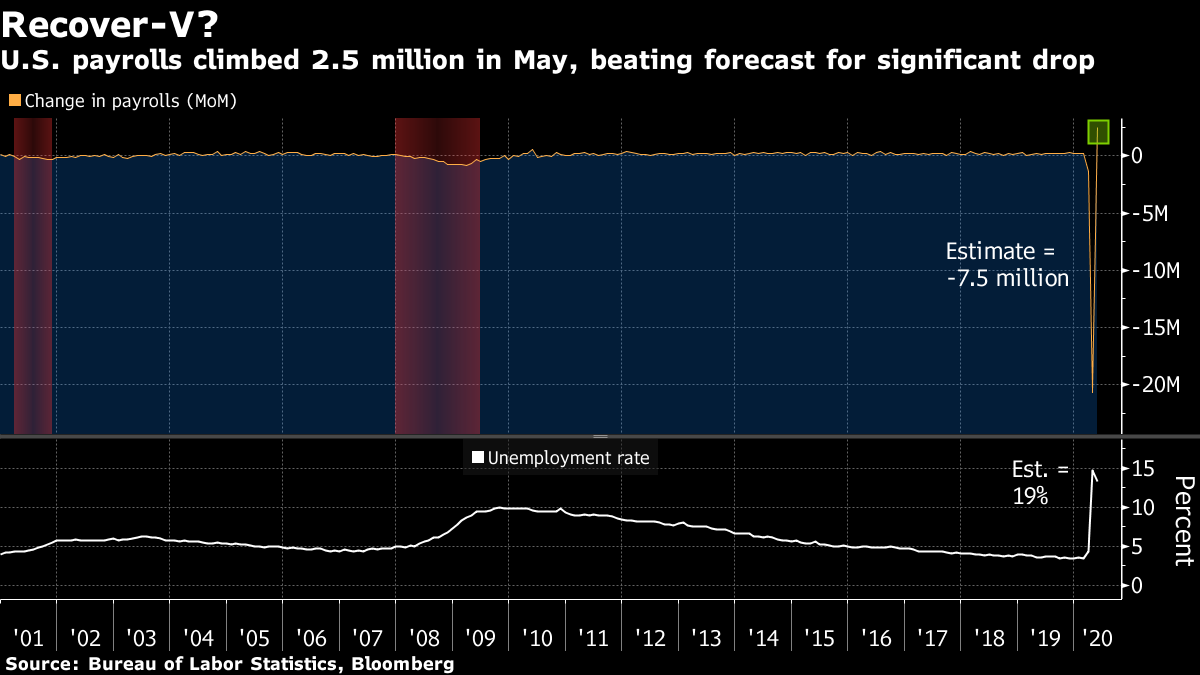 What I will note is that U.S. jobs are not the only economic figures creating V-shaped charts. For instance, passenger car sales in China have recovered to their pre-pandemic levels, according to Nomura, while department store sales in Korea are also flashing the 'V' sign. Research from Bank of America Merrill Lynch economist Michelle Meyer shows that total credit card spending in the U.S. has so far recovered 60% of the loss experienced during the outbreak, and in U.S. states that are furthest along in terms of re-opening, consumer spending "is running at roughly the same levels as this time last year." | 


Post a Comment