| The U.S. vice president is self-isolating after an aide tests positive to coronavirus, Asian markets look set for a mixed start to the week, and the race to trace the origins of the virus is in full swing. Here are some of the things people in markets are talking about today. Virus Latest U.S. virus cases rose 1.8% from a day earlier as fatalities approached 80,000. The increase was below the 2.1% daily average of the past week.
Vice President Mike Pence is self-isolating away from the White House after an aide was diagnosed with coronavirus on Friday, said three people familiar with the situation. Meanwhile, Americans should brace for even more gut-wrenching news on unemployment amid the coronavirus pandemic, and Congress should consider providing more help, said Federal Reserve Bank of Minneapolis President Neel Kashkari . The U.K. outlined plans to restart activity and get people who can't work at home back on the job. Johnson & Johnson plans to make one billion vaccines by next year, and Regeneron Pharmaceuticals Inc. said hundreds of thousands of antibody treatments could be ready by summer's end. China locked down a city in the northeast after cases rose. The death toll from the coronavirus in Indonesia neared 1,000, a day after the world's fourth-most populous country reported a record surge in new cases. Read more here. Markets Open Stocks in Asia were set for a mixed start on Monday as investors assess valuations following the recent uptick in risk appetite, with sentiment still fragile as economies cautiously reopen. Moves in currency markets were largely muted in early trading and S&P 500 futures opened modestly lower. The S&P 500 rose on Friday, when Treasury yields ticked higher. That was in spite of the biggest monthly loss in U.S. jobs in more than 70 years as investors were anticipating the damage and speculating it will mark a low point during the pandemic-fueled economic slump. China Stimulus The People's Bank of China said the country faces unprecedented economic challenges from the coronavirus pandemic and it will resort to "more powerful" policies to counter the hit to growth. Policy makers will pay more attention to economic growth and jobs among multiple targets, the central bank said in its quarterly monetary policy implementation report , released Sunday. It reiterated that prudent monetary policy will be more flexible and appropriate, and that it will maintain liquidity at a reasonably ample level. The phrase "will avoid excess liquidity flooding the economy" was missing from the policy outlook section. It was in the previous report for the fourth quarter of 2019. Swelling Deficit Australia's budget deficit will blow out to 7.2% of gross domestic product this fiscal year and in the 12 months through June 2021 as revenue collapses and spending soars in response to a virus-induced economic shutdown, Deloitte Access Economics said in a report released Monday. Fewer workers and lower incomes mean personal taxes take the biggest hit compared with official forecasts, it said. Relative to the Mid-Year Economic and Fiscal Outlook released in December, revenues are set to fall short by 6% in 2019-20, and then 16% in 2020-21, it said. Profits will "take a pounding as well," meaning corporate taxes look set to fall well shy of official forecasts. The government and central bank put together a fiscal-monetary package worth 16.4% of GDP to help nurse households and firms through the crisis. Hunt for Virus Origins The best minds in virology are trying to unravel a mystery: How did a lethal coronavirus jump from the wilds of rural China to major human population centers? And what chain of genetic mutations produced a pathogen so perfectly adapted for stealth and mass transmission? While crash vaccine programs are underway in the U.S., Europe and China, an inoculation to ward off the virus may not be ready for months, and the jury's out on potential treatments. In the meantime, to reduce the risk of deadly secondary outbreaks or the emergence of an entirely new strain, disease chasers need to retrace the pathogen's journey around the globe. That means heading back to China, where it all started sometime in 2019. What We've Been Reading This is what's caught our eye over the past 24 hours. And finally, here's what Tracy's interested in this morning Let's talk about the coronavirus and corn. Chinese and American corn prices have been diverging recently as China gradually reopens its economy and the U.S., for the most part, remains firmly in lockdown. You can see in the chart below that the gap between the Dalian futures contract for corn and the Chicago futures contract has grown markedly in recent weeks. 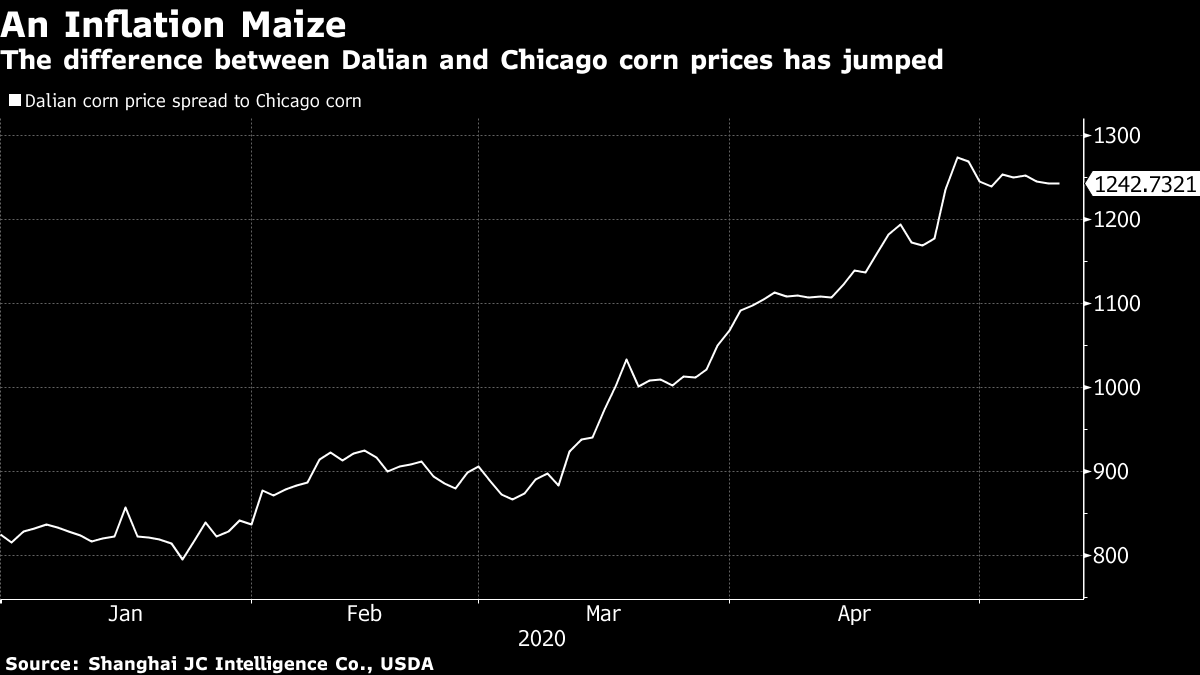 It's a similar story with a few other commodities. For instance the Dalian No. 1 soybean contract (largely domestically-grown soybeans) has been rising, while the No. 2 soybean contract (a proxy for imported U.S. soybeans) has been falling. In oil, crude prices on Shanghai's INE futures exchange have traded close to the largest premium to crude from the Middle East since mid-2019. What does it all suggest? Perhaps there's a kernel of truth to the notion that supply disruptions to global goods might be enough to push up inflation — at least in the short-term. You can follow Bloomberg's Tracy Alloway at @tracyalloway. | 


Post a Comment