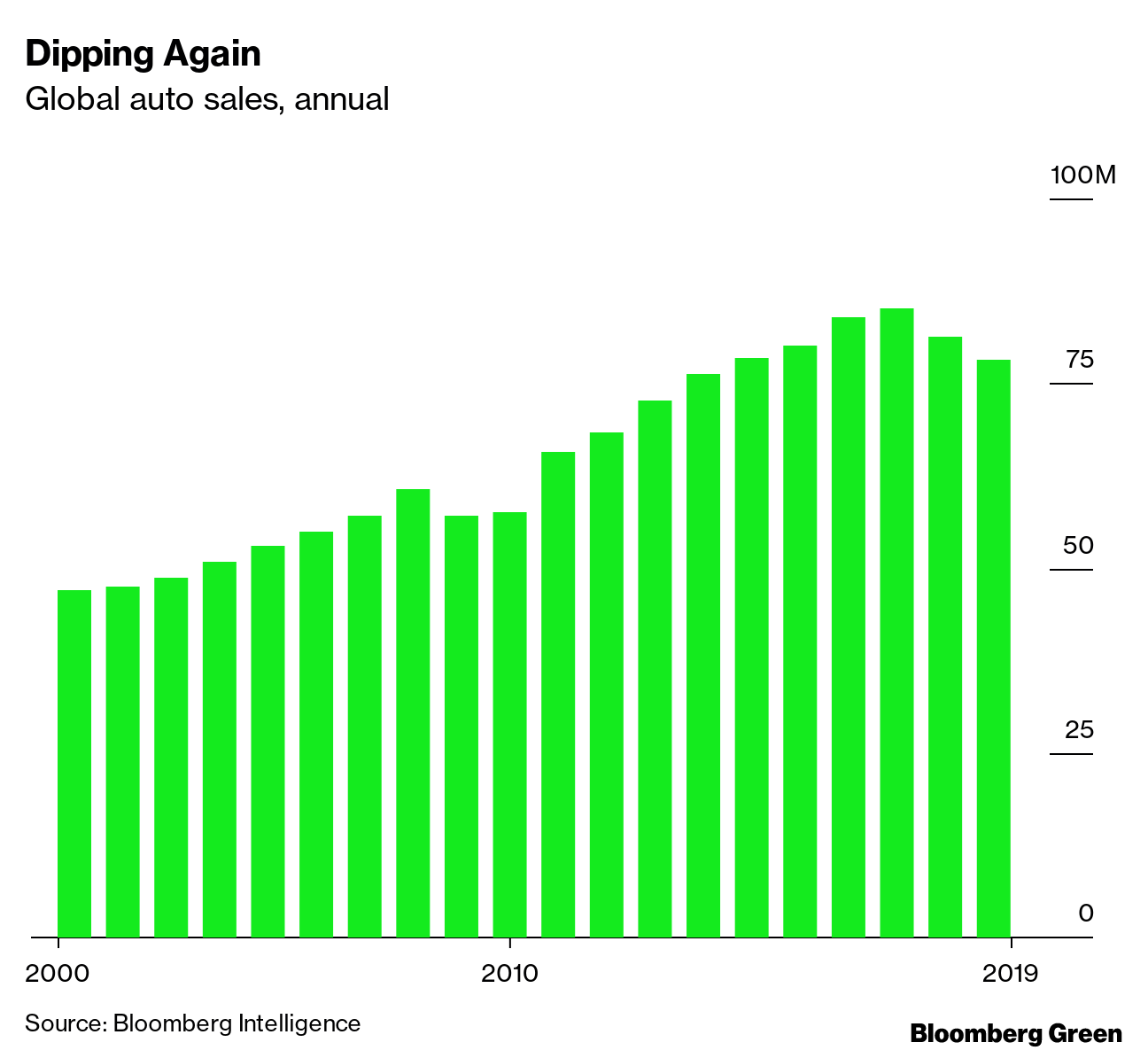
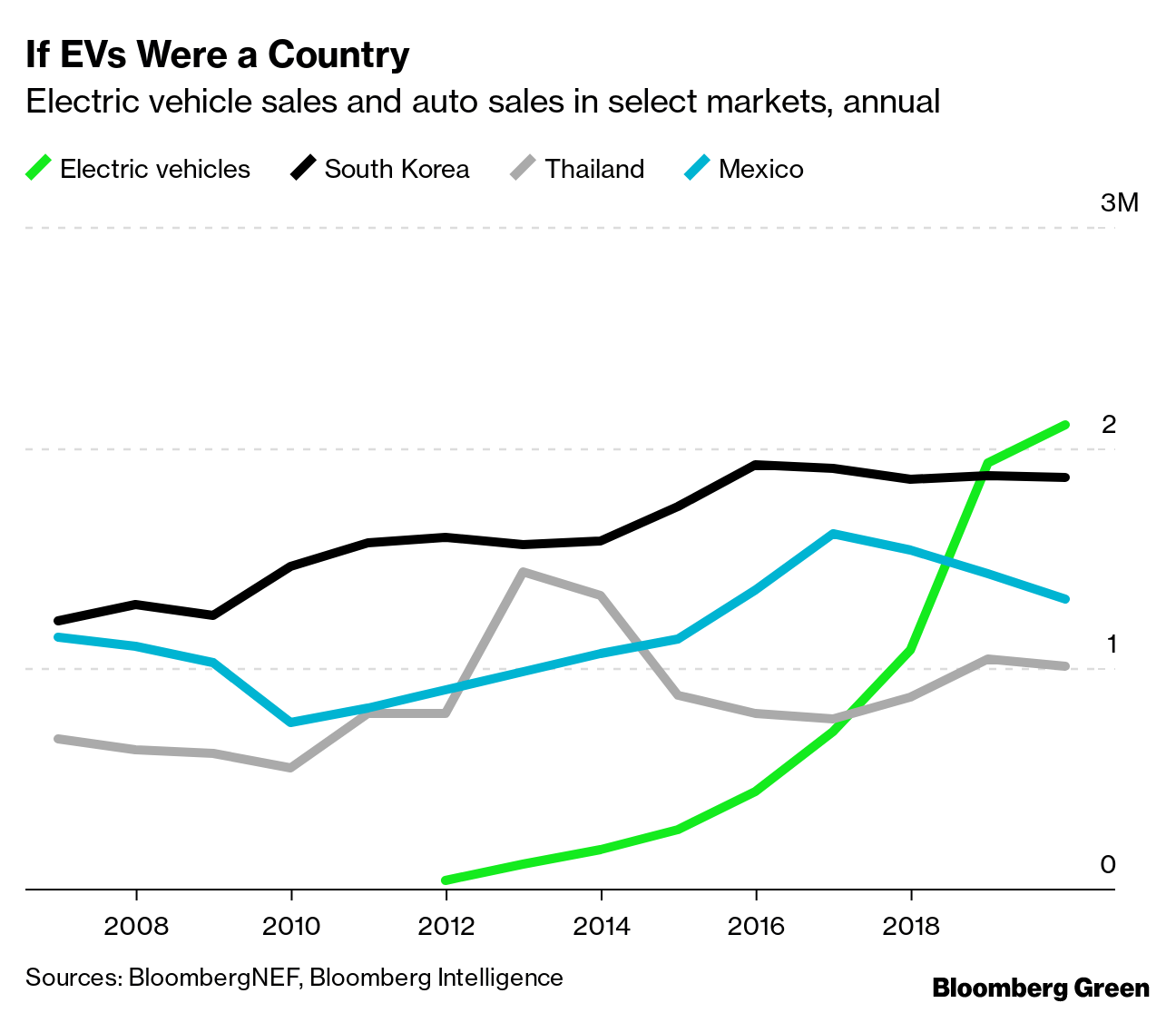
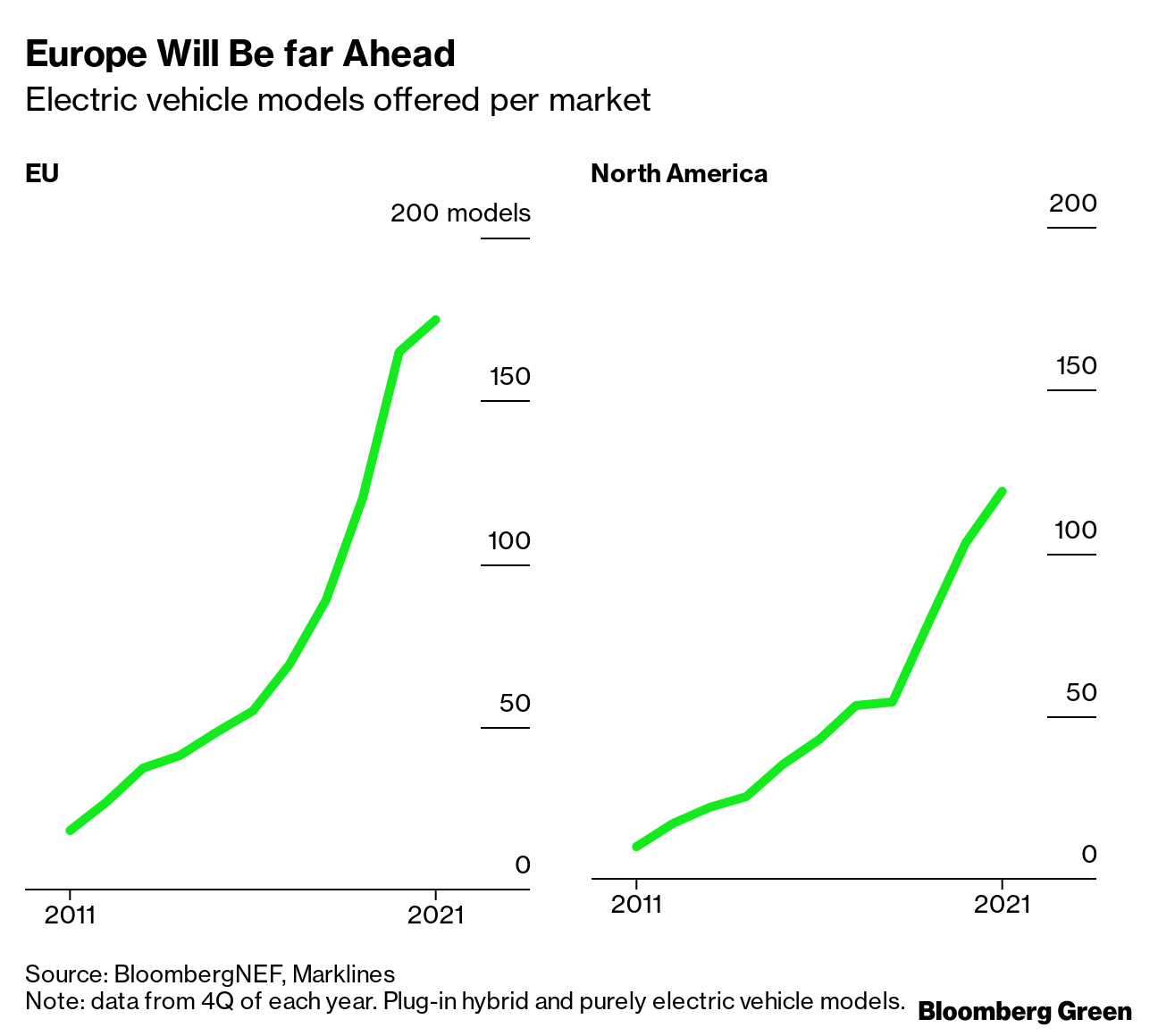
| The global auto industry has more than $2 trillion in annual revenue and employs millions of people in dozens of countries. It's also shrinking—at least in terms of what it delivers to customers. The number of vehicles sold last year, 78 million, was down for the second year in a row, and came in more than 8% below 2017's peak. This year, sales in China, the world's largest auto market, were down 80% from a year earlier in February, when many people were barricaded at home due to the threat of COVID-19. Growth seems unlikely to pick up this year. The China Passenger Car Association said last month that nation-wide sales for the year could be down 5% from 2019. There is a warm spot in this cold market, however: electric vehicles. Automakers sold 2.1 million plug-in hybrid and purely electric vehicles last year, up 9% from 1.9 million in 2018. My BloombergNEF colleagues expect EV sales to grow another 14% this year, to 2.4 million vehicles. Last year's passenger electric vehicle market was bigger than South Korea's passenger vehicle market, significantly bigger than Mexico's auto market, and twice the size of Thailand's market. The projected level of growth for 2021 would make the global EV market bigger than the French auto market, the second-largest in Europe after Germany. The EV market has always skewed towards a number of key countries and regions. In 2013 and 2014, Tesla's sales in the U.S. made North America by far the largest market. Europe was the largest EV market in 2015; since then, Asia Pacific (and China in particular) has been the main driver of global sales. My colleagues still expect China to be the largest EV market this year, but Europe should see the most growth. BloombergNEF projects a 50% increase in sales on the continent in 2020, to more than 800,000. What's driving those sales? (Pun intended.) Firstly, and most importantly, strict fuel economy regulations. Europe's mandatory fleet-wide fuel efficiency targets are low enough that, assuming total European auto sales remain steady this year at around 15 million, they'll have to sell at least 608,000 pure electric vehicles or 906,000 plug-in hybrids in order to meet them, according to a BNEF estimate. Also important is the fact that Europeans will have many new models to choose from this year and next. By 2021, Europe will have 175 EV models on the market, 50% more than in North America. Some—like the VW ID.3, the Peugeot e-208, the Volvo XC40, the Opel Corsa-e, and the Skoda Vision e—have the potential for high-volume sales given their competitive price points. Then there's BMW, which is bringing its i4 sedan to market in 2021. Oliver Sachgau and Christoph Rauwald of Bloomberg News said it well in their story on the announcement: the i4 "ditches the quirky design" of BMW's earlier i3 in favor of something both sleeker and more mainstream. It's electric; it's a BMW; it's not that complicated. A pretty tidy sales pitch, no? Nathaniel Bullard is a BloombergNEF analyst who writes the Sparklines newsletter about the global transition to renewable energy. Sign up to receive the Green Daily newsletter in your inbox every weekday. | 











Post a Comment