| Welcome to your morning markets update, delivered every weekday before the European open. Good morning. Italy is closing its schools due to the virus, central bank responses are being closely watched and OPEC meets. Here's what's moving markets. Containment Italy announced schools would be closed nationwide until March 15 in the starkest effort thus far in Europe to contain the spread of the coronavirus, with the government also considering a ban on public and cultural events. That came after the European Commission said both Italy and France are at risk of slipping into recession, the International Monetary Fund said it sees "more dire" possibilities ahead for the global economy and as U.S. lawmakers agreed on a $7.8 billion emergency spending package to respond to the outbreak. One sign of some relief? Food prices have dipped from a five-year high. Responses The virus outbreak has created a damaging one-two punch for the global economy, not only hitting supply as factories shut down but also weighing heavily on demand as consumers stop shopping and traveling. The Federal Reserve and Bank of Canada have both moved to cut rates and European investors are now glued to their screens watching for any hints of action from the region's monetary policy officials or indeed coordinated actions from central banks and governments. The Bank of England says it stands ready to work with the Treasury to shore up the economy and the European Central Bank has made similar statements, which its researchers think need to be combined with a shift in fiscal rules. OPEC OPEC oil ministers will meet on Thursday, before being joined by their oil-producing allies on Friday, in what will be a closely watched meeting. A production cut is widely expected but the familiar split between Saudi Arabia and Russia on how much to trim output has emerged, with Saudi Arabia pushing for a deeper cut that the OPEC technical committee has recommended. Once those in attendance reach an agreement on the quantum of a cut, the next stage will be for the market to decide whether that will be enough to bolster a bruised market. Airlines Nowhere has the virus outbreak taken a heavier toll than in the airline industry and the first failure emerged on Wednesday evening with the collapse of Flybe, a U.K. carrier already facing financial difficulties and which had been seeking a government bailout. In the U.S., United Airlines and JetBlue are both cutting flights to deal with the swift drop in travel demand, Australia's Qantas Airways has had a warning about substandard plane-cleaning practices and Vietnam Airlines passengers and crew have been quarantined on fears there were exposed to the virus. All as leaders from the U.S. industry got a pep talk from President Donald Trump. Coming Up… Asian stocks extended the rally seen in the U.S. overnight and European futures are pointing to another positive open following the U.S. spending package. It is a relatively quiet day for economic data, with U.S. factory orders topping the agenda later in the European day, while the European earnings front will be brisk, topped by updates from German car parts firm Continental AG, U.K. insurer Aviva Plc and bookmaker GVC Holdings Plc. Irish lawmakers will meet on Thursday too amid more pressure to accelerate talks on agreeing on a coalition to govern. What We've Been Reading This is what's caught our eye over the past 24 hours. - Six ideas on market metrics to watch right now.
- James Bond has been delayed by the virus.
- Bernie Madoff shouldn't get a break on his sentence, prosecutors say.
- The hot pot queen has opened a family office.
- Saving a bookstore giant by going indie.
- Throw a chicken wings party inspired by a YouTube hit.
- Does paying citizens to have children work?
And finally, here's what Cormac Mullen is interested in this morning The slump in global bond yields to record lows has the potential to make the asset allocation decision much easier for income investors. The relative attraction of stocks over bonds in the U.S. is now at its highest ever based on estimated dividend yields, and is not far off that level in Europe. The spread between the 12-month forward dividend yield on the S&P 500 Index and the 10-year U.S. Treasury yield jumped to the widest on record this week, according to data compiled by Bloomberg. The equivalent for Europe, using a basket of regional government bonds, is closing in on 4%. Of course much of this relative attractiveness argument depends on how accurate one believes the estimated dividends to be. While payouts have shown a historical tendency to be "sticky", the impact on company earnings from the coronavirus outbreak is still very much uncertain. Amid the potential wave of profit warnings still to come from global corporates, income investors will be keeping a close eye for any comments on dividends. 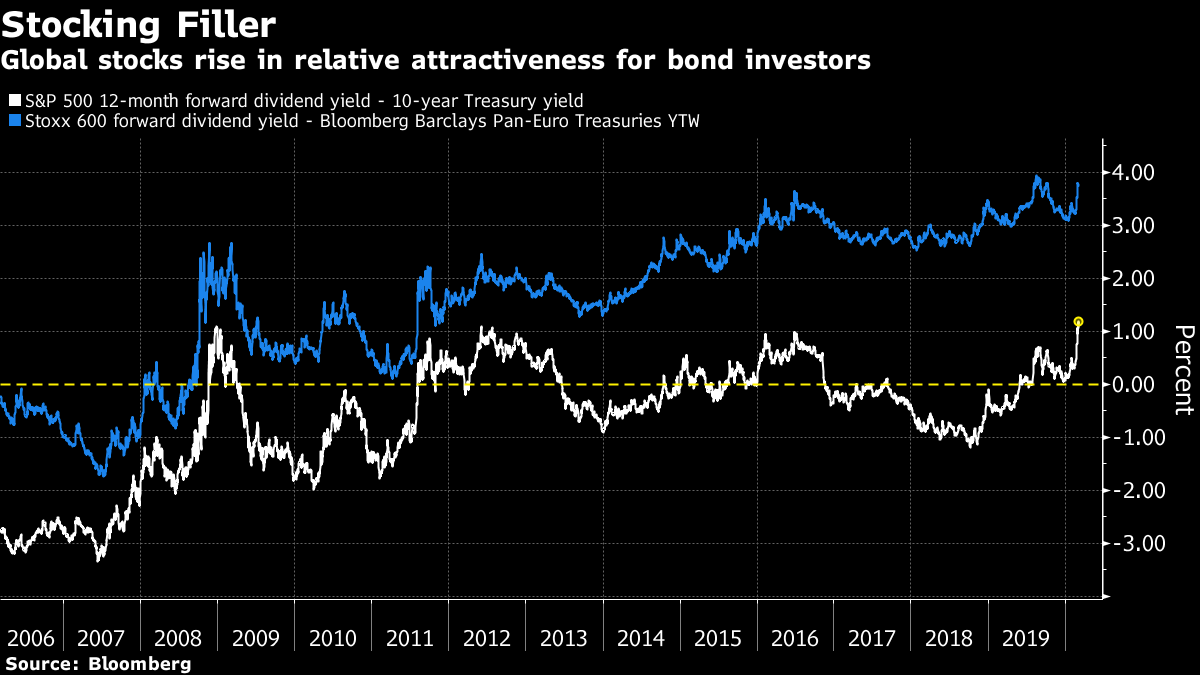 Cormac Mullen is a cross-asset reporter and editor for Bloomberg News in Tokyo. Like Bloomberg's Five Things? Subscribe for unlimited access to trusted, data-based journalism in 120 countries around the world and gain expert analysis from exclusive daily newsletters, The Bloomberg Open and The Bloomberg Close. | 


Post a Comment