Coronavirus death toll exceeds 2,000, China considers economic support measures and Fed minutes are due. Grim milestoneDeaths from the coronavirus passed 2,000 with the number of confirmed cases globally rising to about 75,000. While the rate of increase seems to be slowing, there are warnings of the possibility of fresh outbreaks as the Chinese economy restarts. German sporting-gear rivals Adidas AG and Puma SE said they saw a drop in business -- of 85% in the case of the former -- due to store closures in China. As well as the human and economic impact from the outbreak, there appears to be growing dissent within the Asian nation as authorities attempt to ramp up propaganda messages. Further support China is considering further measures to protect the country's economy from the worst of the fallout from the virus. Already this week has seen the People's Bank of China provide medium term lending for banks and cut the interest rate it charges for that money. Attention now seems to be turning to the airline industry, one of the hardest hit in the wake of numerous travel bans. The options range from mergers to direct cash injections in the struggling carriers. MinutesInvestors will be eager to see if there is more detail on the Federal Reserve's plans to end the expansion of its balance sheet when the minutes of the Jan. 28-29 meeting are published at 2:00 p.m. Eastern Time. Any comments on the repo market, and the speed at which the bank intends to withdraw liquidity support, will also be closely watched. There is unlikely to be much on the possible effects of the coronavirus on the U.S. economy as concerns have only intensified since the meeting was held. Markets riseReports of further Chinese measures to support its economy have helped lift equities. Overnight, the MSCI Asia Pacific Index climbed 0.3% while Japan's Topix index closed 0.4% percent higher as the yen gave weakened. In Europe, the Stoxx 600 Index had gained 0.6% by 5:45 a.m. in a broad-based recovery. S&P 500 futures pointed to a higher open, the 10-year Treasury yield was at 1.549% and gold's strong recent performance continued. Coming up…The Federal Reserve dominates the agenda, and not only because of the release of the minutes. Bankers scheduled to speak at different times today: Atlanta Fed President Raphael Bostic, Cleveland Fed President Loretta Mester, Minneapolis Fed President Neel Kashkari, Dallas Fed President Robert Kaplan and Richmond Fed President Thomas Barkin. In economic data, 8:30 a.m. sees the publication of the U.S. January housing starts number and PPI for the month. Tonight's Democratic presidential nomination debate will be the first to include Michael Bloomberg. (Bloomberg is the founder and majority owner of Bloomberg LP, the parent company of Bloomberg News.) What we've been readingThis is what's caught our eye over the last 24 hours. And finally, here's what Joe's interested in this morningAccording to a new survey of fund managers conducted by Bank of America, the most likely catalyst for a bout of sustained inflation is governments embracing Modern Monetary Theory. Of course, most people who talk about MMT don't really have any idea what MMT is, but crudely speaking, it basically means a shift to more active fiscal policy, with an aim of achieving full employment. If governments around the world ever went down this route, it would represent a turn away from primarily relying on central banks, while prioritizing employment stability over price stability. In light of this, it may be worth keeping an eye on developments in the U.K. As Bloomberg Opinion's Pankaj Mishra writes today, the recent upheaval in the finance ministry could represent the beginnings of such a turn being put into practice. This doesn't mean that the U.K. under PM Boris Johnson is set to embrace full MMT or anything quite like that. But we may at least have one of our first test cases of a major Western developed economy ready to push on the fiscal gas pedal. Obviously, as per the BofA survey, it will be interesting to see if the inflation needle moves in a meaningful way. A more active fiscal approach may also have novel effects on financial markets. While over-reliance on monetary policy poses all kinds of dangers, for investors there's a peace of mind in relinquishing it to the hands of independent technocrats who dampen volatility and offer predictability. Left to the control of politicians, policy may be herky jerky -- slower to start, but with a more powerful result and attendant ramifications on vol. In the big picture, the much-anticipated "handoff to fiscal" may still be a long way away, if ever, but in the meantime the U.K. is once again worth keeping a closer eye on. 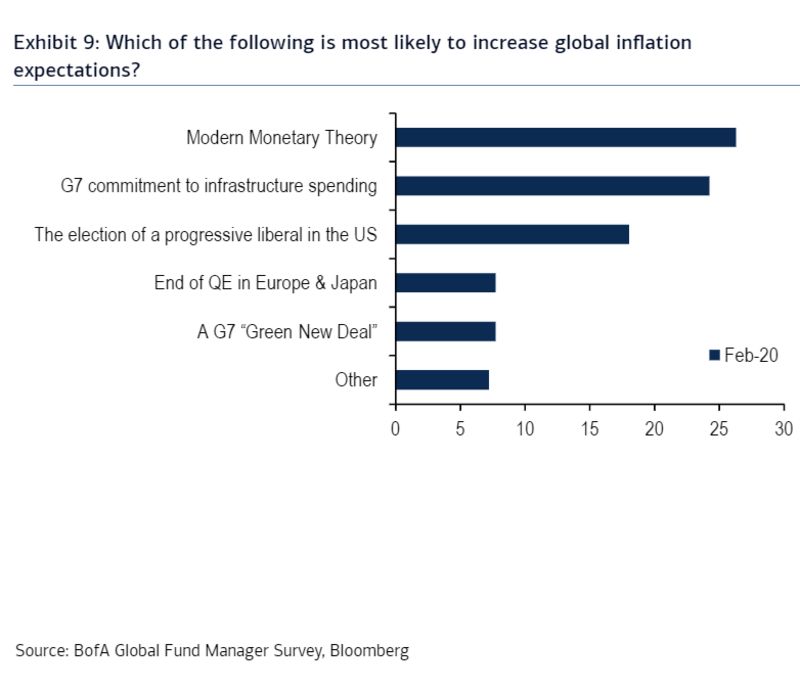 Like Bloomberg's Five Things? Subscribe for unlimited access to trusted, data-based journalism in 120 countries around the world and gain expert analysis from exclusive daily newsletters, The Bloomberg Open and The Bloomberg Close. | 


Post a Comment