| Welcome to your morning markets update, delivered every weekday before the European open. Good morning. The EU is studying that phase-one trade agreement, Chinese growth is stabilizing and there's another $1 trillion company in town. Here's what's moving markets. Trade War Challenge Just when you thought you could take a trade-war news break as the U.S. and China signed the phase-one trade agreement, the European Union threatened a challenge to the World Trade Organization. At issue is whether a pledge by China to increase purchases of U.S. goods by at least $200 billion over the next two years is WTO-compatible. If the European Commission has legal concerns after studying the pact, it would need weeks or months to discuss the next steps with the EU's national capitals. Maybe Deutsche Bank CEO Christian Sewing was on to something Thursday when he said the U.S.-China conflict will be one of the biggest trends shaping the new decade. China Growth The world's second-largest economy got some good news on the growth front: gross domestic product rose 6% in China in the final quarter of 2019 from a year earlier, stabilizing after slowing to the weakest pace in almost three decades. Investment accelerated for the first time since June, which signals that a firmer recovery could be under way. That phase-one trade deal has improved the outlook for Chinese factories and exporters this year, though uncertainty remains around implementation. Chinese stocks were little changed. Trillion-Dollar Club And then there were three: Alphabet Inc. became the third U.S. tech company with a $1 trillion valuation, trailing only Apple Inc. and Microsoft Corp. Alphabet, which closed Thursday at $1,451.70 a share, may have further to go, according to analysts at Deutsche Bank who this week assigned the stock a street-high view of $1,735 per share. Amazon.com flirted with the trillion-dollar level last year, but now needs a rally of more than 7 percent to get it across the line. Globally, however, it's oil that reigns supreme: Saudi Aramco tops the valuation charts after its initial public offering. Facebook Foes Four potential competitors of Facebook Inc. sued the social media company, accusing it of anticompetitive behavior and asking a judge to order CEO Mark Zuckerberg to give up control. The group called Facebook "one of the largest unlawful monopolies ever seen in the United States," and also claimed that if Facebook isn't forced to sell its Whatsapp and Instagram assets, it will integrate them into the social network and consolidate its market power across the globe. Facebook said the claims are "without merit." Coming Up… Asian stocks edged up on Friday, with the global record-setting rally showing little indication of letting up amid the improving Chinese economy and signs of strong American consumer demand. Treasuries dipped after the U.S. announced plans for a new 20-year bond. In Europe, Richemont just posted third-quarter sales growth of 4%, matching estimates. Later we'll get an update from gambling company GVC Holdings Plc and December U.K. retail sales. It's also worth watching French retailers after Casino slashed its forecast for full-year operating profit in France after the close of market Thursday. What We've Been Reading This is what's caught our eye over the past 24 hours. And finally, here's what Cormac Mullen is interested in this morning Every financial asset boom has its crazy valuation comparisons. Perhaps the most famous is during Japan's ill-fated 1980s' property bubble the Imperial Palace in Tokyo was said to be worth more than all the combined real estate in California. I'm loathe to use the "b" word about today's market, but I have been noticing a few more extreme valuation size and scopes recently. On Thursday Google parent Alphabet joined the elite club of U.S. technology firms with a valuation of $1 trillion or more, and Apple's market capitalization is within striking distance of surpassing the entire Australian stock market (whose benchmark is at a record high). The iPhone-maker's value has already exceeded levels seen among several major equity markets around the world including Taiwan and Russia, my colleague Jackie Edwards noted Friday. Sometimes these extremes can be more to do with stock-specific factors -- Tesla's market cap exceeding the combined value of GM and Ford for example (which happened this month) -- but other times they can reflect a "this is nuts'' moment in a broader market. The $17 trillion in negative-yielding debt is a good recent example from the bond market. So if equities continue to march higher, keep an eye out for the most ridiculous extreme comparison. Chances are you'll be referring to it in years to come and asking "what were we thinking?'' 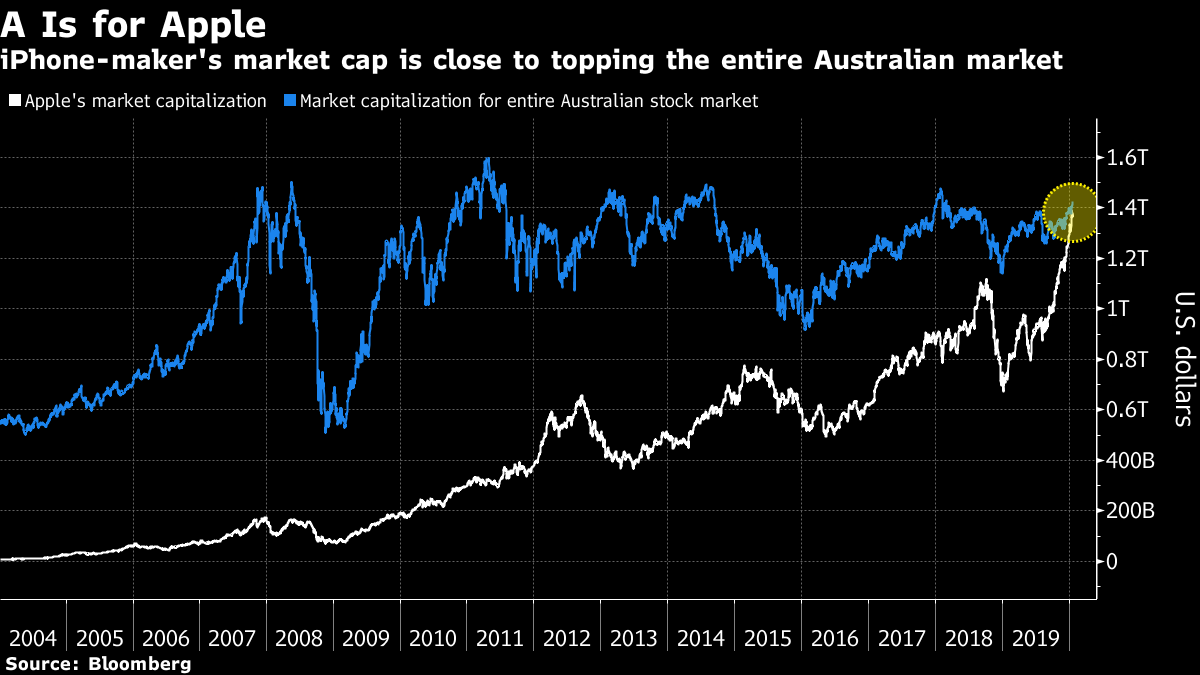 Cormac Mullen is a Cross-Asset reporter and editor for Bloomberg News in Tokyo. Like Bloomberg's Five Things? Subscribe for unlimited access to trusted, data-based journalism in 120 countries around the world and gain expert analysis from exclusive daily newsletters, The Bloomberg Open and The Bloomberg Close. | 


Post a Comment