| The U.K.'s Boris Johnson gets his election after all, markets await the Fed's policy decision, and the White House wants direct control over where cars are made. Here are some of the things people in markets are talking about today. Election Expectations A day after we wrote British Prime Minister Boris Johnson had failed in his attempt to trigger a snap election for December, it looks like it's back on. Johnson eventually won the necessary backing in Parliament for the vote in an attempt to resolve the Brexit crisis that has paralyzed the country's politics, weighed on its economy, and left its citizens angry and divided. The vote on Dec. 12 will be the third time the U.K. has gone to the polls to choose a new government in four and-a-half-years. The campaign will pit Johnson, the charismatic and controversial face of the pro-Brexit movement, against the radical left-wing Labour leader Jeremy Corbyn, who defied pundits and pollsters — and nearly won power two years ago. Markets Mixed Stocks in Asia were poised for a mixed start Wednesday after a lackluster session for U.S. equities as markets await the Federal Reserve's policy decision. The central bank is widely expected to lower rates again Wednesday, and the key for markets will be the tone of Chairman Jerome Powell's press conference later in the day. Treasuries and the dollar were flat, while equity futures dipped in Japan and nudged higher in Hong Kong. A report that China and the U.S. might not sign a partial deal next month dented U.S. stocks exposed to the battle. Elsewhere, the pound was flat, gold held at $1,487.71 an ounce and crude decreased 0.6%. Trump Car(d) In its most direct intervention yet to manage trade and production, the Trump administration wants to dictate how and where global auto companies make cars and parts, according to people familiar with the effort. The issue is being discussed between Trump administration officials, congressional staff, and domestic and foreign auto makers. The White House wants specific language that would allow it to unilaterally administer the production rules for companies, but the companies, lawmakers and even the U.S. International Trade Commission have cautioned that the rules are so strict that they would result in higher car prices and lost sales. The push illustrates how much Trump's administration has drifted from Republicans' free-market ways. Slide To The Right Having spent much of his first term laying the groundwork to transform India into a nation that is both attractive to global investors and unabashedly Hindu, Prime Minister Narendra Modi is now doubling down. He's pushing India further to the right — at home and abroad — as the nation grapples with its worst economic slowdown in six years. He's already visited nearly a dozen nations since his landslide re-election win in May, seeking investments from the Middle East, sharing a stage with Donald Trump in Texas, hosting Chinese President Xi Jinping at a seaside resort, and clashing with Malaysia and Turkey over India's lone Muslim-majority state of Jammu and Kashmir. At home, Muslims, who make up about 15% of the broader population, are worried about nationalist reforms — including changes to Muslim divorce laws and updated a registry that could strip citizenship from nearly 2 million people, including many Muslims. Bitcoin Resistance Over the past few days, Bitcoin has been on a monster rally. But as the largest digital currency loses steam, technical indicators show it could face further resistance at the $10,000 level. Bitcoin gained nearly $2,500 at its peak this week after China's government embraced the digital token's underlying blockchain technology. But it hit a ceiling at $10,000, indicating that tougher times could lie ahead. For many investors, it will need to meaningfully breach that level for confirmation that the rally could continue, historical pricing patterns suggest. Among major cryptocurrencies, Bitcoin was the lone standout to sell-off on Tuesday, with other tokens gaining. What We've Been Reading This is what's caught our eye over the past 24 hours. And finally, here's what Tracy's interested in this morning Earlier this year, China's securities regulator was trying to rein in investor demand for convertible bonds, a relatively new offering in the country's market. The securities usually allow companies to tap relatively cheap financing but can be viewed as risky for investors, since they typically get paid a low coupon in exchange for the chance of converting their bonds into equity further down the line. 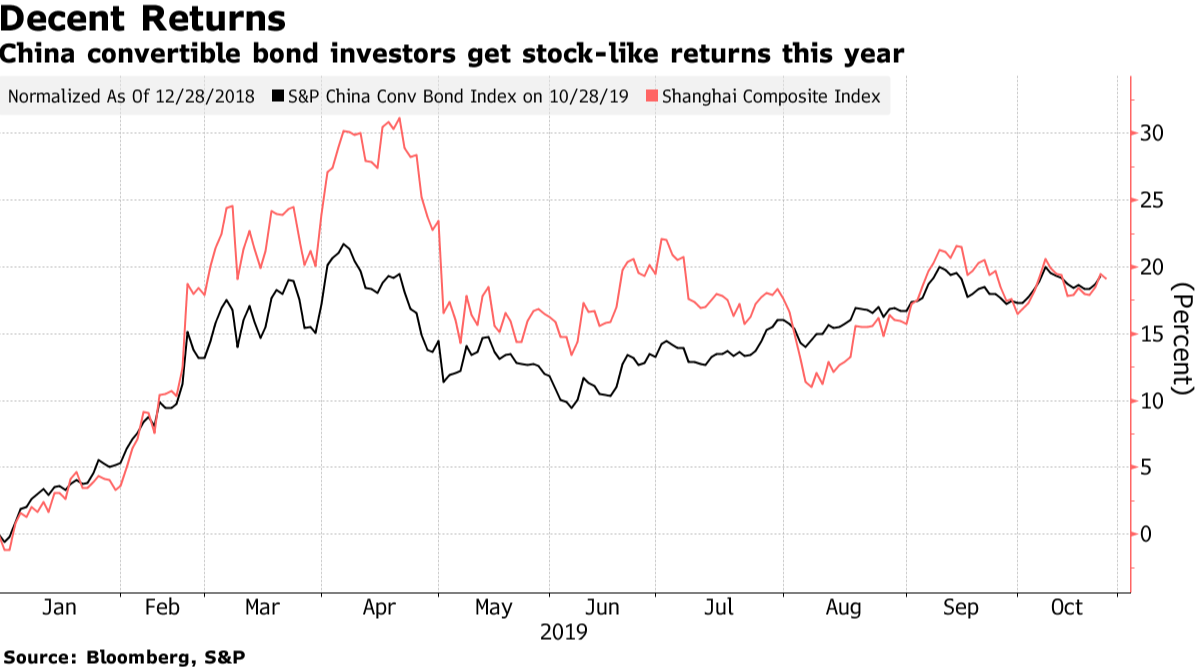 Fast forward to this week. Bloomberg reports that a convertible bond offering by Shanghai Pudong Development was — wait for it — about 330 times oversubscribed, meaning the $7.1 billion (50 billion yuan) offering attracted a cool $1.1 trillion worth of orders. The size of the deal makes it the biggest convertible bond sale in China on record — but not, rather amazingly, the most oversubscribed. (Citic Bank sold a 40 billion yuan deal in March that attracted orders that were a stunning 5,500-times over the actual amount on offer.) The Shanghai Pudong offering "will be one of the most liquid convertible bonds around when trading starts," one investment professional says. You can't really disagree with that statement, but you could also scratch your head and wonder what happened to the regulator's attempts to cool investor demand. You can follow Bloomberg's Tracy Alloway at @tracyalloway. The best in-depth reporting from Asia Pacific and beyond, delivered to your inbox every Friday. Sign up here for The Reading List, a new weekly email coming soon. Before it's here, it's on the Bloomberg Terminal. Find out how the Terminal delivers information and analysis that financial professionals can't find anywhere else. Learn more. | 


Post a Comment