Header Ads

YouTube is free. But 50 million people pay for it anyways.

Four years ago, I sat next to music mogul Lyor Cohen in Austin, Texas at the annual South by Southwest festival to discuss YouTube's plans for a new paid music service. I really only had one question. How was YouTube going to get anyone to pay to use a product they already get for free?

The video company had tried to get people to pay for a music service a couple times, as well as a service that had original series (a la Netflix and Hulu). That didn't work. YouTube attracted more than 1.5 billion users (now 2 billion) by offering them a bottomless repository of music videos, pranks, trailers, comedy, video blogs, late-night clips and just about anything else you could imagine for free. Let me say that again. FOR FREE. Free is core to YouTube's appeal.

Cohen said YouTube would 'frustrate and seduce' its users, a comment that ran counter to Google's customer-first ethos. The comment went over like a lead balloon inside his new company, and led me to fear Cohen would try to body check me the next time he saw me. (He didn't, thankfully.)

But over the past four years, YouTube has done the unthinkable. It figured out how to get people to pay for its service. The company has signed up 50 million subscribers across its suite of paid services, which include a music service and a premium video service. It convinced about 2.5% of its users to pay in order to watch videos in the background, skip ads and access all kinds of music playlists. When you have 2 billion users, converting even a tiny percentage is a big deal.

There are caveats. This include people still on free trials. YouTube didn't break out how much revenue it's getting, or what the average person is paying. The service has been especially successful in emerging markets where YouTube is popular and other paid media services have struggled. 

And yet even if YouTube is only getting people to pay $2 a head, it has built a subscription business that makes more than $1 billion a year. This is a huge deal for several constituencies, starting with YouTube.

The company doesn't exactly need money. Its advertising sales spiked 84% last quarter to more than $7 billion. Based on advertising alone, YouTube is about as big as Netflix. But the best media businesses have two revenue streams, advertising and subscriptions. That's what made TV networks so profitable.

With its success selling subscriptions, YouTube is one of the first online media businesses to crack the code. It's certainly the biggest. Netflix doesn't sell ads. Spotify's advertising business is smaller than YouTube's subscription business. (And its subscription business is also smaller than YouTube's advertising business.) Hulu sells subscriptions and ads, but is only in the U.S.

We spend a lot of time talking about how Netflix changed Hollywood, and with good reason. But the biggest and most influential media company of past 20 years is probably YouTube. It's the biggest video service in the world and the biggest music service in the world. It also created an entire new class of entertainer, the creator.

Speaking of music… this is also a very big deal for the music industry. Around the same time Cohen was promising to seduce YouTube viewers, record labels were worried that Spotify was getting too powerful.

The music industry had just spent 10 years entirely beholden to Apple thanks to iTunes, and it didn't want another tech company to have that much power over it. So it set about urging Amazon and YouTube to take paid music more seriously. (Apple had already introduced its paid service, which remains the No. 2 player globally.)

While neither YouTube nor Amazon is close to dethroning Spotify, they don't have to be the top player. They just have to compete. There are now four music services with more than 50 million subscribers, and that doesn't include the Chinese services.

Record companies don't have the upper hand on Spotify. They aren't going to pull their music if Spotify rolls out a product that upsets them. But nor can Spotify do whatever it wants; the record companies aren't dependent on it in the way they once were on Apple.

Even as Spotify's growth slowed a bit last quarter, music companies reported record results. Music companies have gotten very, very good at forcing all types of companies to pay them for their work. Be it social media websites, fitness apps or video games. (Universal Music Group Chief Lucian Grainge all but took credit for YouTube Music's success in a statement this week.)

This does not solve the ever-present tension between the music industry and YouTube (or Silicon Valley at large). Artists and independent record labels still mistrust technology. And the corporate side of the music industry will always resent YouTube for devaluing its work.

But money has a habit of silencing critics. The music industry's frustration, once at a full boil, is now at more of a gentle simmer. As YouTube's Chief Business Officer Robert Kyncl told me this past week, "We make money, they make money. We succeed, they succeed. The alignment is perfect." – Lucas Shaw

The best of Screentime (and other stuff)

Behind Hollywood Glamour, This Instagram Account Highlights Dark Side for Workers
The double whammy of the streaming wars and the pandemic is taking a toll on Hollywood's film crews.
The Silent Partner Cleaning Up Facebook for $500 Million a Year
Accenture has thousands of employees who work on cleaning up the worst videos and posts on Facebook.
The Diapers.com Guy Wants to Build a Utopian Megapolis
"Let the people own the land!" says Marc Lore. "But in a capitalistic way."
The Netflix Show that Turbocharged Formula One
My old college newspaper colleague Josh Robinson writes about "Drive to Survive," the Netflix show that has reinvigorated the sport of Formula One.

Want to do business in China? Good luck.

These are some of the headlines out of China in the last couple of weeks:

China cracks down on video game play.

"China will limit the amount of time children can play video games to just three hours most weeks. … Gaming platforms from Tencent Holdings Ltd. to NetEase Inc. can only offer online gaming to minors from 8 p.m. to 9 p.m. on Fridays, weekends ."

China cracks down on celebrity fan clubs.

"On Friday, the Cyberspace Administration of China banned the ranking of celebrities by popularity. The authority called for greater regulation of what it called the "chaos" of fan clubs and the power they wield over music, movies and television programs."

China fines celebrities for tax evasion

"The government also took a swipe at celebrities themselves. A regulator accused an actress, Zheng Shuang, of tax evasion, fined her over $46 million and ordered broadcasters to stop showing content that she has appeared in. Ms. Zheng had been mired in a scandal this year over surrogate babies. Online video and social media sites also scrubbed references to Zhao Wei, one of China's top actresses, for reasons that remained unclear."

Yikes. That doesn't even include the Chinese crackdown on Tencent, which has tanked the stock for Tencent Music Entertainment, the Spotify of China. Shares in that company have fallen more than 50% this year. Nor does it factor in the difficulty U.S. studios are having getting movies released in China right now.

U.S. industrialists saw China as a huge opportunity over the last decade. But the past couple years have underscored just how perilous that opportunity may be. Companies were already having to worry about censoring themselves to access the Chinese market. Now they risk investing in a business that gets all but shut down overnight.

The 'Jeopardy' saga reaches its inevitable conclusion

I've avoided writing too much about "Jeopardy" here, in large part because so many other reporters have done great work on it, from Claire McNear's expose about disgraced producer Mike Richards to Lesley Goldberg's piece this week on Richards' 'tumultous legacy' at "The Price is Right," another famous game show.

Those stories are the reason Sony caved this week and removed Richards as executive producer, a position that was untenable after questions about Richards' professionalism and the manner in which he hired himself to succeed Alex Trebek as host.

This whole saga is a reminder of two things. Hollywood will often empower bad people if it's not held accountable, and even when you hold them accountable those people still often walk-off with a boatload of cash.

The most popular musician in the world is…

MÃ¥neskin, the first Italian rock band to hit the top 10 all over the world. MÃ¥neskin was discovered busking on the streets of Rome, and first rose to fame on the Italian version of "The X Factor." But it had a small following outside of Italy, a country that has largely exported classical music and opera to the rest of the world.

But that changed this year when MÃ¥neskin won the Eurovision Song Contest (and then an older song of theirs went viral on TikTok).

  • The No. 1 movie in the world is… "Shang Chi." Marvel's first movie with an Asian lead is expected to tally $140 million worldwide over the long weekend.

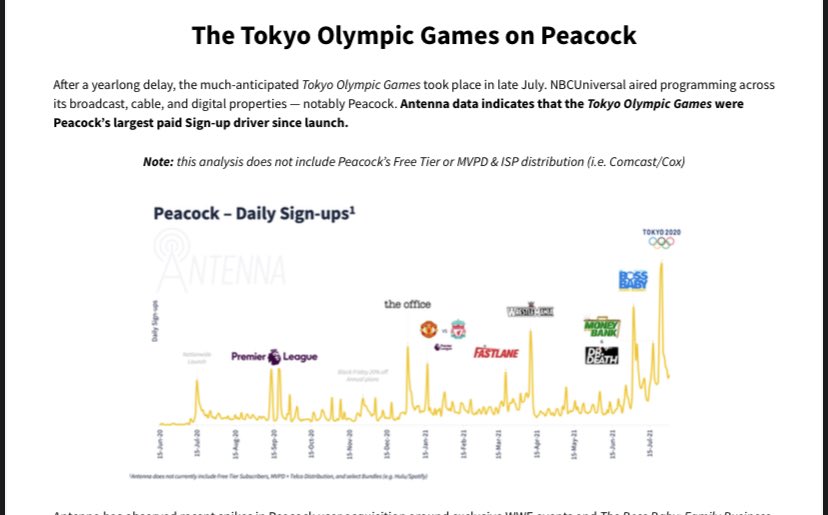
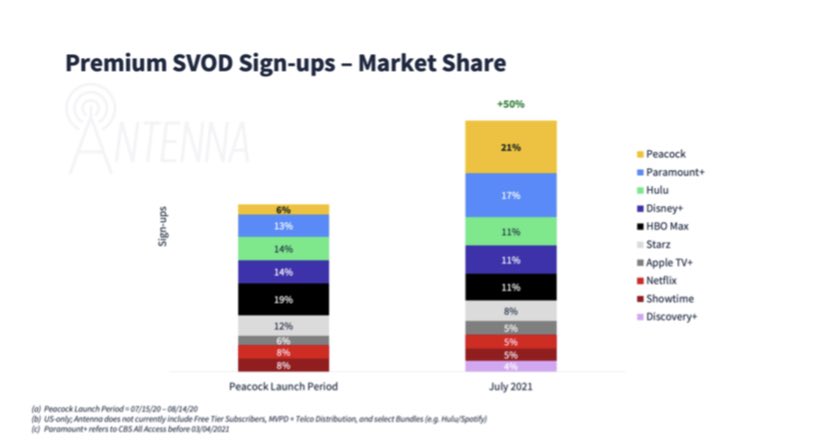
The Olympics boost Peacock

Two charts of the week, courtesy of Antenna Data.

This one indicates that the Olympics drove more sign-ups to Peacock than any other show or sporting events.


This one indicates that Peacock gained the most subscribers of any streaming service in the month of July.

The bad news is that Peacock's actual coverage of the Olympics wasn't good, and NBCUniversal knows that. Who knows how many more customers they could have driven if they had done a better job? (Also bad news: TV viewership for this year's games plummeted.)

But the good news is the company will get another chance next year with the Winter Olympics.

Deals, deals, deals

  • Apple acquired Primephonic, a classical music service. Fans of classical music have been among the last to embrace streaming, and it would seem like a good audience to add to Apple Music. But Apple said it would shut down Primephone and create its own classical music service.
  • Spotify hired Julie McNamara to oversee its in-house podcasting studios. McNamara, like Spotify Chief Content Officer Dawn Ostroff, comes from the world of TV.
  • Twitch star DrLupo is ditching Amazon's livestreaming site for YouTube. He said the deal would give him the money and flexibility to spend more time with his family (and not stream live 12 hours a day six days a week).
  • Amazon is working on a live audio service, joining a parade of companies that already includes Spotify, Facebook, Twitter, Clubhouse and Stationhead.
  • Hollywood's biggest union elected a new president.
  • Riot Games, the publisher of "League of Legends," hired a former Netflix executive to lead its entertainment studio.

Weekly playlist

Metallica asked 53 artists to record a cover of any song from their famous Black Album. That list includes jazz maestro Kamasi Washington, alt rocker Phoebe Bridges and reggaeton act J Balvin. Give it a listen.

No comments