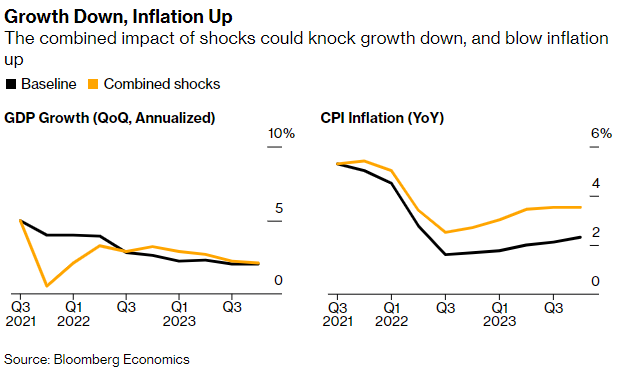
| Hello. Today we look at risks to the Federal Reserve's taper plans, the economic cost of broken child-care systems and financial threats in China. A key lesson of the pandemic has been, when it comes to economics, not to be too confident about the "base case." So many unexpected developments have happened — from tight labor markets to persistently high inflation to breakthrough Covid-19 infections — that it's been a tough time to be making forecasts. Cue a new tool created by Bloomberg Economics, called SHOK (its function on the Bloomberg terminal.) With the Federal Reserve poised Wednesday — in almost everyone's base case — to signal that it will make a formal announcement about tapering its asset purchases at the following meeting, in November, the team used SHOK to run through some alternative scenarios. One includes a 2015 redux. Back then, turmoil in China reverberated right round the global economy, spooking the Fed into putting off the launch of a cycle of interest-rate hikes. Then-Fed Chair Janet Yellen cited "concerns about the deftness in which policymakers" in Beijing were addressing economic risks. Now, as then, there are major questions outstanding about what Chinese policy makers' intentions are. This time it's with regard to a property slowdown and the potential for defaults at giant developer Evergrande and similarly leveraged enterprises. Global equities have shown themselves vulnerable. Another uncomfortable parallel with events in the last decade is the current impasse between Republicans and Democrats in Congress over raising the federal debt ceiling. Applying a selloff in markets on the scale of that seen in the damaging 2011 debt-limit fight, Bloomberg Economics estimates a 1.5 percentage-point cut to U.S. economic growth next quarter, ensuring "a rocky start to 2022." Either or both a China or debt-limit shock could upend the outlook for the Fed. There's also the risk of extended supply shocks thanks to shortages of semiconductors and other key items, keeping inflation elevated and the pressure on the Fed to rein in the easy money. The main takeaway of the exercise by Anna Wong, David Wilcox, and Tom Orlik: What would it take to knock the U.S. recovery off course and send Federal Reserve policy makers back to square one? Not much.
- Read the full Big Take here and our decision-day guide here
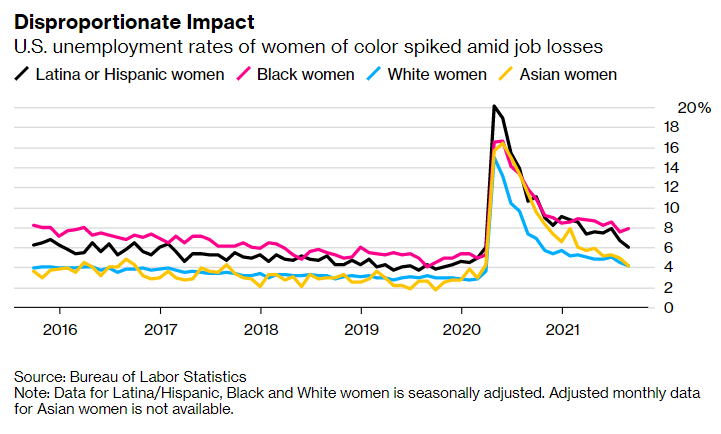
—Chris Anstey The child-care crisis has driven a workforce gender gap for decades. The pandemic — which some economists have dubbed the U.S.'s first female recession — has made it undeniably worse. By one estimate, the crisis cost women globally at least $800 billion in lost income in 2020, "equivalent to more than the combined GDP of 98 countries," according to Oxfam. After ignoring the issue for decades, some nations are finally addressing broken child-care systems. Bloomberg reporters examined seven economies to see what new policies — from the incremental to the experimental — have been put in place since the start of the pandemic. Read the full story here. "You can't be a prosperous country with half of your workforce sitting on the sidelines," says Titan Alon, a University of California, San Diego economics professor. Click on the links to read any of the stories in full: - Not just the Fed | The Bank of Japan held its key stimulus tools in place, while Brazil's central bank is set to hike its benchmark interest rate 100 basis points later on Wednesday. On Thursday, Norway is set to be the first developed central bank to raise rates.
- At the ECB | The European Central Bank will discuss boosting its regular asset purchases once the pandemic-era emergency stimulus comes to an end, but any such increase is uncertain, Governing Council member Madis Muller told Bloomberg.
- Standoff looms | The Democratic-controlled House passed a bill that would suspend the U.S. debt ceiling into December 2022 and provide the government funding to operate past Sept. 30. Republicans have vowed to block it in the Senate over the debt-limit provision.
- Reality check | U.K. Prime Minister Boris Johnson, who talked up a trade deal with the U.S. as a prize of Brexit, doesn't look likely to deliver it anytime soon and is turning his attention to other pacts. Britain faces a string of other economic headaches.
- Spending slump | China's virus restrictions have disrupted another holiday spending period, worsening the growth outlook for the world's second-largest economy,
- Diverging outlook | Growth paths in developing Asia are diverging as some nations struggle to contain virus outbreaks while those that avoided tough restrictions or have advanced vaccination campaigns gain from stronger global demand, according to the Asian Development Bank.
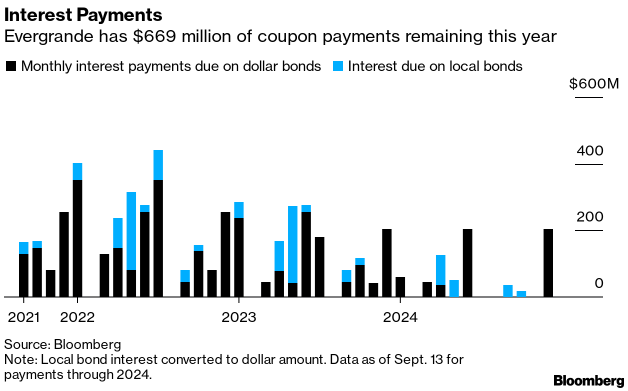 Cash-strapped Chinese developer China Evergrande Group has caught global markets' attention lately, with bears even saying this could be the nation's "Lehman Moment." China Beige Book say there's two very clear reasons why it won't be. - The enormous size of the Chinese financial system in assets and liabilities dwarfs its American equivalent in 2008 and makes seemingly scary numbers associated with Evergrande "look paltry."
- Contagion is "near impossible." That's because the financial system is non-commercial with Beijing controlling the banks, making any bankruptcy a state choice. "Beijing says lend, so you lend."
"No Lehman-style contagion story makes sense here and therefore no Lehman Moment will there be," the firm wrote in a Sept. 20 note. Read more reactions on Twitter - Click here for more economic stories
- Tune into the Stephanomics podcast
- Subscribe here for our daily Supply Lines newsletter, here for our weekly Beyond Brexit newsletter
- Follow us @economics
The fourth annual Bloomberg New Economy Forum will convene the world's most influential leaders in Singapore on Nov. 16-19 to mobilize behind the effort to build a sustainable and inclusive global economy. Learn more here.
Delta Spread, Inflation Fear, Fed Taper — Bloomberg Economics Outlook Webinar: Join Stephanie Flanders, Head of Bloomberg Economics, at 10:00 Eastern Time on Sept. 23, as she leads a discussion with Bill Dudley, David Wilcox, Tom Orlik, and Dan Hanson on the outlook for 2022. Sign up here.
Bloomberg New Economy Conversations — Getting to Net Zero: The cost of scaling up renewable energy has fallen dramatically. Is 2021 the year in which we'll see major investments in areas like green hydrogen, carbon capture and other technologies needed to prevent environmental catastrophe? What are the most promising new areas and who is at the forefront? Join New Economy Editorial Director Andrew Browne on Sept. 28 at 10 a.m. as he discusses these issues with HSBC Group Chief Executive Noel Quinn, Hyundai Motor Co. Vice President of New Energy Business Development Jae-Hyuk Oh, and others. Register here.
| 






Post a Comment