| The Fed finally signals tapering is coming. The U.S. authorizes a third vaccine dose for high risk categories. Hong Kong critics are warned to stay away from countries that have extradition agreements with China. Here's what you need to know today. Federal Reserve Chair Jerome Powell said the U.S. central bank could begin scaling back asset purchases in November and complete the process by mid-2022, after officials revealed a growing inclination to raise interest rates next year. Powell, explaining the central bank's first steps toward withdrawing emergency pandemic support for the economy, said tapering "could come as soon as the next meeting." That refers to the policy gathering at the beginning of November, although he left the door open to waiting longer if needed. Powell also said there is little direct U.S. exposure to debt of the crisis-hit Chinese company Evergrande but said the giant's problems could impact global financial conditions Asian stocks look set for a steady open after U.S. shares took in their stride the prospect of a reduction in Federal Reserve stimulus. The Treasury yield curve flattened. Futures were little changed in Australia, while Japan is closed for a holiday. The S&P 500 rose for the first time in five sessions and the Nasdaq 100 ended higher. U.S. contracts edged up at the open. Elsewhere, oil pared a rally, gold held a retreat and Bitcoin traded above $43,000.  | The U.S. Food and Drug Administration plans to authorize a third dose of the Pfizer-BioNTech Covid-19 vaccine for people over 65, those most susceptible to severe disease and people whose jobs put them at risk. Meanwhile, Joe Biden called on other countries to help vastly expand production and availability of coronavirus vaccines for developing countries; U.S. births are on the rise again after the number of babies conceived plunged in many states during the depths of lockdown; and a vaccine developed by China's Sichuan Clover was found to prevent 79% of Covid-19 cases of any severity caused by the delta variant in late-stage trials. The results make it the first Chinese shot to offer clear efficacy data against the variant. President Joe Biden plans to meet in person with French President Emmanuel Macron in October, seeking to mend ties after a U.S. nuclear-powered submarine deal with Australia outraged officials in Paris. While Biden sought to smooth relations, U.K. Prime Minister Boris Johnson told France to get over it. Elsewhere, Taiwan has submitted an application to join a Pacific trade deal, just days after China sent its own request to become a member of the agreement. The Taiwanese application to join the Comprehensive and Progressive Agreement for Trans-Pacific Partnership was sent to New Zealand. Taiwan's government will announce the decision Thursday morning. China's rapidly growing military influence and unilateral changing of the status quo could present a risk to Japan, Prime Minister Yoshihide Suga said in an interview with Bloomberg, ahead of the first Quad summit. He said Japan should strengthen its alliance with the U.S. to bolster deterrence, and also work on increasing its own defensive capabilities. This is what's caught our eye over the past 24 hours: Spare a thought for Japan's bored yen traders, struggling to eke out a few pips of a move in a currency that is as quiet as the fanzone in Tokyo's Olympic Stadium. With just one exception, the trading range this month in the dollar-yen has never been tighter in 46 years, according to data compiled by Bloomberg through lunchtime Wednesday. Even the prospect of a new administration, the threat of a China Evergrande restructuring and chatter surrounding Federal Reserve tapering have done little to wake the currency out of its September slumber. 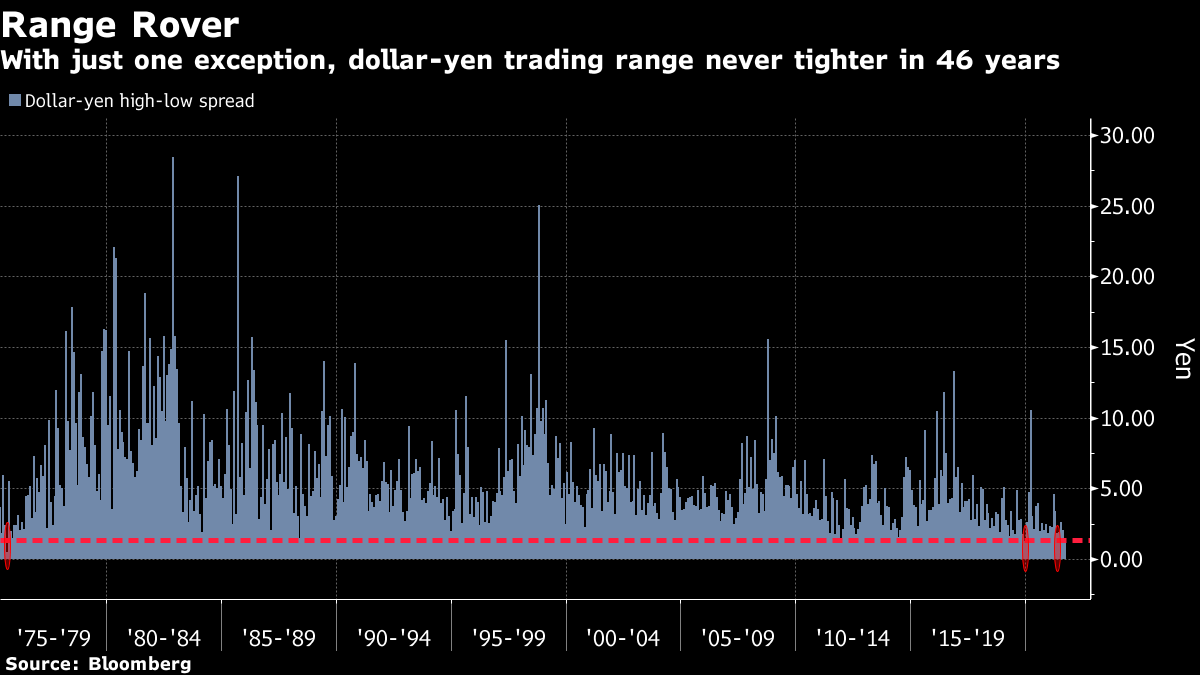 Market activity is falling as a result. Japan's foreign-exchange margin trading volumes fell to some $3.8 trillion in August, the lowest since before the pandemic, according to data from the Financial Futures Association of Japan. There seems to be little indication that yen watchers expect the quiet to end. The average year-end forecast for the dollar-yen is 110, less than half a percent from where the currency traded Wednesday, according to analysts surveyed by Bloomberg. - Cormac Mullen is a markets reporter and editor for Bloomberg News in Tokyo.
| 






Post a Comment