| El Salvador's Bitcoin experiment has a rocky start. Warnings on China's campaign to cool property are multiplying. Remote work's honeymoon phase is ending. Here's what you need to know this morning. El Salvador's experiment adopting Bitcoin as legal tender had a rocky start as the cryptocurrency's price crashed on its first day, while the roll-out was hampered by technical glitches. The digital coin dropped as much as 17% to the lowest in a month amid news that the government disconnected its Bitcoin wallet early in the day to fix technical glitches. By mid-morning, the issue appeared to be overcome. El Salvador's President Nayib Bukele said the country had taken advantage of the crash to "buy the dip," adding 150 coins to take the country's holding to 550, worth about $26 million. Billionaire crypotobull Mike Novogratz said he believed the sudden plunge in Bitcoin was the consequence of investors having gotten a little too excited. Meanwhile, a prominent former central banker argued that India must accept cryptocurrencies as an asset. Asian stocks look set for a cautious start after a dip in U.S. shares on concern that the delta variant is slowing the economic recovery. Futures for Japan were steady, Australian contracts slipped and those for Hong Kong rose. U.S. futures fluctuated after the S&P 500 fell and the Nasdaq 100 climbed to a record as investors sought more defensive areas of the market. Chinese technology equities listed in the U.S. jumped on bets that the worst of Beijing's regulatory crackdown has passed. A selloff across bond markets intensified in part due to a flood of debt sales. The dollar rallied to around the highest levels this month. Warnings that China's campaign to cool its property market will go too far are multiplying. Economists at Nomura Holdings are calling the curbs China's "Volcker Moment" that will hurt the economy, while counterparts at Bank of America say the campaign is "unnecessarily aggressive." Meanwhile, Xi Jinping's push for "common prosperity" has triggered something rare in China: a spirited public policy debate, which may not be a good thing for Xi; China is moving to complete its purge of Hong Kong's election system; Beijing has banned tutoring firms from enrolling new students or collection fees; and investors are pouring cash into ETFs that buy Chinese stocks. Israel, once a front-runner in the global race to move on from Covid-19, is now one of the world's biggest pandemic hot spots, with the highest per-capita caseload globally. Here's what it's doing to protect the vulnerable and ensure vaccines are still working, and what the world can expect next. In the U.S. a new milestone has been reached, with three-quarters of adults now having had at least one vaccine shot. And Johnson & Johnson's vaccine cut the risk of getting infected by about half, according to a trial of almost half a million health workers in South Africa. Remote work's honeymoon period is ending, according to a Deutsche Bank report. A growing number of employees report feeling isolated from colleagues, workers are increasingly likely to develop musculoskeletal problems due to inadequate remote-work setups, and nearly 40% of workers in the U.S. feel exhausted after a full week of virtual meetings. Even so, a proprietary survey showed people expect to continue working from home two to three days a week once the coronavirus is no longer deemed a threat. For Wall Street, as for much of the rest of the world, getting back to normal hasn't really gone to plan. This is what's caught our eye over the past 24 hours: - North Korea to stage its first military parade under Biden's watch.
- Suu Kyi's allies in Myanmar declare war against Junta.
- The Taliban's new cabinet includes a U.S.-designated terrorist.
- A big pharma CEO is battling Wall Street's most feared fund.
I've written previously that one of Bitcoin's strengths seems to be the sheer number of narratives people can attach to it. At various times Bitcoin has been lauded as a method of payment, a speculative asset whose value is destined to go up, a hedge against inflation, a way of disintermediating traditional banks, a way of literally saving the planet or chipping away at governmental power, and so much more. Bitcoin is a thing on which people can project their hopes and dreams — whether it's for a fairer society, a more inclusive financial system, or simply a better future for themselves. It's one of the few major cryptocurrencies that can do that, as some of the more popular ones (such as Ether, Solana, Cardano, etc.) come with a specific "use case" attached to them. 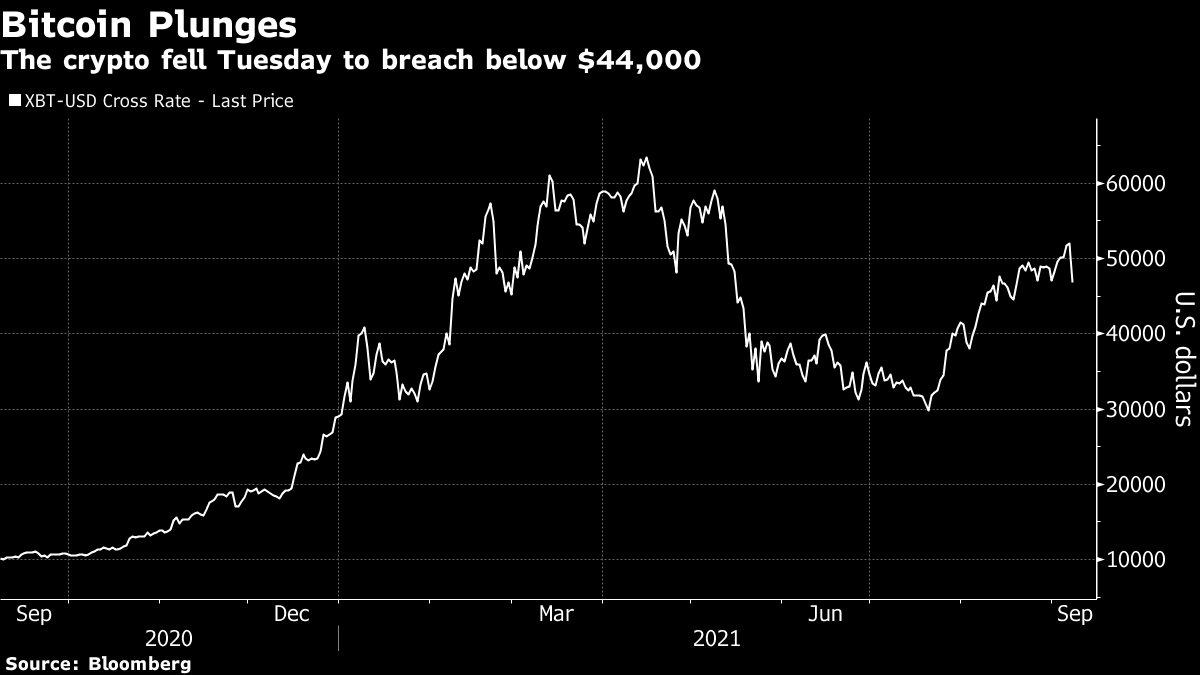 On days like today, however, you can see the downside of a momentum-driven asset. Bitcoin dropped as much as 17%, with the Bloomberg Galaxy Bitcoin Index falling as much as 19%, on the day El Salvador officially adopted it as legal tender. It's not the first time the cryptocurrency has followed an extreme pattern of "buy the rumor, sell the fact" — it followed a similar pattern in other major "life events," such as when futures trading was announced and when it actually started. But it is a good reminder that a thing that runs on hopes and dreams can respond rather capriciously to reality. | 





Post a Comment