| Global stock selloff looks likely to spill into Asia. Evergrande puts the spotlight on the health of the China's property sector. Europe is showing Asia how to get over Covid. Here's what you need to know today. China Evergrande's liquidity crisis is putting the spotlight on the health of the nation's property sector, particularly junk-rated firms. Such companies are facing increasingly tough conditions. Meanwhile, the indebted developer is facing another bond interest payment after giving no sign that it had paid a separate one last week. It needs to pay a $45.2 million coupon on Wednesday for a dollar bond that matures 2024. Separately, Hong Kong's central bank has asked banks in the city to report their exposure to Evergrande over potential systemic risks to the region's financial system. Similar is happening in the U.S., with Federal Reserve officials asking lenders about their exposure. A global equity selloff looks set to spill into Asia after U.S. stocks saw their worst day since May and bond yields spiked on concerns about inflation. The dollar rallied. Futures declined about 1% in Japan and Australia, and were also lower in Hong Kong. Mounting concern over the debt-ceiling impasse in Washington added to investor angst. The yield on 30-year Treasuries jumped almost 10 basis points. Brent crude pulled back from a three-year high above $80 a barrel. Gold also fell.  | As the world struggles to get to grips with the delta variant, European nations dominate the top of Bloomberg's Covid Resilience Ranking for a third month, with Ireland taking the lead after a startling turnaround. Southeast Asian economies continue to populate the bottom rungs in September, with Indonesia, Thailand, Malaysia, Vietnam and the Philippines occupying the lowest five spots. Singapore, which is trying to pivot from a Covid Zero approach to a vaccine-led reopening, fell 11 places, while former No.1 placed New Zealand slipped to 38. The U.S. continued to fall. Check out the full story of where the world is at with Covid right now here. U.S. Democrats hit a wall in their high-stakes effort to simultaneously avert a government shutdown, avoid a debt default and advance President Joe Biden's $4 trillion agenda, as feuding gripped lawmakers. Meanwhile, Democratic Senator Elizabeth Warren said that she denounced Fed Reserve Chair Jerome Powell to his face as " a dangerous man," because he was making it too easy for big banks to take big risks. In the Senate, Republicans for the second time in as many days blocked a Democratic move to raise the federal debt limit, escalating risk less than three weeks before the U.S. Treasury potentially runs out of capacity to avert a federal payments default. They are trying to force Biden to abandon his $3.5 trillion domestic spending bill. Read more about the debt-ceiling drama — and it's dirty secret — here. Japan's ruling party picks a new leader Wednesday to replace outgoing Prime Minister Yoshihide Suga. Candidates Fumio Kishida, Sanae Takaichi, Taro Kono and Seiko Noda are battling it out in what has been one of the most wide-open elections for leader of the ruling Liberal Democratic Party in about a decade. The LDP is expected to use its majority in parliament to elect the winner as the next prime minister at an extraordinary session on October 4. Traders don't seem to mind who wins — for investors any of the candidates would be an improvement on Suga. This is what's caught our eye over the past 24 hours: The big story in markets right now is Tuesday's surge in bond yields, with the two-year Treasury jumping 4 basis points to hit 0.32% and the 30-year up as much as 11bps. At the moment, there seems to be two ways of viewing the sell-off in bonds. The simplest lens is that investors are reevaluating the Federal Reserve's commitment to low rates and essentially betting that the central bank will have to blink in the face of higher inflation. There was some suggestion of this from the outcome of last week's FOMC meeting, when the dot plot showed the median participant had moved up their expectation of a first rate hike to 2022 from 2023. But on the other hand, you can also look at the back-up in bond yields as more of a function of what's going on in Europe, where it's been an exceedingly noisy few days with an unfolding energy crisis and German elections. Jon Turek at Cheap Convexity points out that while inflation breakevens have been surging in the U.K. and Europe as energy prices rise, they've remained pretty static in the U.S., suggesting the market isn't really that worried about inflation in America. Meanwhile, Michael Purves over at Tallbacken Capital Advisors argues that the short-term correlation between Treasuries, gilts and bunds has jumped to historically unusual levels in recent days, suggesting technicals are at play. 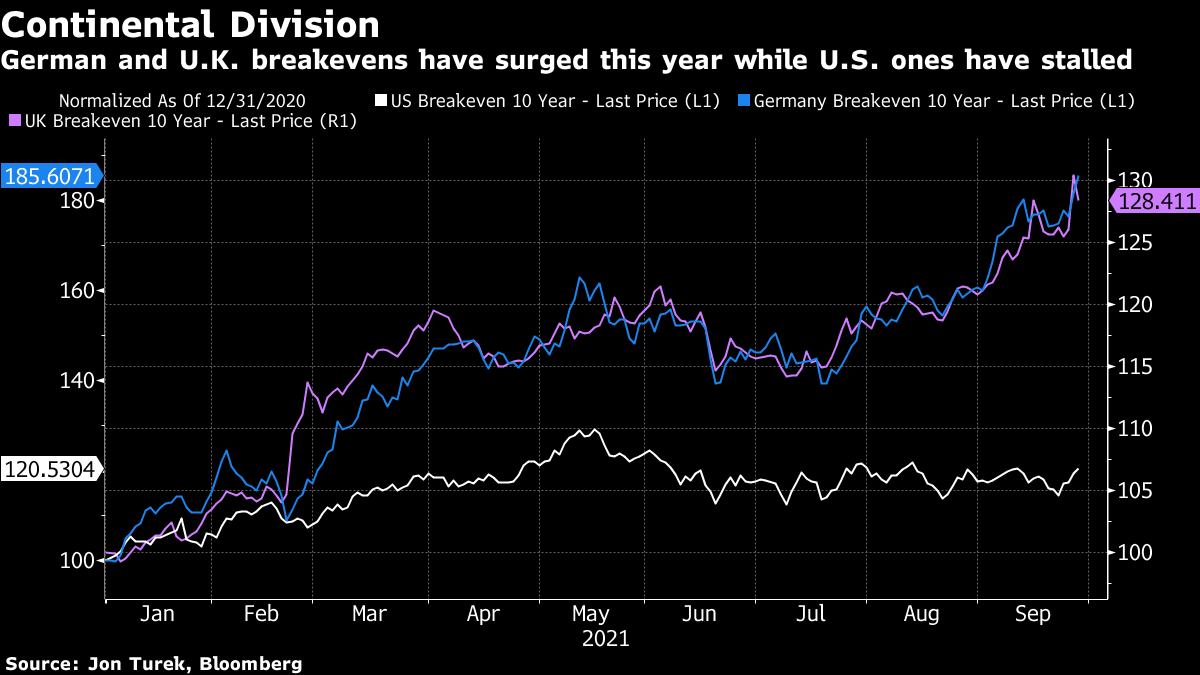 "Certainly inflation (and deflation) can be exported and imported — but we also have to take stock that some of the factors driving part of the European inflation story are somewhat specific to those countries," says Purves. "Perhaps more importantly, while the Fed is no doubt taking stock of the overseas inflation situation, it also has demonstrated that it's predisposed to seeing through much of the supply-constrained related inflation in the U.S. — let alone supply shocks overseas. In other words, the forces driving this Treasury selloff hang on a much more speculative set of dynamics and assumptions than might otherwise be the case." | 






Post a Comment