| Evergrande misses interest payments. United Nations chief says the world is headed for ecological destruction and calls vaccine inequity "an obscenity." Hong Kong broadens language used to describe national security violations. Here's what you need to know to start your day. Troubled developer China Evergrande Group missed interest payments due Monday to at least two of its largest bank creditors, taking the company a step closer to one of the nation's biggest debt restructurings. Despite the uncertainty, Wall Street analysts are putting their faith in the Communist Party. Citigroup, Fidelity and AllianceBernstein are saying Evergrande may indeed default, but Chinese authorities will take steps to prevent the property giant's crisis from destabilizing the financial system and the economy. Meanwhile, Ray Dalio says the debt crisis "is all manageable" even as lenders take a hit. The world's richest banker, Uday Kotak, begs to differ, calling it China's Lehman moment. China's economy will now grow at a slower-than-expected pace in the years through 2023 on delayed policy easing, says the Bank of America. Asian stocks look set for a steady initial start Wednesday as traders evaluate the debt crisis at Evergrande and brace for a Federal Reserve meeting that is expected to telegraph a reduction in stimulus. China resumes trading after a two-day holiday, while Hong Kong is shut. Dip buying waned in the U.S. session, leaving the S&P 500 little changed. U.S. contracts fell early in the Asian morning. Bitcoin fell for a third day, dropping briefly below $40,000, amid rising criticism from regulators.  | UN Secretary-General Antonio Guterres has warned that the world is hurtling toward ecological destruction. He also called global vaccine inequity "an obscenity" as President Joe Biden was set to announce an order of 500 million Pfizer doses for export across the world. Biden urged cooperation against the urgent threats of climate change and disease, seeking to shore up alliances shaken by recent U.S. foreign policy missteps. Biden pledged that the U.S. would double its financial support to help low-income countries adapt to a warming climate and shift to clean energy. China says it will bolster support to help poorer nations develop clean energy and plans to stop building new coal-fired power plants abroad. Meanwhile, the Taliban named a UN envoy and asked that their foreign minister be allowed to speak at the General Assembly. The European Union and the U.S. are cautiously moving to rein in China, seeking stronger enforcement of investment-screening rules and trying to keep technology from being misused to threaten security and human rights. The document, prepared for the inaugural meeting of the U.S.-EU Trade and Technology Council on Sept. 29, states the nations will cooperate to combat forced labor and support a level playing field globally. Meanwhile, the U.K. is exploring joining an existing free-trade agreement between the U.S., Mexico and Canada, a recognition the Biden administration won't start negotiations on a bespoke deal any time soon. Hong Kong has quietly broadened the language it uses to describe national security violations, a shift lawyers said could expand the reach of a government crackdown on dissent in the Asian financial hub. City authorities have begun using the phrase "contrary to the interests of national security" in recent weeks to define new red lines in the entertainment industry and the tax code. Previously, officials had warned more specifically against anything that might "endanger national security." The latter term appears 31 times in the full text of the security law, while the "contrary to" phrasing is absent. This is what's caught our eye over the past 24 hours: Fears of an imminent restructuring of the world's most-indebted developer might seem like an opportune time for investors to tilt their portfolios toward more robust companies, but that's yet to happen in Asia. Despite the crisis at Evergrande, a Goldman Sachs basket of Asia ex-Japan stocks with less-than-robust balance sheets — based on measures such as leverage and liquidity ratios — has continued to best a cohort of stronger peers this quarter. Since the end of June, the gauge has outperformed by about 12 percentage points through Monday. That's in contrast to the U.S. and Europe, where it is the stronger names which have outperformed, beating weaker peers by around 10 and 8 percentage points respectively. 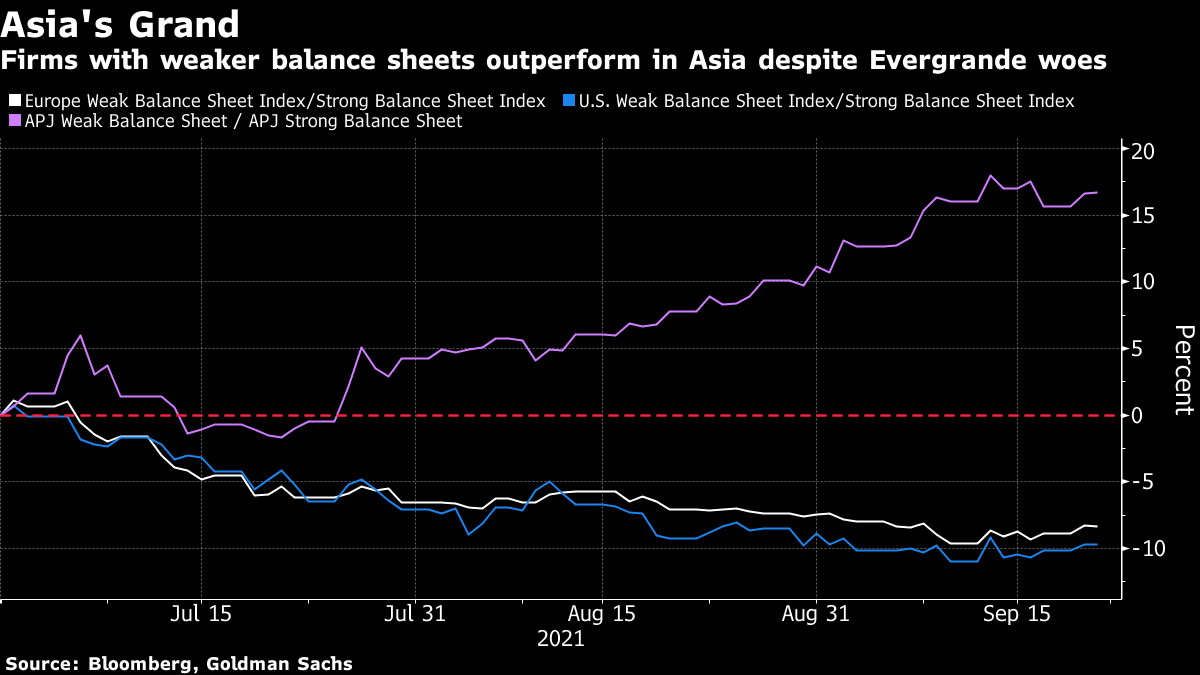 The divergence likely stems in part from the different drivers of underperformance in Asia's stock market this year. The biggest losers have included those stocks most affected by China's crackdown on private enterprise, which has little to do with the structure of a company's balance sheet. But that shouldn't distract from the broader theme that fundamentals eventually matter. Asia investors would do well to follow the example of their U.S. and European peers, and dial back their exposure to the region's weaker firms. - Cormac Mullen is a Markets reporter and editor for Bloomberg News in Tokyo.
| 





Post a Comment