| Two weeks ago, the delta variant was ripping through the U.K., stoking fears of a record wave of Covid-19 clobbering one of the world's most highly vaccinated countries. Then, almost overnight, daily cases plummeted, renewing hope that the pandemic's end—at least in some places—is within sight. Now, with the U.S. and much of the world facing delta's fury, people are looking to the U.K. for answers about how their outbreaks might unfold. But there's no single answer, since places have different levels of vaccine coverage—and different societal behavior, among other variables—that allow for wild discrepancies in case trajectories. Even U.K. experts are struggling to pinpoint what's truly accounted for the sudden reversal—and whether it's really time to relax. Theories include the possibility that young people are skipping out on Covid tests (mandatory when schools were in session) to older people doubling down on social distancing to the virus simply running up against a wall of immunity. 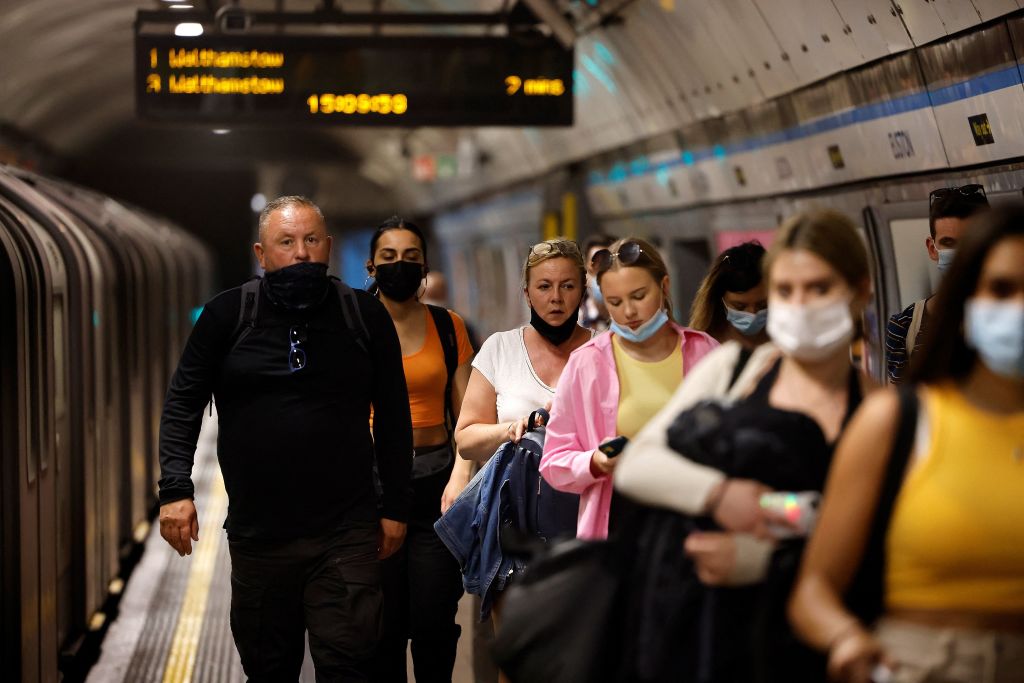 Commuters wearing face coverings due to Covid-19 in London. Photographer: Tolga Akmen/AFP There's consensus on one point: the high level of vaccinations in the U.K., where about 57% of the population has had both shots, has been a godsend. That's a key reason why the level of hospitalizations and Covid deaths in recent weeks—while still going up—is nowhere near approaching the horrors of last winter. Ravindra Gupta, a clinical microbiology professor at Cambridge, is nonetheless urging officials to refrain from jumping to conclusions. The level of danger won't be clear until the fall, he says, when schools are back and cooler weather sends people increasingly interacting indoors. He's concerned about the threat delta poses to some people who've already been fully vaccinated. It's so transmissible that people's antibody levels need to be higher than ever to prevent infection. The fact that antibody levels fall with time shouldn't be a major problem for most people who've been vaccinated, since other parts of their immune system are now primed to spring into action and fight off the virus if they happen to catch Covid (so-called "breakthrough" infections). But delta could still prove dangerous or even fatal to some elderly or otherwise at-risk groups whose immune systems aren't as robust. And so, it's important to keep on developing Covid-19 therapies, while simultaneously working to limit the virus's ability to spread in the first place, Gupta says. Countries need to vaccinate as many people as possible to limit the chances for new variants to emerge—perhaps a version of delta that's even better at infecting the vaccinated—and reduce the chances of Covid patients unnecessarily filling up emergency rooms. That's only becoming more essential as it's evident that the coronavirus is here to stay.—Tim Loh | 




Post a Comment