| The Editors Guild of India on Tuesday moved the Supreme Court seeking a special investigation team (SIT) probe into the Union government's role in the Pegasus snooping row. It has stated that the "indiscriminate use" of top-end surveillance technology against journalists destroys free speech and "poisons the heart of democracy". The Guild pointed out that freedom of the Press is a hard-won right essential to democracy. "Freedom of the Press relies on non-interference by the government and its agencies in the reporting of journalists, including their ability to securely and confidentially speaking with sources, investigate abuse of power and corruption, expose governmental incompetence, and speak with those in the Opposition," the petition, filed through advocate Lzafeer Ahamed B.F., said.  The petition follows the one filed by senior journalists N. Ram and Sashi Kumar, challenging the government to come clean about the Pegasus allegations. Rajya Sabha member John Brittas and Supreme Court lawyer ML Sharma have separately moved the court. Journalists Paranjoy Guha Thakurta, SNM Abdi, Prem Shankar Jha, Rupesh Kumar Singh and Ipsa Shataksi, reported to be victims of Pegasus surveillance, had also moved the apex court, saying they were subjected to "deeply intrusive surveillance". They said a forensic examination done by the Amnesty International on mobile phones revealed traces of interference. A Bench led by Chief Justice of India N.V. Ramana is scheduled to hear the Pegasus row petitions on August 5. On Tuesday, the Guild said a court-monitored probe should look into "every aspect of the use of Pegasus by the government against Indian citizens, especially journalists". Questions and attempts to garner the truth from the government have reached a dead-end. In fact, the government had "stonewalled" efforts to seek accountability, the petition said. The government had "deliberately avoided" public debate on the issue. It had only provided some "obfuscated answers" to straight questions about its alleged role in the snooping, the plea stated. "The citizens of India have a right to know if the Executive government is infringing the limits of their authority under the Constitution and what steps have been taken to safeguard their fundamental rights," it said. The Guild told the court that it was only seeking the enforcement of the public's right to know the truth about who was behind the Pegasus surveillance exercise. It also sought a "complete overhaul" of the "surveillance architecture" by even challenging the constitutionality of Section 5 of the Indian Telegraph Act, 1885, Rule 419A of the Indian Telegraph Rules 1951, Section 69 of the Information Technology Act, 2000 and Information Technology (Procedure and Safeguards for Interception, Monitoring and Decryption) of Information Rules, 2009.  Rahul Gandhi reaches Parliament on a bicycle to protest against rising fuel pricesFormer Congress president Rahul Gandhi on Tuesday gave a call to Opposition leaders to "unite the majority voice of the people of India" that is represented by their parties. Accompanied by his party colleagues and Opposition leaders, Gandhi rode a bicycle to Parliament to protest against the rise in the prices of fuel and cooking gas. Just before the cycle protest, he hosted a breakfast meet for leaders of 15 Opposition parties at the Constitution Club, close to Parliament. 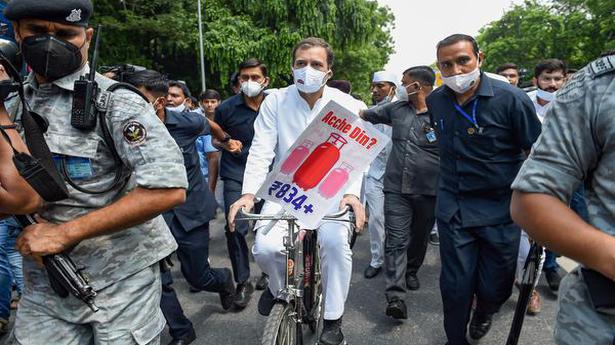 "We [the Opposition parties] represent 60% of the people, the majority of the people. When the government shuts us up, they are not humiliating us as members of Parliament but the majority voice of the people of India. The single most important thing in my view is: let's unite this voice," he told all the Opposition MPs. "The more this voice unites, the more powerful it will become, more difficult it will become for the BJP and RSS to suppress this voice," he asserted. The principles for the foundation of such unity should be worked out now, he added. Congress spokesperson and Rajya Sabha member Abhishek Singhvi called the meet "historic" and claimed that it was "a trailer for 2024 [Lok Sabha polls]". He said, "This shows you the new resolve, new direction, new momentum and a new determination and grit.... We will proceed unitedly without fear and deterrence. Be it Pegasus, the terrible price rise, the farmers' issue or any number of governance issues". He, however, played down a question on who would be the face of the "united Opposition" by terming it "irrelevant" at this point in time. DMK's Kanimozhi, NCP's Supriya Sule and Praful Patel, Trinamool Congress's Saugato Roy, Kalyan Banerjee and Mahua Moitra, Shiv Sena's Sanjay Raut and Priyanka Chaturvedi, Samajwadi Party's Ram Gopal Yadav and Rashtriya Janata Dal's Manoj Jha were among those present.The BSP was a notable absentee. The Congress is clearly sending a subtle message that it continues to occupy the pole position when it comes to taking on the Narendra Modi government. Gandhi said on Twitter, "Neither our faces are important nor our names. What is essential is that we are the people's representatives. Behind every face lie crores of faces who are troubled by price rise and inflation. Are these the 'acche din' [good days]". In its third week now, Parliament has failed to function properly, as the Opposition has been insisting on discussing the Pegasus issue and the three farm laws before every other issue. Gandhi's is one among the select few Indian numbers that were identified as a possible suspect for hacking by an international consortium of investigative journalists. Parliamentary panel recommends money in banks, social security measures for informal workersDirect transfer of money into bank accounts of informal workers and an urban employment guarantee scheme were among the recommendations of the Parliamentary Standing Committee on Labour in its report on the impact of the pandemic on rising unemployment and job loss. The report, which was presented in the Lok Sabha and tabled in the Rajya Sabha on Tuesday, said: "The pandemic has devastated the labour market, denting the employment scenario and threatening the survival of millions of workers and their families." The panel, which is chaired by Bhartruhari Mahtab, called on the government to improve social security measures for workers. Citing the Periodic Labour Force Survey (PLFS), the report said 90% of workers were in the informal sector, which is 419 million of the 465 million workers. The PLFS quarterly bulletin for April-June 2020 showed the unemployment rate in urban areas for those above 15 years at 20.8%, an increase from 9.1% in January-March 2020. The committee noted that the PLFS data for years prior to the pandemic were available and the real impact of Covid-19 would only be seen when the PLFS for 2019-2020 and 2020-2021 are available. It asked the Labour Ministry to take up the issue of timely completion of the PLFS with the Statistics and Programme Implementation Ministry. "Although no survey data are available as yet on the impact of the second wave which has undisputedly been more severe than the first, anecdotal evidence as well as the situation experienced during the first wave suggest that there would have been significant income losses particularly in the informal sector, pushing the vulnerables deeper into crisis," the report said. The panel said it was of the "studied opinion that the Covid-19 crisis in India has come in the backdrop of pre-existing high and rising unemployment". "Therefore, a comprehensive plan and roadmap are required to address the deteriorating condition of employment much aggravated by the pandemic, and widening disparities in the job market in the organised sector…Offering another round of income support to the poor to compensate for loss of jobs/employment incurred due to the two lockdowns imposed would go a long way in mitigating their woes." Indian student's death in Tianjin is homicide, suspect held, says Chinese Foreign MinistryThe death of a 20-year-old Indian student in China's Tianjin city was a homicide and a foreigner has been arrested in connection with the murder, the Chinese Foreign Ministry said here on Tuesday. The suspect's nationality has not been disclosed, officials said. Aman Nagsen, who hailed from Bihar's Gaya, was a student of Business Administration in the Tianjin Foreign Studies University. He was found dead on July 29. The Chinese Foreign Ministry, in a written response to PTI, said that around 8.00 pm, Tianjin police received a call that an "Indian student was lying on the floor of the dormitory with no sign of life". "The initial investigation of the public security organ found it to be a case of homicide and the suspect is another foreign student of the university. Compulsory measures have been taken on the suspect and the case is still under further investigation. "Relevant Chinese competent authorities have notified the Indian Embassy in Beijing of the situation of the case on July 30 and 31 respectively and maintained communication with the Embassy," it said. The Chinese side will handle the case in accordance with law and offer assistance in follow-up matters, it said, adding that an autopsy was conducted on Tuesday. The issuance of the death certificate is expected to take a few days as it is a case of homicide, the officials said. Nagsen was one of the few Indian students who remained in China through the coronavirus pandemic while most of the 23,000 odd Indian students, who left for home, were stuck in India, unable to return due to Beijing's reluctance to lift visa restrictions. Embassy officials said Nagsen's family has been informed of the progress of the investigations. An official of the embassy was expected to visit Tianjin, located about 100 kms from Beijing, to discuss the progress of the case and work out arrangements to send the body to India. Currently, no flights are operational between India and China. Covid Watch: Numbers and DevelopmentsThe number of reported coronavirus cases from India stood at 3,17,28,944 at the time of publishing this newsletter, with the death toll at 4,25,275. The second wave of the Covid-19 pandemic is "still raging" in the country and is far from over, Lav Aggarwal joint secretary, Health Ministry, told a press conference on Tuesday. Himachal Pradesh, Jammu and Kashmir, Lakshadweep, Tamil Nadu, Mizoram, Karnataka, Puducherry and Kerala have registered a rise in the Reproduction Number (Rt ), which was a cause of concern, he said. Reproduction Number is the average number of new infections generated by one infected individual during the entire infectious period. R>1 denotes a spreading infection. Rt for India is 1.2. "If it has gone over 1, it shows it is a significant problem and some States have registered an increasing trend of over 1," said Aggarwal. Only Andhra Pradesh and Maharashtra show a declining trend and in States like Bengal, Nagaland, Haryana, Goa, Delhi and Jharkhand, the R-factor is at 1. The Health Ministry said 44 districts had reported a high case positivity and eighteen districts had shown an increasing new Covid-19 cases trend in the last four weeks. "The Delta-driven second wave is still not over, and currently we have Kerala (10 districts), Manipur (9), Mizoram (6), Nagaland, Arunachal Pradesh and Meghalaya (4 each) among others that remain a cause of concern. Also 49.85% of the total cases in the last week were reported from Kerala. Malappuram, Thrissur, Kozhikode, Ernakulam, Kottayam, Alappuzha, Kasargod, Pathanamthitta, Wayanad and Idukki districts in Kerala are showing a worrying trend," said Aggarwal. An overall declining trend had been observed across India in weekly positivity since the week ending 10th May . "Weekly positivity has been less than 2% for the first time in the past 3 months," he said. The pandemic was far from over and globally too there was a rise in cases, NITI Aayog member (Health) V.K. Paul said. The Delta variant was a dominant problem. "COVID-appropriate behaviour and vaccination are vital and we urge the vulnerable population to avail themselves of the vaccination facility as soon as possible. This definitely contributes to the reduction of severity and mortality." In Brief:More than 99% of the Central Board of Secondary Examination (CBSE) students have passed Class 10, according to the results released on Tuesday. Last year, 91.46% passed the exam. In fact, eight States and Union Territories -- Tamil Nadu, Andhra Pradesh, Puducherry, Nagaland, Mizoram, Meghalaya, Goa and Lakshadweep -- recorded a 100% pass this year. All Kendriya Vidyalayas across the country also had a 100% pass rate. Evening Wrap will return tomorrow. | 
 Open in browser
 More newsletters


Post a Comment