| Hello. Today we look at the spread of the delta variant across Asia, vaccine hesitancy among Hong Kong's elderly and how 3D printing has failed to live up to the hype. The delta variant is challenging the part of the world that's been most successful in blunting the economic impact of Covid-19. Just 12 months ago, the Asia-Pacific region's rapid containment of Covid-19 made them the envy of the world as the virus ravaged the U.S. and Europe.
Now, from Seoul to Sydney, Bangkok to Beijing, authorities are reimposing growth-sapping restrictions as low vaccination rates in many of those places leave their populations vulnerable. So far, it's consumers who are bearing the brunt. The central bank in Australia, where two-thirds of the population are confined at home after delta slipped through the strict travel quarantine system, estimates spending drops about 15% during lockdowns. China is imposing internal travel and movement restrictions in the middle of the summer break as infections return to places like Wuhan and Beijing, prompting reductions in forecasts for economic growth. Cases there jumped to a six-month high on Friday of 101 infections, with delta reaching regions that account for 38% of national gross domestic product. 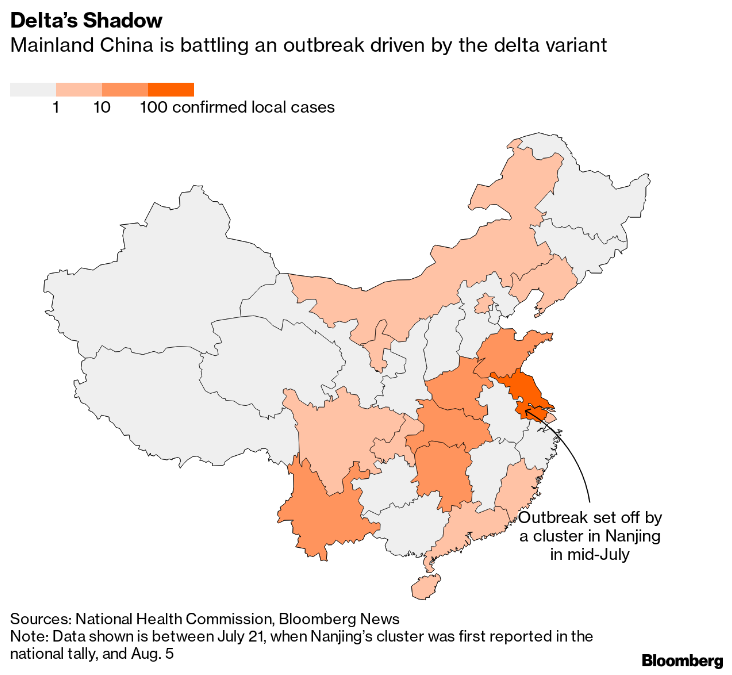 Supply chains from Vietnam to Thailand, where outbreaks are surging, have also been interrupted, with factories that make goods for Nike and Adidas shutting over virus restrictions, potentially missing out on the crucial holiday shopping season. That raises the prospect of Asia's delta hit reverberating worldwide, if exports are delayed longer term. "The current delta wave in Asia may snarl production networks further," said Frederic Neumann, co-head of Asian economic research at HSBC in Hong Kong. "The risk is that growth scars linger."
Already, there are signs the U.S. economy is starting to feel the effect too as events are cancelled and some consumers start to fret. --Malcolm Scott 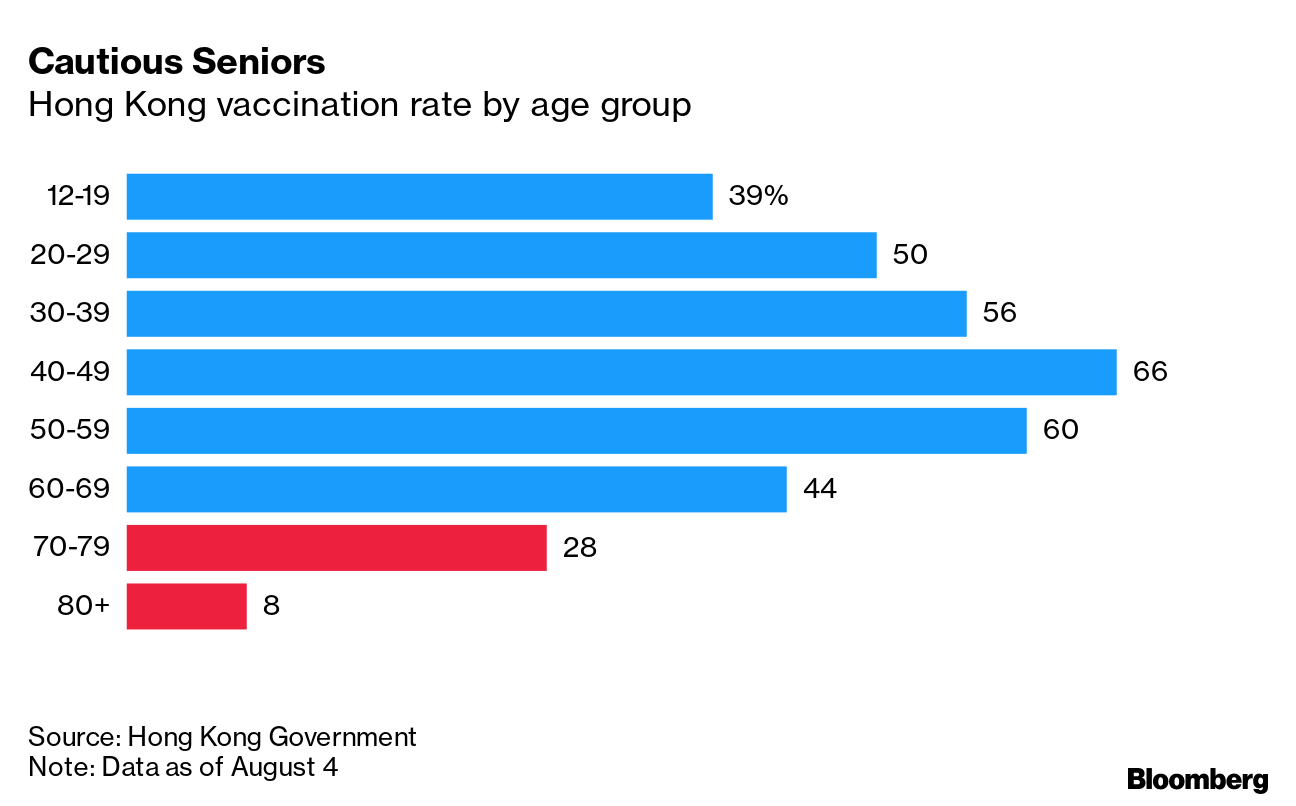 Unlike the U.S., where anti-vaccine fringe groups have fueled resistance to Covid shots, Hong Kong is facing a different challenge. Most of the city's elderly are reluctant to get inoculated, and some point to an unlikely source for the hesitancy: their doctors. Almost half a year into the territory's vaccination program with freely available shots, seniors are still staying away, due in part to advice from ultra-cautious doctors to defer vaccination if they have chronic conditions not yet under control. - Coming up | The U.S. payrolls report for July is out today with the median forecast of economists surveyed by Bloomberg anticipating a 850,000 advance in jobs.
- New finance chief | South African President Cyril Ramaphosa appointed Enoch Godongwana, a political ally and advocate of investor-friendly policies, as his new finance minister.
- U.K. challenge | Chancellor Rishi Sunak's quest to repair the public finances just got an added impetus after the Bank of England began a countdown to the end of rock-bottom borrowing costs. Meantime, starting salaries in the U.K. surged at the fastest pace in at least 24 years.
- India holds | The central bank kept interest rates unchanged at a record low, setting aside concerns over fast inflation.
- China's Olympic spirit | With the country poised to top the Olympic gold medals table for the first time since 2008, Beijing is taking even bigger steps to make sports a driver of economic growth.
- Dropping zeros | Venezuela will remove six zeros from the bolivar in an attempt to save a currency that has been wracked by hyperinflation.
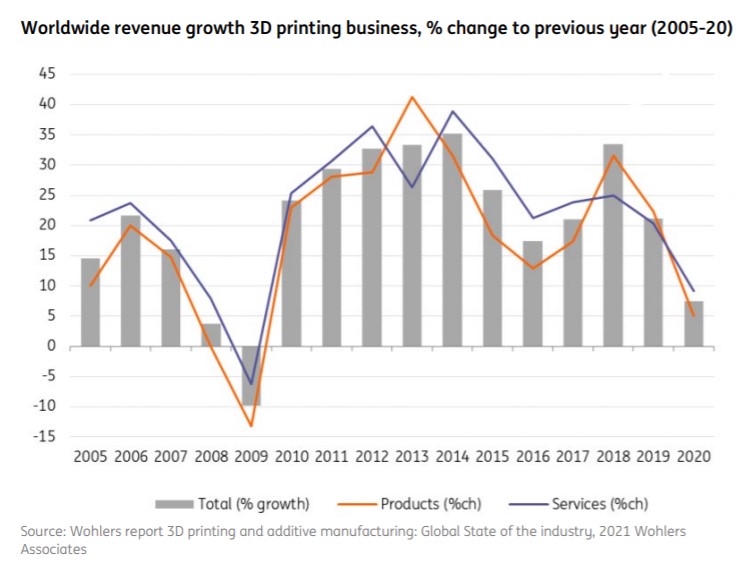 3-D printing — celebrated half a decade ago as a means to revolutionize production — had global revenue of just $12.8 billion in 2020, which is 0.1% of the global value-added of manufacturing, ING's Head of International Trade Analysis Raoul Leering wrote in a report. While it's the dominant production technique in some niche markets — dentistry, medical devices and hearing aids — it's currently too expensive to become a widely used method in manufacturing. Leering says that there currently is no sign of further technological breakthroughs that would bring down costs.
Still, thanks to other drivers of growth — including reshoring and the technology's ability to produce customized products much cheaper than traditional machines — ING predicts that 3-D printing could make up 5% of all manufactured products around 2040. When it comes to research: How long is too long?  Read more reactions on Twitter - Click here for more economic stories
- Tune into the Stephanomics podcast
- Subscribe here for our daily Supply Lines newsletter, here for our weekly Beyond Brexit newsletter
- Follow us @economics
The fourth annual Bloomberg New Economy Forum will convene the world's most influential leaders in Singapore on Nov. 16-19 to mobilize behind the effort to build a sustainable and inclusive global economy. Learn more here. | 


Post a Comment