| What's happening? France accuses Britain of politicising Covid-19 travel restrictions, and the pandemic disguises the depths of the U.K.'s post-Brexit labor shortages. Britain backed down over Covid-19 restrictions on visitors from France after the government in Paris said quarantine rule were based on questionable science. French Junior Minister for EU Affairs Clement Beaune said they were "a little bit political," regrettable and discriminatory. Britain responded by allowing vaccinated visitors from France to skip a 10-day self-isolation mandate. It also eased rules for people entering England from India, Bahrain and travel hubs such as the United Arab Emirates. Covid-19 is disguising one of Britain's biggest challenges post-Brexit. Companies across key parts of the economy just can't find enough people. Hundreds of thousands of individuals are being forced to self-isolate, worsening labor shortages caused by Britain's post-Brexit points system for hiring non-U.K. nationals. "A lot of people left because of Covid," said Jonathan Portes, professor of economics and public policy at King's College London. "But a lot of them may not come back because of Brexit." Prime Minister Boris Johnson defended the "vital work" of the Royal National Lifeboat Institution rescuing migrants — including young children — after former U.K. Independence Party leader Nigel Farage described it as providing a "taxi service for illegal trafficking gangs." The U.K. Parliament is debating new legislation designed to toughen penalties on people smugglers sending migrants across the English Channel.  A group of people thought to be migrants crossing from France come ashore from the local lifeboat at Dungeness in Kent, U.K. Photographer: Gareth Fuller - PA Images The U.K. and New Zealand are "closing in" on a trade deal that would go beyond the rollover agreement struck when Britain left the European Union, International Trade Secretary Liz Truss told the Daily Express. Critics point to the relatively small expected boost to GDP compared to the U.K.'s former trading relationship with the EU. It's all part of a plan for Britain to reach beyond its old "baseline alliances" in the West because the "tectonic geopolitical plates have shifted," according to a Telegraph interview with Foreign Secretary Dominic Raab. — Lizzy Burden We aim to keep you up to date on how the U.K. navigates the world after Brexit. Got tips or feedback? Email us at beyondbrexit@bloomberg.net 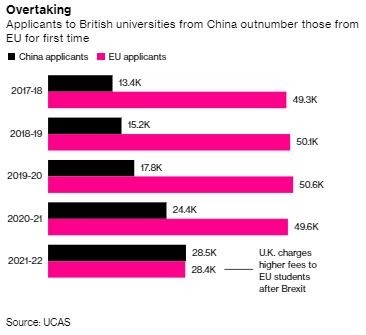 Brexit's impact on U.K. universities was laid bare when the number of Chinese applicants outstripped the total number of would-be students from the EU for the first time, according to data from admissions service UCAS. Still, it isn't a financial concern as international students' fees are higher than those paid by domestic students. You can follow us @Brexit on Twitter, and listen to Bloomberg Westminster every weekday. Share Beyond Brexit: Colleagues, friends and family can sign up here. For full EU coverage, try the Brussels Edition. You can find all of our newsletters here, but here are some we think you'd particularly enjoy: Bloomberg is also tracking the progress of coronavirus vaccines and mapping the pandemic. Sign up here for our Coronavirus Daily newsletter and here for our podcast. Subscribe to Bloomberg.com for unlimited access to trusted, data-driven journalism and expert analysis. | 


Post a Comment