| Afghanistan exit, Moderna vaccine creates a lot of antibodies, and commodities in focus. The last U.S. military plane has left Afghanistan as an uncertain future under the Taliban looms, while President Joe Biden faces criticism at home for the chaotic withdrawal. The Taliban has called for good ties with the U.S. after the 20-year conflict that killed tens of thousands of Afghans and about 2,400 Americans, while costing in excess of $1 trillion. A State Department official said yesterday that recognition of a new government in Kabul wouldn't come any time soon. China looks like a big source of incoming international recognition for the regime as Beijing eyes the country's mineral wealth. A study which directly compared immune responses found the vaccine manufactured by Moderna Inc. developed more than double the antibodies of the Pfizer Inc. and BioNTech SE Covid shot. Shares in Moderna fell, however, as Japan investigated the deaths of two people who received that vaccine. The White House is pushing for the start of planned booster shots from Sept. 20, a target that already looks ambitious as public-health advisors take a cautious path. With the number of cases remaining stubbornly high, the EU yesterday moved to curb travel from U.S. Covid may have killed as many as 4.5 million people in India, ten times the official total, according to the National Bureau of Economic Research. Aluminum's year-long rebound quickened this morning with a 3% surge to reach the highest in a decade. Supplies of the metal are becoming increasingly tight as Beijing seeks to curb pollution from the metal's energy-intensive production process. Goldman Sachs Group Inc. analysts raised their price target for aluminum along with nickel and zinc. Meanwhile, the oil market is focused on tomorrow's OPEC+ meeting which is expected to stick to its plan to raise production by 400,000 barrels a day. Global equities are rising again, with Asia shaking off weak Chinese data while yesterday's record Wall Street close is helping sentiment in Europe. Overnight the MSCI Asia Pacific Index added 1.1% while Japan's Topix index closed 0.5% higher. In Europe the Stoxx 600 Index was 0.1% higher at 6:16 a.m. Eastern Time. S&P 500 futures pointed to a higher open, the 10-year Treasury yield was at 1.28% and gold was higher. The FHFA House Price Index and S&P CoreLogic house prices for June are at 9:00 a.m. MNI Chicago PMI is at 9:45 a.m. and a consumer confidence reading is at 10:00 a.m. Earnings include Designer Brands Inc., American Woodmark Corp., Anaplan Inc., Ambarella Inc., PVH Corp. Here's what caught our eye over the last 24 hours. Robinhood, Virtu and Charles Schwab all dropped yesterday after SEC Chairman Gary Gensler said a full ban on payment for order flow is "on the table." (That's where market makers pay retail brokers to execute client flows.) While PFOF has always been controversial simply because it sounds too good to be true for brokers, the case for banning the practice isn't straightforward. From the retail traders' perspective, Gensler made the point in a June speech that they may be losing out more on the reduced price improvement than they would from paying commission. Is that true? In the latest breakdown of execution statistics by Bloomberg Intelligence's Larry Tabb, market makers profited from 49% of the spread, brokers 13% and clients 38% -- a sign there's at least some benefit for all parties involved. But whether that's true or not, commissions are inherently more transparent and comprehensible, so it might be a larger deterrent on excessive trading. This would dovetail with the more paternalistic line that the SEC seems to be taking with its growing concern over the gamification of trading, a topic on which it's now seeking comment. 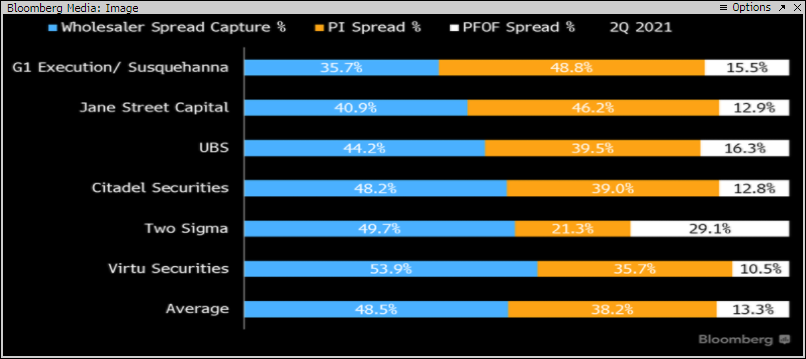 Source: Bloomberg Intelligence Source: Bloomberg Intelligence Gensler's interview yesterday signaled the other part of his concern is PFOF's effects on the market's overall fairness and competitiveness. Retail execution has become a concentrated business largely dominated by Citadel Securities and Virtu with high barriers of entry, though it's about to become a bit more competitive with the entry of Jump Trading and Hudson River Trading. But Gensler's fear is siloed access to retail flows has given the market makers too much of an advantage. In short, the SEC now seems increasingly convinced that whether it's from the Robinhood trader or broader market's perspective, the market structure that gave rise to the retail-speculation boom needs to change. The question is how substantive that change will be. Follow Bloomberg's Justina Lee on Twitter at @justinaknope Like Bloomberg's Five Things? Subscribe for unlimited access to trusted, data-based journalism in 120 countries around the world and gain expert analysis from exclusive daily newsletters, The Bloomberg Open and The Bloomberg Close. | 


Post a Comment