| This is Bloomberg Opinion Today, a BBQ of Bloomberg Opinion's opinions. Sign up here. Today's AgendaUniversal Basic Income May Cause More Harm Than GoodThose opposed to the idea of a universal basic income say it would discourage people to work, inadvertently increase inequality and lead to social instability. Allison Schrager dives into a new study from the National Board of Economic Research that suggests these skeptics may be right. The study examined lottery winners over a five-year period, which makes it a good test for universal basic income because the winnings are large enough that the income they generate can be life-changing — unlike many UBI experiments, where the payments are small. The winners worked less and were unlikely to start a successful business. Many moved to rural areas, but few moved to higher-quality neighborhoods, in terms of college attainment of neighbors, average income and other metrics that are a proxy for opportunities available to them or their children. (One positive effect: Lottery winners are more likely to marry and less prone to divorce.) This bodes ill for what guaranteed-income schemes might beget. Working less and at less-demanding jobs often means forgoing wage increases and learning new skills. This is especially harmful for young people who are still establishing their careers and acquiring skills. Most wage increases occur in your 20s and 30s; miss out on those years, and the odds are you won't catch up. On balance, then, a welfare system that makes payments contingent on earnings, age or even having a child is a better alternative to UBI. It's cheaper, too. Bonus Gen Z Reading: Why young Brits want to keep their masks on. — Therese Raphael Organic Farmers Are Being Incentivized to Damage the EnvironmentA loophole in the USDA's National Organic Program encourages farmers to cut down native forests and grasses so the land can be used to grow organic crops. This, Amanda Little explains, is not only a net loss for the environment, but it also undermines the Biden administration's vision for reforming the food system and putting America on a path toward climate-smart agriculture. The glitch is in an ostensibly sensible rule that requires farmland to be free from pesticides for three years before its production can be certified for sale as organic. This is a necessary precaution, but a costly one: Farmers must fallow their fields to transition from conventional to organic production. Some have come up with a more expedient alternative of simply clearing wildlands that have never been treated with agrochemicals and get certified without the wait. Hundreds of thousands of acres of native forests and grasslands have been converted to agricultural use in the last year — and millions of acres in the last decade. The incentive to do this is strong: Organic foods sell at a premium over conventional products and demand is growing. U.S. sales rose by more than 12% to $62 billion in 2020. A straightforward solution would be to impose a 10-year waiting period before converted grasslands and forests can be certified for organic production. The Trump administration didn't care to close the loophole, but Joe Biden should. Bonus Environmental Policy Reading: Climate groups pressing for change need to get their timing right. — Jonathan Bernstein And European Environmental Policy Reading: The EU must back its climate plans with redistribution, innovation and investment. — Lionel Laurent The Chip Dip Isn't Affecting All Carmakers the Same WayIs the worldwide shortage in semiconductors good or bad for carmakers? That depends on which carmakers you ask, says Anjani Trivedi. In the U.S., the shortfall has forced manufacturers to shift from making more cars to better ones. These vehicles are selling apace and have boosted margins. Companies like Volkswagen AG and General Motors Co. have reported brilliant first-half results. In China, Korea and Europe, many manufacturers have either seen sales slump or expect to. This divergence in performance shows that some companies have risen to the challenges of the pandemic by being nimble and managing production effectively — and these traits will become even more critical in the years ahead as the industry transitions to electric vehicles. Companies that have not demonstrated these qualities can blame their poor performance on the chip shortage, but they should be worried about the road ahead. Telltale ChartsAmerican manufacturing companies have announced 38 software acquisitions so far this year. That's nearly 5% of all transactions for the sector and, if the rate holds, will be the highest percentage for any year since at least 1998. 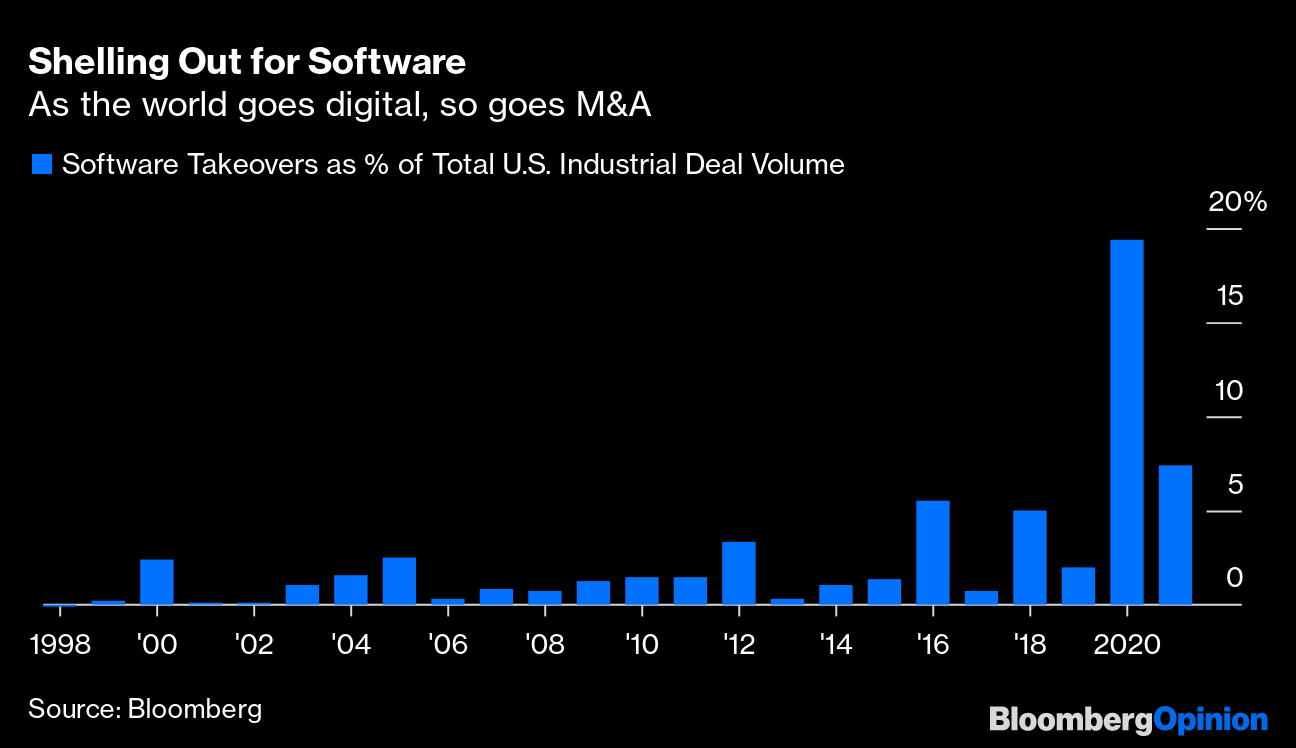 What's going on? As Brooke Sutherland points out, the pandemic has only accelerated digital adoption in the industrial sector, and buying a software company can be a more cost-effective alternative to developing software capabilities in-house. There's also an element of keeping up with the Joneses: The companies that aren't doing software deals — rightly or wrongly — are perceived as falling behind. Inevitably, the valuations for software firms are soaring. Manufacturers may have no choice but to invest in software, and some of these deals will undoubtedly succeed. But there will also be consequences for overpaying or choosing the wrong target. Bonus Tech Reading: Facebook's $1 billion incentive scheme for content creators is just not cool enough. — Tae Kim Further ReadingBiden should stand with Cuba's protesters — and ease policies that have contributed to their suffering. — Bloomberg's editorial board For macroeconomic and political reasons alike, Biden should give Jerome Powell another term as Fed chairman. — Ramesh Ponnuru Mastercard's problems in India underscore the urgency of U.S.-led international digital trade agreement. — Andy Mukherjee India's new industrial policy is no more likely to succeed than its old industrial policy. — Mihir Sharma For activist hedge funds eyeing the consumer sector, Unilever Plc is a target hiding in plain sight. — Andrea Felsted ICYMIThe Big Take: The future of space is bigger than the dreams of billionaires like Musk, Bezos and Branson. The U.S. has warned investors that China's increased control over Hong Kong threatens the rule of law and endangers employees and data. Biden hinted he is considering lifting a ban on travel from Europe, 16 months after flights were grounded by the pandemic. China's Xiaomi has overtaken Apple as the world's second-largest cellphone maker. Despite vaccinations, Covid-19 is still killing Americans faster than guns, cars and flu — combined. KickersLeo Messi may have to learn how to get by on $80 million a year. How many brand tie-ins can you spot in the "Space Jam" remake? There are more than 200. The post-pandemic marriage boom is straining the pockets of wedding guests. If you enjoyed the BBQ … maybe you'll buy the grill maker's IPO? Notes: Please send T-bone steaks (medium rare, if you don't mind) or grilled carrots to Bobby Ghosh at aghosh73@bloomberg.net. Sign up here and follow us on Twitter and Facebook. | 


Post a Comment