| Hello. Today we look at how U.S. businesses are sounding the alarm on inflation, healthy trade data out of Asia, and whether the surge in money supply is feeding through to higher prices. As the late U.S. Defense Secretary Donald Rumsfeld might have put it, the likelihood of this year's surge in consumer prices proving "transitory," as policy makers anticipate, is a known unknown. But the slew of corporate earnings statements and analyst calls are shedding some light on the outlook. The comments suggest price pressures aren't about to fade. Chipotle Mexican Grill Inc., the restaurant chain that hiked wages earlier this year, said Tuesday it may raise its prices further. CFO Jack Hartung said the company has seen "no resistance whatsoever" to higher menu prices yet. Other recent comments, gathered by Olivia Rockeman and Peyton Forte, add to signs that businesses are getting used to a new era of faster inflation: Soft drinks "Is there somewhat more inflation out there? There is. Are we going to be pricing to deal with it? We certainly are." - Hugh Johnston, CFO, PepsiCo Inc.
Household lubricants "In order to combat the economic factors we've been experiencing, we've begun implementing price increases in many of our markets." - Jay Rembolt, CFO, WD-40 Co.
Recliner chairs "We continue to face raw material price increases, due to supply and demand trends and supply chain disruptions." The company will take "further actions when and if necessary." - Melinda Whittington, CEO, La-Z-Boy Inc.
Paints and coatings "This inflation cycle is much higher than anyone anticipated and we're continuing on a business-by-business basis, working to secure further selling price increases," - Michael McGarry, PPG's chief executive officer
Investors are responding to what they're hearing — bidding up the stock prices of companies with the power to pass along cost increases. As Bloomberg Opinion Columnist John Authers shows with a dashboard of 35 indicators, the official data are "flashing alarmingly bright" and businesses are "sounding the alarm." Even still, "nobody is positioned for the Fed to lose control of inflation anytime soon, nor for Germany or Japan to snap out of their disinflationary malaise." 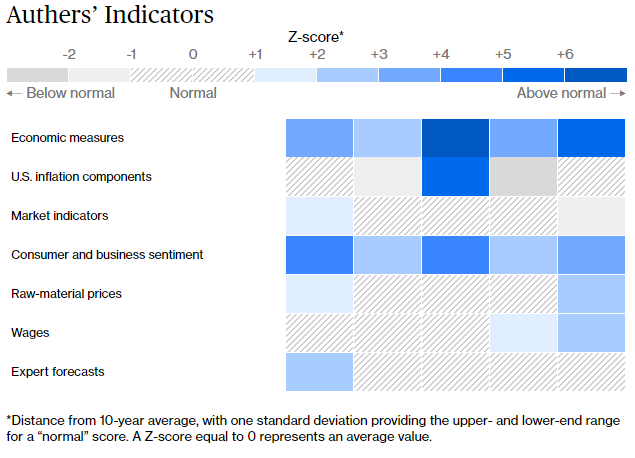 Economists are starting to incorporate faster price gains hanging around longer. The median forecast in Bloomberg surveys is for a 2.5% gain in the consumer price index in the first quarter of 2022, up from the 2.3% predicted in April. All food for thought for Federal Reserve policy makers as they prepare to discuss, at the policy meeting next week, their plans to taper asset purchases. —Chris Anstey 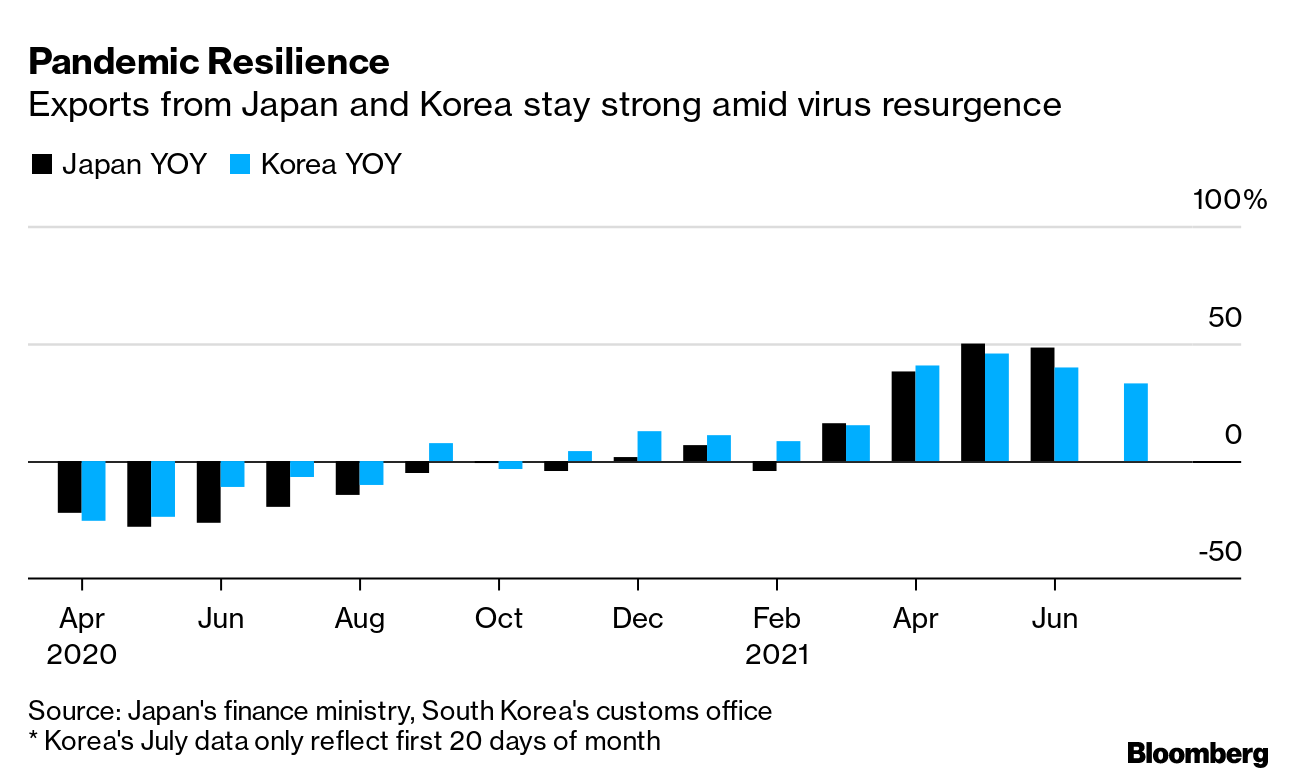 Japan and South Korea continued to rack up solid export gains in a sign that the impact of virus variants has yet to have a major impact on global demand even as the recovery in world trade inches closer to its peak. Exports out of Japan, the world's third-largest economy, jumped 49% in June from the dismal level of a year earlier, while the value of Korea's overseas shipments in the first three weeks of July gained by a third. Importantly, exports continued to gain on a month-over-month basis, an indication that the recovery in global trade still has legs. Still, economists cautioned that monthly export gains were also close to plateauing and would be offering less help to global growth in the second half of the year, with the impact of virus variants still difficult to fully assess. - ECB goal | The European Central Bank starts a potentially heated two-day meeting on Wednesday, with officials needing to decide how their newly unveiled monetary strategy affects near-term policy.
- Battling expectations | The Bank of Russia spent years convincing citizens that it could bring inflation under control. A few months of surging prices has been enough to demolish that progress.
- Housing concerns | A rally in Swedish home prices that made its housing market one of the world's frothiest is reigniting political calls to remove a controversial tax perk seen as part of the problem.
- Empty rooms | A fourth Covid emergency in Tokyo and a decision to bar spectators from the main athletics events have triggered a wave of hotel room cancellations, the latest setback for the Olympic host.
- Scope to maneuver | The Philippines has room to cut banks' reserve requirement ratio as the economy recovers from the effects of the pandemic, Finance Secretary Carlos Dominguez said in an interview.
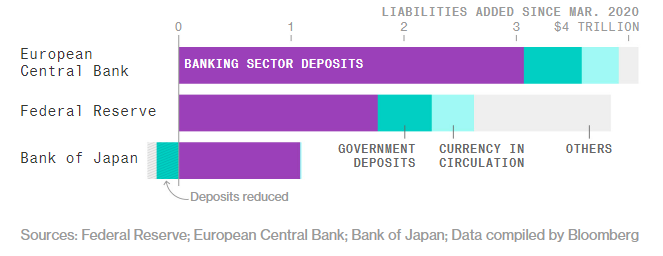 A recent exploration of the Fed, ECB and BOJ's unprecedented $9 trillion pandemic asset-buying spree by Bloomberg News showed how much of that has ended up right back at central banks in the form of banking sector deposits. Morgan Stanley Strategist Matthew Hornbach, in a July 19 report, examines that and other issues relating to the massive increase in U.S. money supply over the past year to assess whether it's feeding through to inflation. The short summary of his 19-page report is: probably not. Here's a couple of his reasons: - Increases in cash assets on bank balance sheets are less inflationary than increases in loans, especially if a large majority of those cash assets come from QE
- That's because the money supply by itself is not inflationary unless someone uses the money to spend
"We find it hard to conclude that the dramatic increase in the money supply drove inflation higher," Hornbach concludes. "Rather, higher prices have been due to a combination of supply shortages amidst an unprecedented consumer demand substitution between goods and services." A silver lining amid the pandemic's economic damage is the way in which it's changing productivity across industries. 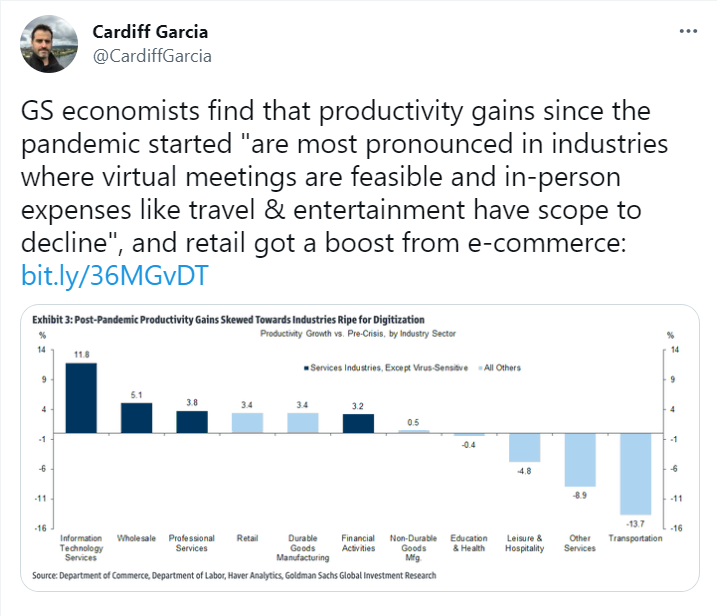 Read more reactions on Twitter - Click here for more economic stories
- Tune into the Stephanomics podcast
- Subscribe here for our daily Supply Lines newsletter, here for our weekly Beyond Brexit newsletter
- Follow us @economics
The fourth annual Bloomberg New Economy Forum will convene the world's most influential leaders in Singapore on Nov. 16-19 to mobilize behind the effort to build a sustainable and inclusive global economy. Learn more here. | 


Post a Comment