| This is Bloomberg Opinion Today, a peanut-butter cup of Bloomberg Opinion's opinions. Sign up here.  This is not a crisis. For a long time, Reese's used catastrophe to advertise peanut butter cups. A typical spot would involve somebody walking down a busy city street eating peanut butter straight from the jar, as one does, while somebody else would be walking in the other direction wielding a chocolate bar like an epee, as one also does. The two would collide, their snacks would crossbreed, and they would yell at each other about it until they realized: Wait. A. Minute. This is delicious! Sometimes crises are really just opportunities, is what I'm saying, in both snack foods and politics. Currently there is what some have described as a crisis of illegal immigration happening at the U.S. southern border. Apprehensions are at highs not seen in decades, notes Justin Fox: 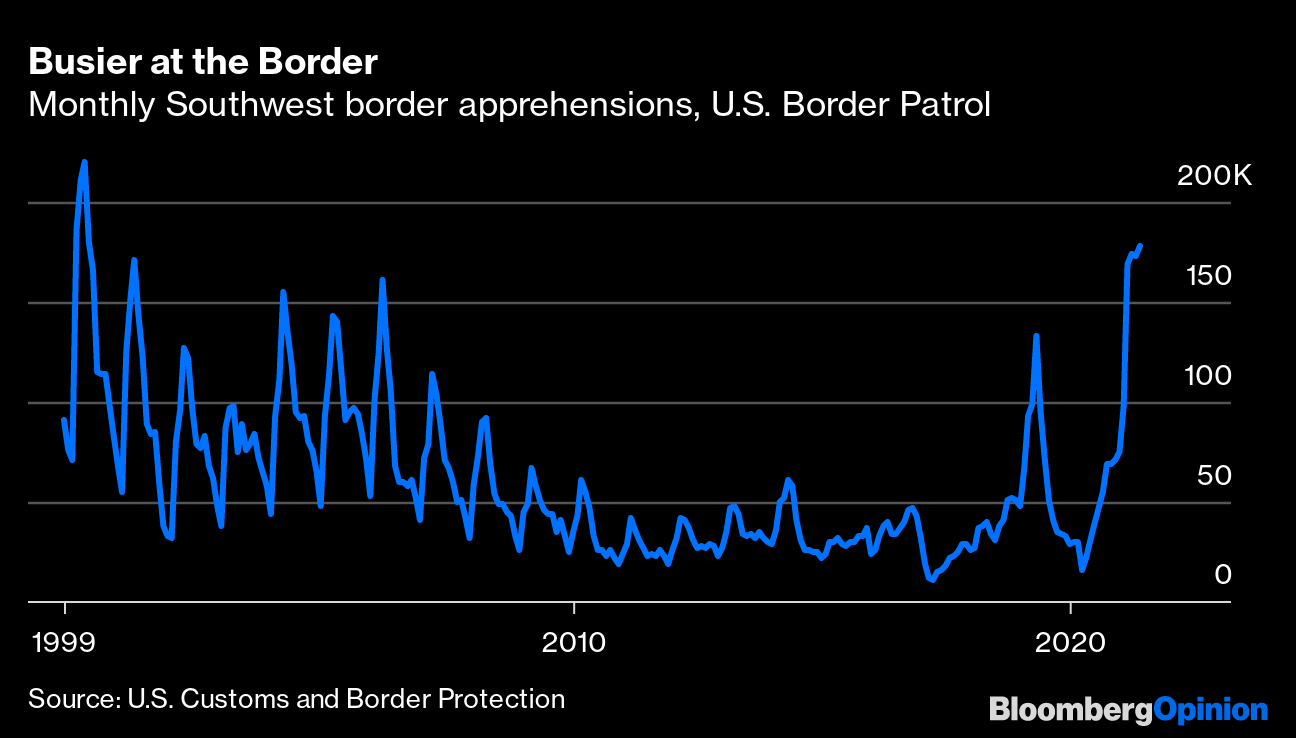 These numbers are skewed by the fact that many people are trying to enter the country more than once. But it's fair to say an unusually large number of people are sneaking into the U.S. This may seem like a bad look for President Joe Biden, particularly after his predecessor built a new national religion around border security. But Justin notes this surge has nothing to do with border policies; the previous administration had its own massive influx in 2019. The real driver of illegal immigration, in fact, is that the U.S. economy is wildly outperforming Mexico and other Latin American economies. This wasn't the case for most of the past decade or so. Here's where the whole chocolate-peanut butter analogy comes in (sort of, if you don't think about it too hard): The U.S. economy is doing so well that businesses can't find workers for menial jobs such as dishwashing and ditch-digging. Meanwhile, we have tens of thousands of people on the border clamoring to wash our dishes and dig our ditches. Illegal immigration is not really the answer, but it still feels as if there's a peanut-butter-cup opportunity here somewhere. (Read the whole thing.) We'd all probably be better off if Latin American countries could get their economic act together and keep more of their people at home. Shannon O'Neill points out the chance to cash in on a green-energy revolution is right there for many of them, but they're blowing it. Populists on both the right (Brazil) and left (Mexico) are tossing aside decades of clean-energy progress and scaring off foreign investment. This is like taking both the chocolate and the peanut butter and throwing them in the trash. And setting the trash on fire. Further Latin American Reading: Pedro Castillo must use moderation to manage a divided Peru in crisis. — Bloomberg's editorial board Netflix investors had a momentary freakout last night after the company reported it had lost some North American subscribers in the latest quarter, until the investors remembered Netflix still has eleventy bazillion subscribers. What's more, as Tara Lachapelle points out, Netflix excels at hanging onto those subscribers by constantly throwing new content at them. It's also starting to learn how to milk more money from them, partly through old-fashioned price hikes. If you're a Netflix user, you can probably think of several shows (cough, "Ozark," "I Think You Should Leave," "Cobra Kai," "Sex Education," cough) off the top of your head you'd be willing to pay a few more bucks to see. Bonus Home-Entertainment Reading: TikTok, already so absolutely huge, aims to get even huger through e-commerce, gaming, live events and more. — Tae Kim Eighteen months into this thing, you'd think public officials would have figured out pandemic management, but no. In the U.K., Boris Johnson's government keeps flip-flopping like a beached cod, confusing and angering the citizenry, writes Therese Raphael. The latest example is its night-club policy. First it invited everyone to dance the night away. Now it's telling them they'll need Covid passports with their dancing shoes. In Singapore, meanwhile, the government announced it would stop using case counts as the benchmark for Covid action. But it retreated at the first sign of trouble, Rachel Rosenthal notes. Hospitalizations and deaths are far more reasonable standards for a country like Singapore, which has high vaccination rates. Maybe they'll figure it out in 2022. As value investing has suffered a long stint in the wilderness, so has the price/book ratio long favored by bargain-hunters. But Nir Kaissar is here to tell you there may be another way to measure value, one that is better suited for these difficult times.  We need a global accounting standard for carbon, so we all know what "net zero" really means. — Robert Hinkle and Peter Orszag Republicans don't want to get to the bottom of the Capitol attack because they know so many Republicans are complicit. — Jonathan Bernstein Biden didn't start Cuban unrest, but he could help it along by giving Cubans a freer Internet. — Eli Lake As long as China and the U.S. keep investing in each other, armed conflict will be less likely. — David Fickling Why did JPMorgan Chase give Jamie Dimon a huge bonus to stick around? — Matt Levine Becoming your grandkids' primary caregiver might not be good for your financial, physical or emotional health. — Teresa Ghilarducci Team Biden is pretty much on board with giving Jay Powell another Fed term. Johnson & Johnson agreed to a huge opioid settlement. Nancy Pelosi rejected putting Jim Jordan and Jim Banks on the January 6 committee. A person in a dream co-authored a math paper. (h/t Scott Kominers) An Alabama doctor talks about treating unvaccinated Covid patients. Beachcombers find a trove of Neanderthal and human artifacts. An appreciation of used bookstores.  Notes: Please send dream papers and complaints to Mark Gongloff at mgongloff1@bloomberg.net. Sign up here and follow us on Twitter and Facebook. | 


Post a Comment