| Hello. Today we look at the faded dreams for an economic revival sparked by the Tokyo Olympics, global trade and innovation in China. If you read this newsletter as soon as it pops into your inbox or flashes across your Bloomberg Terminal, then the opening ceremony for Tokyo's delayed Olympics is about to get underway. Instead of cheering fans, there will be empty stands. Performers will be wearing masks. And for the first time in history, events at the games will be held without spectators and winners will have to place their own medals around their necks. Welcome to the Covid era. Back in September 2013, when Japan won the right to host the Games, it was hoped they'd form the crowning achievement in then-prime minister Shinzo Abe's audacious plan to revive the economy. Yet even before the coronavirus struck, such optimism was flailing. The world's most aggressive monetary experiment has failed to turn around a deflationary mindset that's still suppressing prices. And while structural reforms like bringing more women into the workforce have shown some success, it hasn't been enough to overcome the drag caused by a rapidly aging workforce. About the best you can say about Abenomics is that it helped maintain living standards — no small feat. 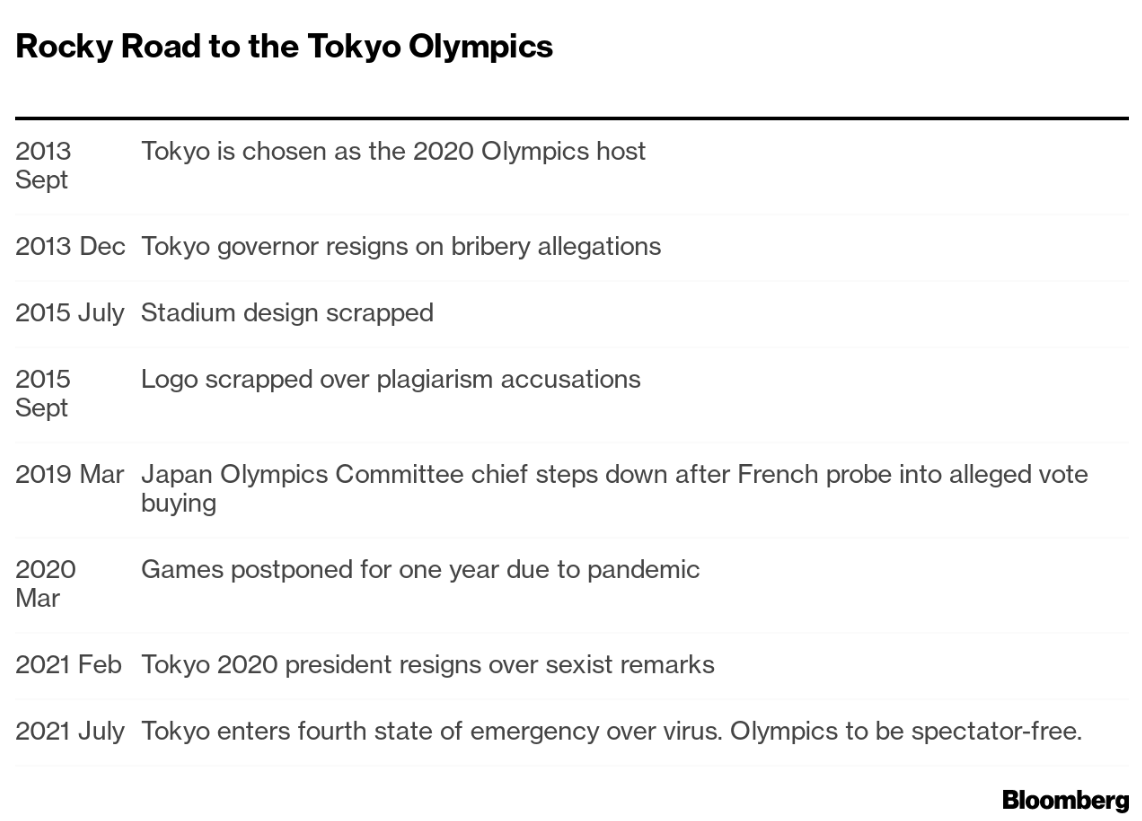 Instead of boosting the economy, the Games look like being yet another drag on it. The official cost has more than doubled to $15.4 billion from its original estimate, including an extra $3 billion needed for the delay and Covid-related safety measures. And the decision to bar spectators could lead to more than a million canceled reservations or plans to stay in hotels. It's all a far cry from the last time Tokyo hosted the Games, back in 1964, when the event marked Japan's return to the international stage. —Malcolm Scott 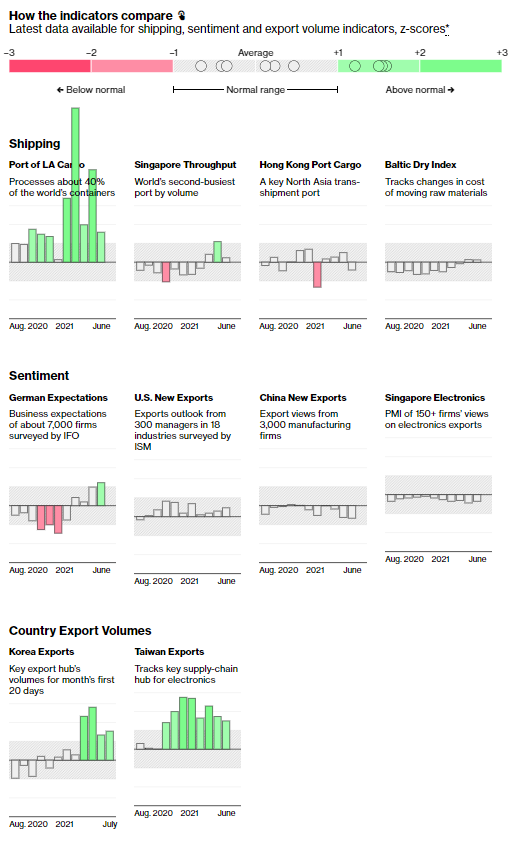 Global goods trade remains a bright spot for a world where more economies are battling an abrupt revival of Covid cases. South Korea and Taiwan each just added to a streak of double-digit, year-on-year export gains. Korea's 33% increase in the first 20 days of July is a particularly reassuring sign, given that the bellwether for global trade is seeing a spike in Covid cases that threatens to set back economic recovery. Most indicators on the Bloomberg Trade Tracker remain above their long-run averages, with almost half in the "above normal" range on the dashboard. - Staying dovish | Christine Lagarde said the ECB has learned from errors of past crises and won't derail the recovery by withdrawing emergency support too early. Bundesbank chief Jens Weidmann and Belgian Governor Pierre Wunsch opposed the new guidance.
- School of thought | In the pandemic, the U.S. government has spent money on a scale not seen since World War II — without worrying too much about how it would pay the bills. That looked to some people like the triumph of Modern Monetary Theory.
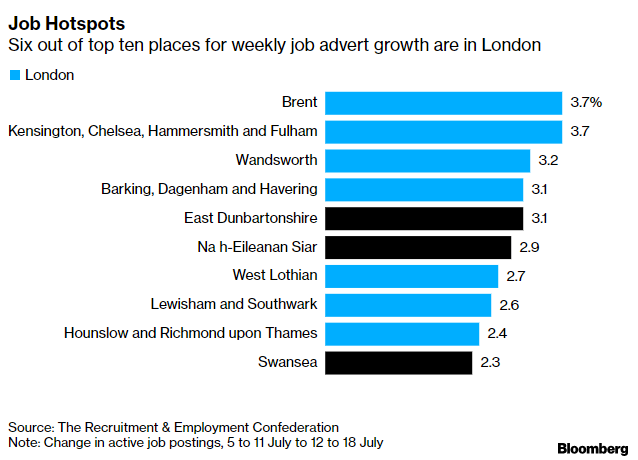
- Hot spot | London's jobs market has sprung back to life, adding to evidence of tightening in the national labor market that's starting to push up wages, fanning concerns about inflation.
 - No bubble | Fresh lockdowns and restrictions in Asia brought on by the faster-spreading delta coronavirus variant are making the region's pursuit of travel bubbles look like an increasingly fruitless endeavor.
- New epicenter | Indonesia is taking the lead in the dismal Covid-19 stakes after a recent streak of 50,000 infections a day.
- Trade talks | The U.S.'s plans for a digital trade agreement covering Indo-Pacific economies may be a step toward Washington rejoining a regional trade deal that President Donald Trump exited in 2017, Australian Trade Minister Dan Tehan said.
- Taper timing | The Federal Reserve will start scaling back asset purchases next year with an emphasis on mortgage-backed securities, according to economists surveyed by Bloomberg, who see the central bank raising interest rates at a quicker pace through 2024 than previously thought.
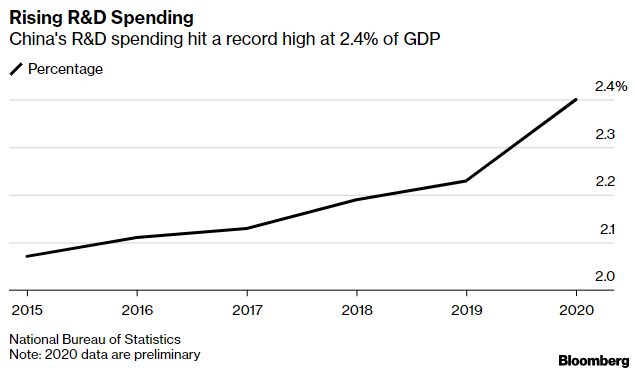 Beijing this week issued an unusually strong call for strengthening basic scientific research in the country's universities - and a new report from HSBC Holdings Plc helps explain why Beijing is anxious. Chinese universities lag far behind their peers in U.S. and Europe in fields such as physics, geography, oceanography and atmospheric science, according to economists at HSBC who analyzed university rankings. This could have negative implications for China's economic development as it may "hold back further research breakthroughs in more applied fields (including engineering fields) if there remain significant gaps in knowledge," HSBC economists led by Qu Hongbin said in the report. Too hot to learn. 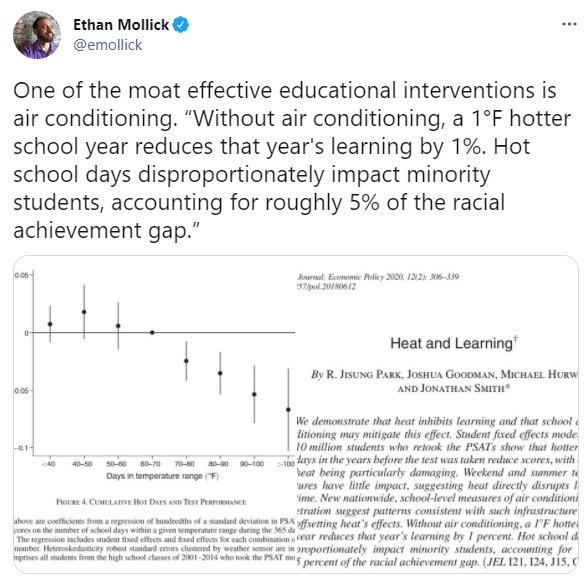 Read more reactions on Twitter - Click here for more economic stories
- Tune into the Stephanomics podcast
- Subscribe here for our daily Supply Lines newsletter, here for our weekly Beyond Brexit newsletter
- Follow us @economics
The fourth annual Bloomberg New Economy Forum will convene the world's most influential leaders in Singapore on Nov. 16-19 to mobilize behind the effort to build a sustainable and inclusive global economy. Learn more here. | 


Post a Comment