| The U.S., U.K. and allies accuse China of the Microsoft Exchange hack. Stocks tumble as the delta variant spooks investors. Major Chinese cities face power blackouts. Here's what you need to know. The U.S., U.K. and their allies formally attributed the Microsoft Exchange hack to actors affiliated with the Chinese government and accused Beijing's leadership of a broad array of "malicious cyber activities," escalating last week's tensions between the White House and China. The group of nations said the Chinese government has been the mastermind behind a series of malicious ransomware, data theft and cyber-espionage attacks against public and private entities, including the sprawling Microsoft Exchange hack earlier this year. Tensions intensified last week when the administration warned investors about the risks of doing business in Hong Kong. Here's the full U.S. advisory. A global stocks selloff is set to continue in Asia as the spread of the delta coronavirus variant stokes concerns about the resilience of the economic recovery and bolsters haven assets. Futures fell about 1% in Japan, Australia and Hong Kong. Cyclical companies have suffered the brunt of the rout, reversing the reopening trade. Commodity, financial and industrial shares led losses in the S&P 500, which fell the most in two months. Long-term Treasury rates spiraled to their lowest since February, flattening the yield curve. Ten-year yields tumbled as much 12 basis points to as little as 1.17% Monday. The dollar rose alongside the yen and the Swiss franc. Oil sank after OPEC+ agreed to boost supply into 2022. Bitcoin slid closer to $30,000. Americans should avoid traveling to the U.K. because of a surge in Covid-19, U.S. government and health officials warned. The U.K.'s much-touted dropping of restrictions came even as the delta variant tore across the country, adding more than 100,000 cases at the weekend alone. While crowds packed into nightclubs to celebrate the dropping of restrictions, the return to office in London's financial center was a much more muted affair. Elsewhere, a U.S. gymnast tested positive at an Olympics training camp outside Tokyo; Indonesian President Joko Widodo's approval rating fell as the death count went up; and more than a third of the world's population may be unable to afford a healthy diet due to the pandemic, according to a new study. Key Chinese cities have warned that homes and factories face new power outages as historic demand and supply shortages strain energy grids. Populous centers including Beijing and Xi'an have alerted electricity users there will be scheduled disruptions as grid operators struggle to maintain overloaded networks. Eleven provinces including eastern manufacturing hubs and landlocked central China, which also suffered outages during last winter's cold spell, reported record demand and peak-load surges last week, according to the State Grid Corp. of China. The nation's electricity providers are experiencing similar pressures seen in the U.S. and other hot spots around the world as temperatures reach alarming levels, while coal prices are being pushed toward a record high. When Tokyo last hosted the Olympics, in 1964, the unveiling of a bullet train capable of the improbable speed of 210 kilometers an hour heralded the dawn of a high-tech era in Japan. Within a decade and a half, innovations such as Sony's videocassette recorder, Toshiba flash memory and Space Invaders, the arcade shoot-em up that revolutionized the gaming industry, made Japan synonymous with global technological superiority. Today, it seems like another age. Here's how a tale of two Olympic Games illustrates the long arc of Japan's tech decline. This is what's caught our eye over the past 24 hours: Is the U.S. Treasury market a secret epidemiologist? I'm being facetious of course, but I can't help but wonder — given that Covid-19 worries seem to be back in full-swing — whether the bond market is somehow weirdly well-positioned to anticipate major turns in the pandemic. Back in late 2019, yield curves around the world started inverting in a move that's traditionally viewed as a harbinger of recession. Lo and behold, the pandemic kicked off a sharp economic contraction. How did the yield curve know?! (Just to be clear, it's doubtful that bond investors somehow correctly predicted the worst global outbreak in more than a century, although they could perhaps have been anticipating financial conditions that would make the world economy susceptible to a growth shock). 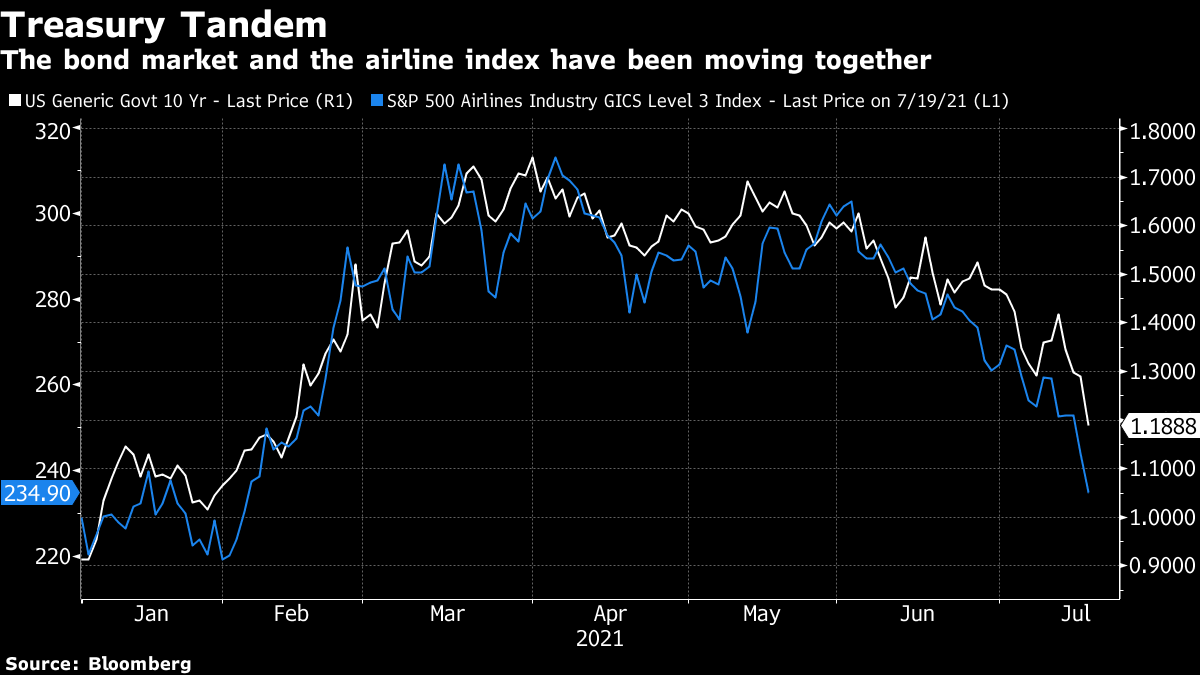 Over the past month, there has once again been plenty of hand-wringing over stubbornly low bond yields, with plenty of analysts and investors saying the move downwards is out of line with the realities of U.S. growth. The yield curve hasn't inverted, but low bond yields have once again been signalling concerns over the future direction of the economy. And yet, if you chart the benchmark U.S. 10-year against the S&P Airlines Industry Index, the move in yields doesn't look that weird at all, but rather totally in tune with pandemic fears and reopening trends. Maybe bonds really do know something that the rest of the market — up until very recently — did not. Go figure. You can follow Tracy Alloway on Twitter at @tracyalloway. | 


Post a Comment