| The Biden administration expressed an important message about America's relationship with China this week: There's no going back. Kurt Campbell, the U.S. National Security Council's coordinator of Indo-Pacific affairs, said at an event hosted by Stanford University that the "dominant paradigm" for bilateral ties going forward will be competition. In the same speech on Wednesday, he also pronounced that the era of U.S. engagement with China had come to an end. While neither of those points will come as a great surprise to China's leaders, Campbell's comments should do much to affirm something many in Beijing have suspected. China's calls for Washington to put ties back on the "right track" will be for naught. The world's foremost powers are instead entering a new era. 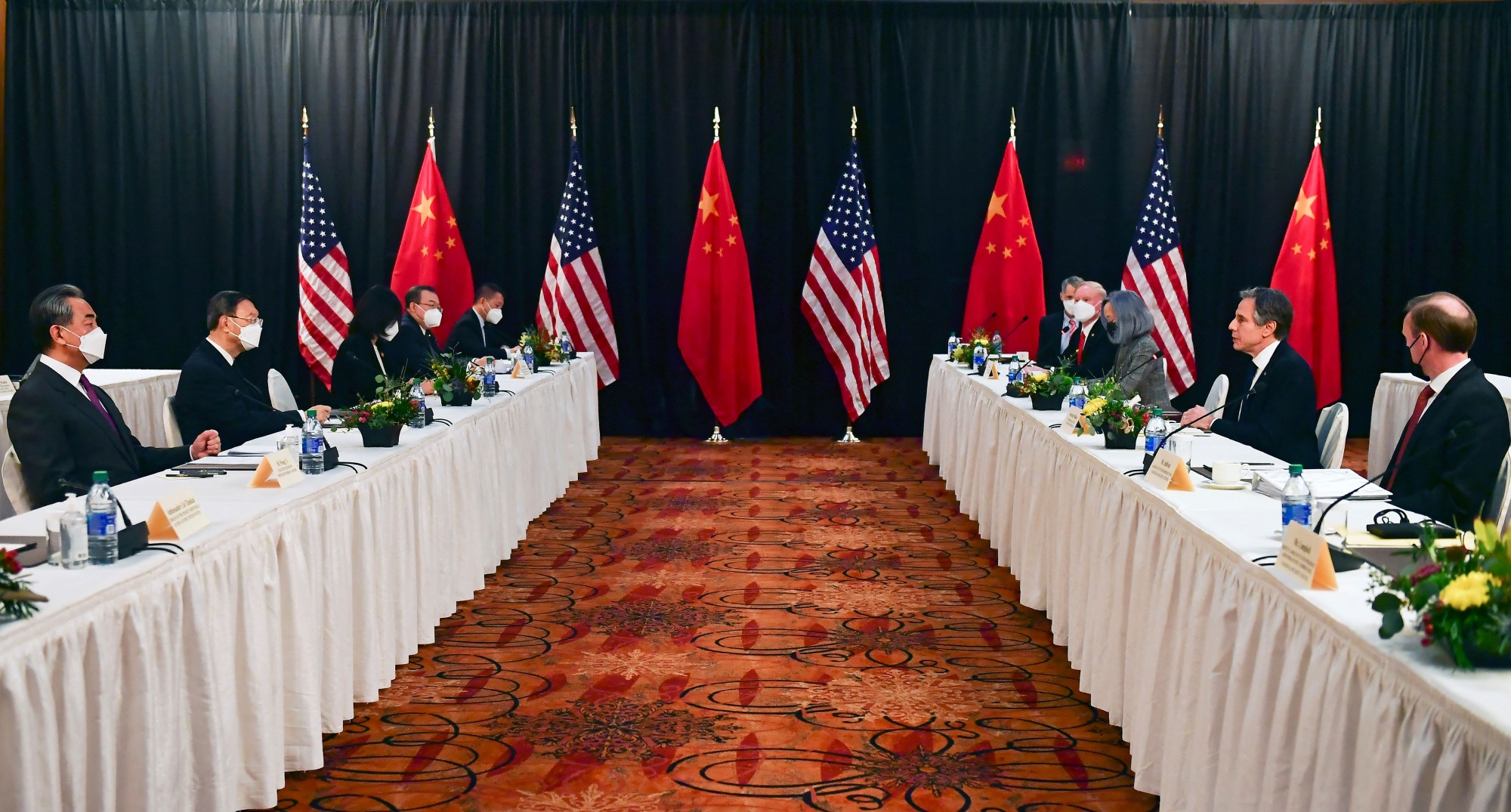 Top U.S. and Chinese diplomats meet in Alaska in March 2021. Photographer: FREDERIC J. BROWN/AFP There's very little about this new period that's certain. Perhaps the most important structure that does exist is the phase-one trade deal signed under former President Donald Trump. Indeed, U.S. Trade Representative Katherine Tai earlier this month said the new administration aimed to build off that deal. The first steps of that effort emerged this week, with Tai having her first phone call with Vice Premier Liu He, who negotiated the trade pact for Beijing. China's commerce ministry called it a "candid, pragmatic and constructive exchange," while Tai's office said she explained the Biden administration's approach to trade and also raised issues of concern. Those readouts don't provide much insight into how the discussion went, though hopefully they were less contentious than the March meetings in Alaska between the nations' top diplomats. Still, they're talking, which isn't something that can be said for many other aspects of the relationship. President Joe Biden's decision to order U.S. intelligence to "redouble" efforts to determine if the coronavirus came from a laboratory in Wuhan, for example, is a topic where the opportunity for dialogue seems remote. Add Taiwan, Hong Kong and Xinjiang to that list. By comparison, trade is a far less contentious matter. What better way to start building a new era than with the low-hanging fruit. A Stronger YuanChina's currency strengthened to a three-year high this week against the U.S. dollar, propelled by the country's economic rebound and weakness in the greenback. Just as important a factor though has been that financial markets have begun to believe that Beijing will tolerate a stronger yuan. As the yuan has strengthened over the last 12 months, so too have concerns that the central bank might think the gains are overdone. Indeed, the People's Bank of China had seemed to be signaling an unease with the yuan's rise through its daily reference rate for the currency, which it has set below expectations almost every trading day this month. But the idea that Beijing might be OK with further gains began to build last Friday. That's when an official from the PBOC's branch in Shanghai wrote an article that said the yuan should appreciate to help offset the surging prices China is paying for its commodities imports. Some misgivings about that article did emerge when it was later deleted and a deputy central bank governor came out to say in a statement Sunday that the exchange rate would remain "basically stable." By Wednesday, any hesitation looked to have subsided. That morning, for just the fourth time this month, the PBOC set its yuan reference rate at a level that wasn't below expectations. As a result, the currency pushed past 6.4 yuan to the dollar to its strongest since mid 2018. On Thursday, the yuan rose to the strongest level since March 2016 against a basket of trading partners. The gains continued early Friday, even after the PBOC issued a carefully worded statement saying the yuan could not be used to offset higher commodity prices. By then, however, markets seemed to have taken on a momentum of their own. 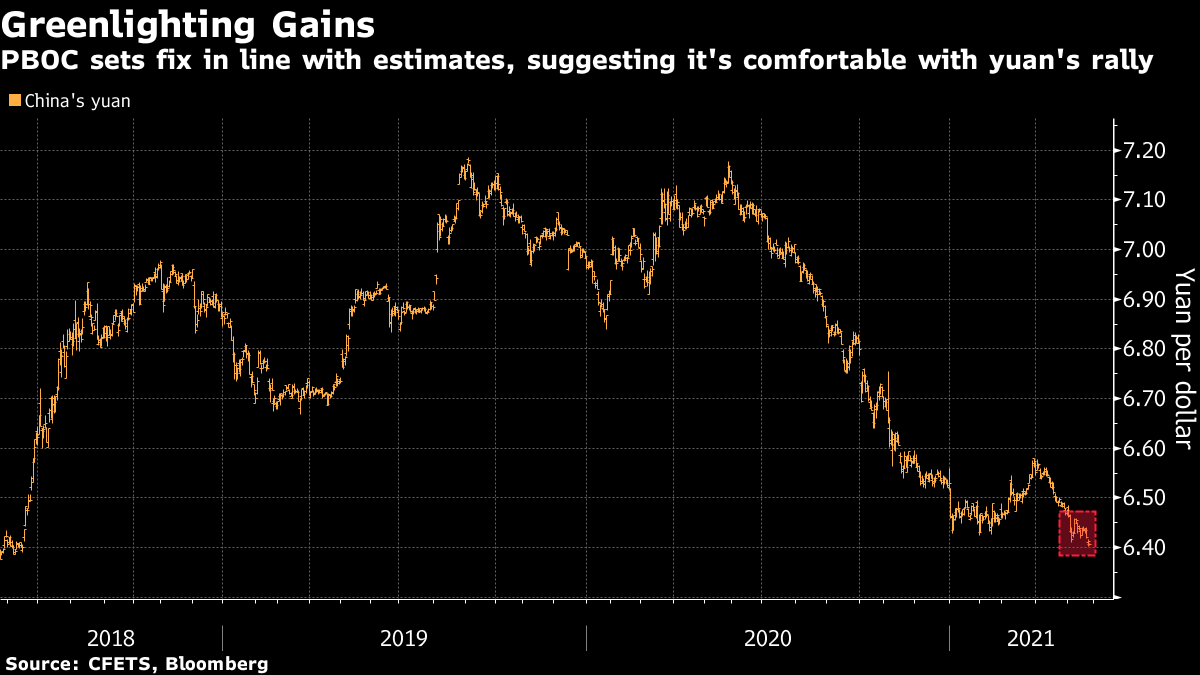 Taiwan's Vaccine PoliticsWith no signs that Taiwan's Covid outbreak is abating, attention has shifted to how authorities can get their hands on vaccines — more specifically, whether Taiwan should work with China. Currently, less than 1% of the island's population has been immunized. President Tsai Ing-wen, who has sought to strengthen ties with Washington as a counterbalance to Beijing, has rejected the idea. This week she ruled out attempts by some local officials to directly obtain Pfizer-BioNTech vaccines from Fosun Pharmaceutical, the shot's distributor for the Greater China region, because it's a Chinese company. Tsai's government has also accused Beijing of obstructing its efforts to sign supply deals with Western drugmakers. Chinese officials have denied the allegation and instead attacked Tsai for turning a "blind eye" to the vaccine shortfall. Ultimately, however, Taiwan is in its current predicament because complacency set in after its initial success controlling the virus. Now it's playing catch up.  A nurse prepares a dose of the AstraZeneca's Covid-19 vaccine at Chang Gung Memorial Hospital in Taipei, Taiwan, on May 13, 2021. Photographer: Bloomberg/Bloomberg Crypto CrackdownOne of the lingering questions about China's crackdown on cryptocurrencies has been why now. One catalyst, it was revealed this week, seems to have been a recent increase in deadly accidents at the nation's coal mines. That's because Chinese officials have come to believe that cryptocurrency mining, the energy-intensive computing process that creates digital tokens and verifies transactions, is a key driver behind a surge in electricity use. Coal prices have in turn shot up, prompting some operators to reopen closed mines without government permission. Some provinces, such as Inner Mongolia, have already banned cryptocurrency mining and are considering stiffer penalties for operators that persist. The global implications are substantial given that China accounts for about 65% of the world's Bitcoin mining as of April 2020, according to an estimate from the University Cambridge. Extra-Large HogsWhen farmers expect pork prices to go higher, many hold off on selling their hogs and instead let them fatten, hoping they can be sold for more in the future. That's what happened late last year as prices began to climb. Circumstances, however, quickly changed. New outbreaks of African swine fever emerged just before the Lunar New Year holiday in February, prompting worries about a resurgence of the disease that decimated China's hog herds in 2019. Farmers reacted by quickly unloading what pigs they had, lest they be killed by the disease before they could be sold. The result has been a torrent of extra-large hogs hitting the market — some the size of polar bears — which has in turn worsened a rout in local pork prices. While this has obviously been an unwelcome turn of events for farmers, it has meant lower prices for consumers, which will come as soothing news for policy makers worried about inflation in Beijing.  What We're ReadingAnd finally, a few other things that caught our attention: Something we think you'd like. We launched a new section called Odd Lots, an expansion of our popular markets podcast with Bloomberg News Executive Editors Joe Weisenthal and Tracy Alloway. Become a Bloomberg.com subscriber to get access to Odd Lots stories on the latest market crazes, Joe and Tracy's weekly newsletter, and more. Next China subscribers get 40% off. | 


Post a Comment