| China cracks down on its tech giants' finance arms. Amazon is still feeling the benefit of the pandemic shopping spree. Feeding the world's chickens and pigs is upending global trade flows. Here's what you need to know to start your day. Chinese regulators have imposed wide-ranging restrictions on the fast-growing financial divisions of 13 companies including Tencent, ByteDance, JD.com, Meituan and Didi, as the country's crackdown on its internet giants continues. Many of the same curbs were earlier employed against Jack Ma's Ant Group. Requirements include stricter compliance when listing abroad and curbs on information monopolies and the gathering of personal data. Companies must restructure their financial wings into holding companies, and sever "improper links" between their payments services and financial products, regulators said. It's unclear how long the firms have to enact changes, or how it would affect their core operations. Asian stocks are poised to open lower Friday, after fresh all-time highs for the U.S. market as investors digested the latest corporate earnings and strong economic growth data. Futures pointed down in Hong Kong, Australia and Japan, where markets will reopen after a holiday. Risk sentiment was buoyed by data showing the U.S. economy expanded at a robust 6.4% annualized rate in the first quarter, while jobless claims fell to a fresh pandemic low. Treasuries weakened and the dollar was steady. In the crypto market, meanwhile, there are just two big themes right now. The U.S. has told citizens to get out of India as soon as possible as the country's Covid-19 crisis worsens. A Level 4 Travel Advisory — the highest of its kind — warned Americans "not to travel to India or to leave as soon as it is safe to do so." As India struggles with the world's worst outbreak, Prime Minister Narendra Modi's party appears to be trailing in exit polls in key state elections. Back in January, the chances of success looked high for his government's vaccination drive. Here's how the country's plans crumbled into chaos. Meanwhile China has detected Covid-19 variants circulating in India among its imported cases. Elsewhere, the EU has clinched a vaccine deal with Pfizer, while members of the bloc including Germany and France are pushing to curb flights from India. And New York is moving to fully reopen on July 1, Mayor Bill de Blasio said. The city's subway may pose a problem. With much of the world on a pandemic shopping spree, Amazon.com reported a big increase in sales and gave a bullish forecast. First-quarter revenue jumped 44% to $108.5 billion, exceeding analysts' estimates. Sales will be between $110 billion and $116 billion in the quarter ending in June, the Seattle-based company said. Shares rose about 4% in extended trading. Amazon has been among the biggest beneficiaries of the coronavirus pandemic, but with the vaccine rollout well underway in the U.S. and elsewhere, investors are on the lookout for signs consumers will start spending more money at physical stores, eating out and traveling. Feeding the world's chickens, pigs and cows has gotten so expensive it's upending global trade flows. As grain prices surge — one gauge of prices is at an eight-year high — American chicken giant Perdue Farms took the rare step of buying soybeans from rival Brazil, while feed makers in China are buying wheat more commonly used for bread. Tactics like these show just how tight the global market has become. The culprits include falling yields, rising Chinese demand and, perhaps most importantly, La Nina, which has made its mark this year in North and South America as well as Australia and Indonesia. In other chicken-related news: Millennials are buying more and more of the birds. What We've Been ReadingThis is what's caught our eye over the past 24 hours: And finally, here's what Tracy's interested in todayThey say it's the unexpected stuff that gets you. In 2008 it was AAA-rated mortgage bonds. In 2012 it was eurozone debt. In 2020 a liquidity squeeze in U.S. Treasuries — the "safest" market of all — forced the Federal Reserve to step in and calm things. So where do the next vulnerabilities lie? Viktor Shvets at Macquarie makes the case that we should be watching crypto. "What drives systemic risk is not just value of individual assets but rather their interconnectedness and the degree of leverage deployed," Shvets writes. "For example, in 2007 there was nothing intrinsically wrong with most individual mortgages but rather it was their packaging and leveraging of collateral obligations that led to the global financial crisis. Although these digital assets are still treated by central banks as a peripheral part of the market, we are seeing a rise of the same interconnectedness as in 2007." 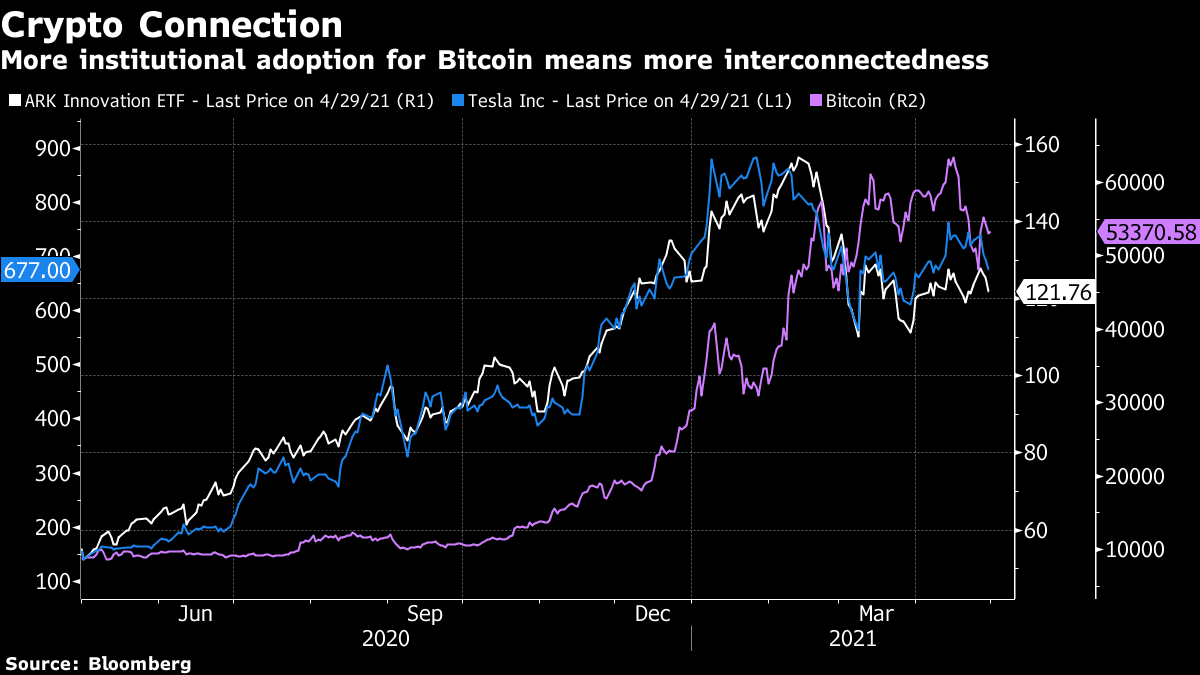 The flipside of Bitcoin's institutional adoption is that it's become more connected with the financial system. Just think of the ARK funds, which own Tesla and Bitcoin through the GrayScale Bitcoin Trust. Tesla also owns Bitcoin now, and so ARK's exposure is higher than one might expect, while Tesla's fortunes are tied to Bitcoin in more ways than one. Even more conservative asset managers might find themselves with crypto exposure as more companies use it to diversify cash balances. And of course the crypto market itself has grown massively along with institutional acceptance, and is estimated to have topped $2 trillion this month. As Shvets puts it: "Losing billions is just a 'bad day in the office' but losing trillions is systemic. Digital investors who are proudly declaring their independence from the state might need to be bailed-out by the same state. What is the end game? Effective nationalization of capital markets might be the only choice, with state controlling both supply and price of money while aggressively using their regulatory and CBDC tools to direct capital, corral vols and manage bubbles, including the digital universe." You can follow Tracy Alloway on Twitter at @tracyalloway. | 


Post a Comment