| Tesla security cameras are breached as part of a massive hack. BioNTech-Pfizer could make 3 billion vaccine shots next year. China summons the British ambassador. Here are some of the things people in markets are talking about today. A group of hackers say they breached a massive trove of security-camera data collected by Silicon Valley startup Verkada, gaining access to live feeds of 150,000 surveillance cameras inside hospitals, companies, police departments, prisons and schools, as well as Verkada customers. Tesla and software provider Cloudflare were on the list of the companies exposed. Some of the cameras use facial-recognition technology to identify people captured on the footage. Meanwhile, China's Microsoft hack last week, as well as Russia's SolarWinds attack, is threatening to overwhelm the U.S., according to former officials and private security firms. Asian stocks looked set to benefit from a rebound in growth shares that sent the Nasdaq 100 to its biggest gain since November. The dollar sank with Treasury yields. The rotation to value shares reversed violently Tuesday with stay-at-home winners surging after being left for dead as vaccinations picked up and Democrats moved to inject $1.9 trillion into the economy. The Nasdaq 100 climbed 4% as stocks with high valuations rebounded. Tesla jumped 20%. Gold surged more than 2% after falling to its lowest since April. Bitcoin traded above $54,000. Oil and copper retreated after recent rallies. BioNTech could have capacity to make 3 billion doses of Covid-19 vaccine with U.S. partner Pfizer next year, the German company's chief executive officer said, making their pioneering shot far more widely available around the world. Both the U.S. and Europe have sought to accelerate vaccine deliveries this year as new, more aggressive variants of the virus spread. Pfizer and BioNTech have committed to make 2 billion doses of their two-shot vaccine this year, which has recently shown a high ability to neutralize coronavirus strains first detected in Brazil, the U.K. and South Africa. The Chinese foreign ministry summoned the British ambassador, escalating a row between the countries over press freedom. The ministry said that Ambassador Caroline Wilson had posted a public article on the popular WeChat messaging service complaining about sanctions on foreign media, even as those news outlets spread fake news. China said the article "deliberately confused defamation with critical news reporting" and was "selectively blind" to the oppression of Chinese media. Tensions between the countries have risen over China's handling of the pandemic, and because Boris Johnson's government offered Hong Kong residents a pathway to British citizenship after Beijing imposed a national security law last year on the former British colony. Million-dollar price tags on a record number of Singapore's public housing sales are a sign the city-state is joining the frenzy gripping property markets from Hong Kong to Toronto. Twenty-three resold government-subsidized flats were purchased for at least S$1 million ($743,000) in February, a new monthly record. Thirty-six sales in that price bracket were concluded in the first two months of the year, a 350% increase from a year earlier. Prices in the city-state have recovered rapidly from a lockdown that lifted last June as low interest rates spurred on buyers to look past the economic recession. What We've Been ReadingThis is what's caught our eye over the past 24 hours: And finally, here's what Tracy's interested in todayWrangling unruly bond yields seems to be the big task facing central bankers at the moment and that means communication is of the utmost importance. It's worth noting then, an unusual divergence in public statements from the Bank of Japan. BOJ Governor Haruhiko Kuroda last week shot down the idea of widening the trading range for benchmark yields ahead of the central bank's long-awaited policy review. His comments on Friday almost single-handedly stopped the sell-off in Japanese government debt, sending yields on the 10-year issue tumbling. 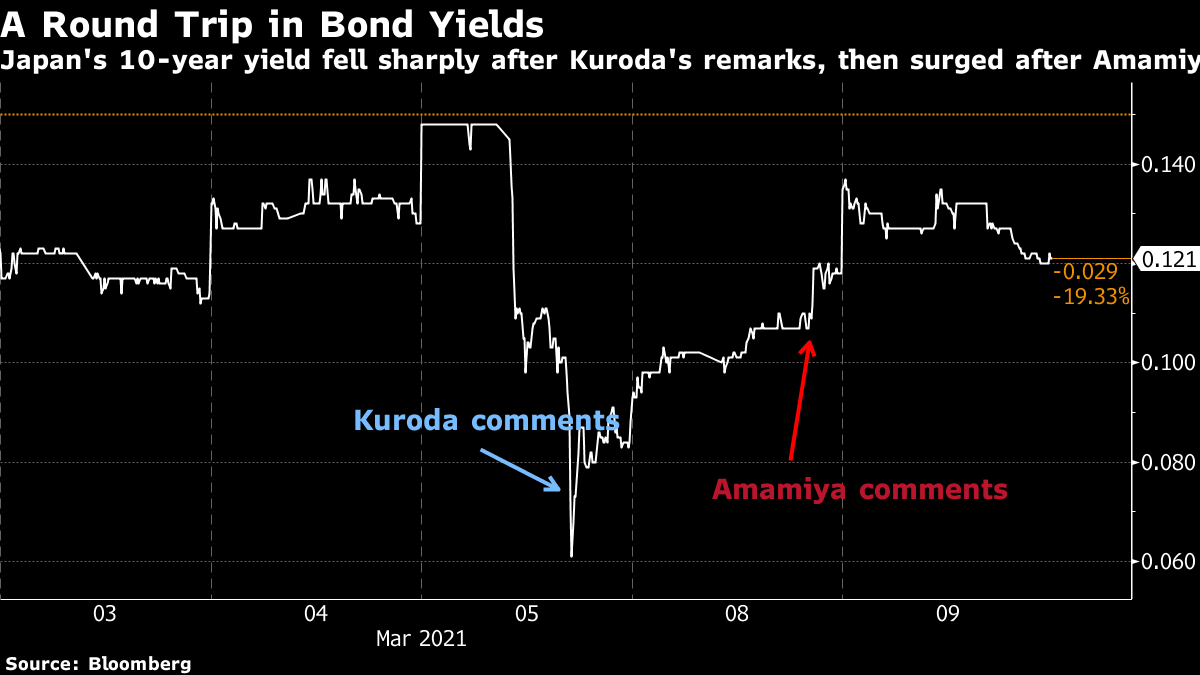 But just a few days later, Deputy Governor of the BOJ, Masayoshi Amamiya, went on the record to suggest the exact opposite, stating that "yields can go up and down more as long as it doesn't hurt the effects of monetary easing." Yields on the benchmark 10-year jumped after his comments, doing a round trip back to where they were trading before Kuroda spoke. It's certainly not an ideal example of central bank communication, especially when bond markets remain jumpy. And it raises the stakes for when the BOJ does finally release its review in just 10 days' time. You can follow Tracy Alloway on Twitter at @tracyalloway. | 


Post a Comment