| It's been clear for some time that the U.S.-China rivalry will be in large part a contest over technology. What's become more apparent recently is how each side thinks it can win. The U.S. approach seems to be coalescing around a two-prong strategy that both denies China access to advanced technology and increases investment to bolster American capabilities. A taste of what that might look like emerged this week when the National Security Commission on Artificial Intelligence released a report on how the U.S. should compete in that field. The group led by former Google Chairman Eric Schmidt recommended using targeted export controls and investment screening to protect critical technologies, while also investing $40 billion to expand U.S. government-led research and development. 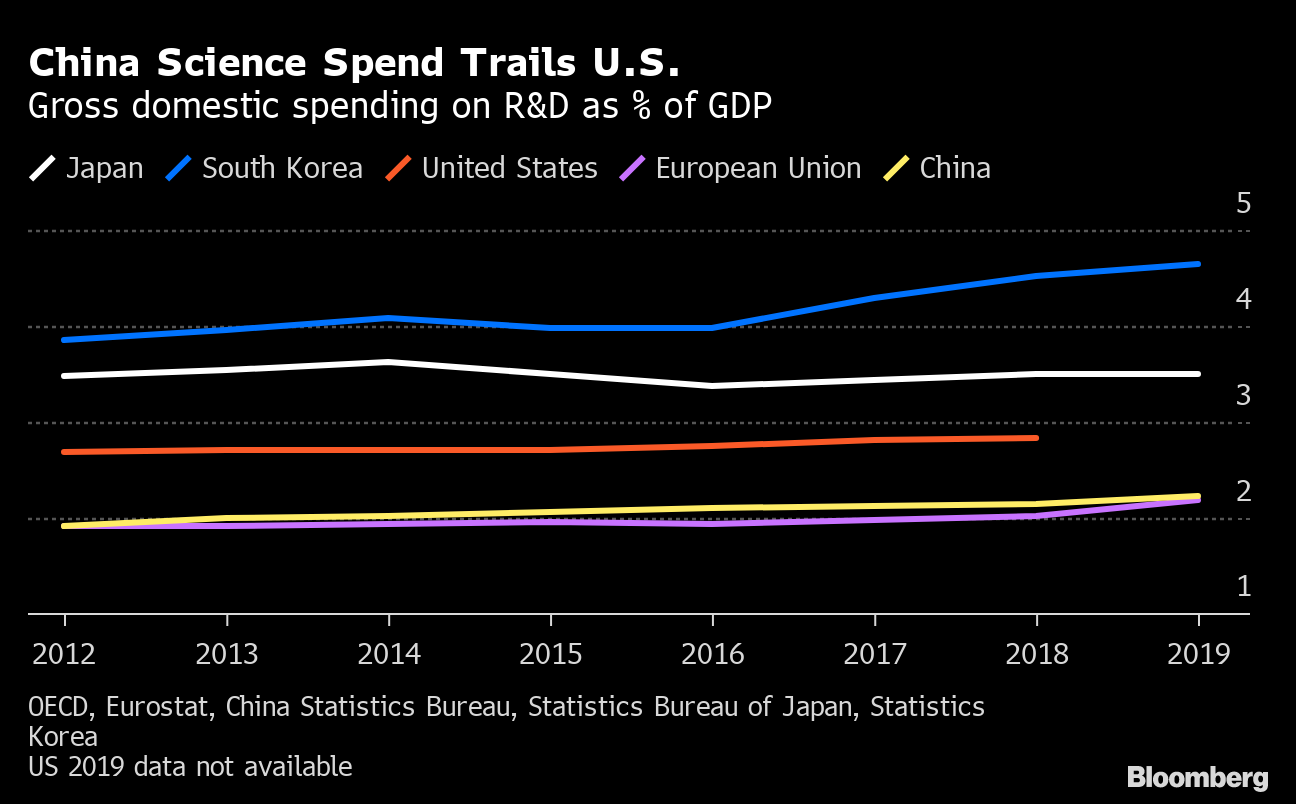 It also became clearer this week that U.S. efforts to limit China's access to technology could expand beyond America's borders. The Biden administration, it was revealed, is planning to rally an alliance of nations to fight for an edge in areas such as chips and quantum computing. These tactics won't elicit much surprise in Beijing, where policy makers have watched U.S. sanctions against Huawei hobble one of China's leading tech companies. Indeed, it was in October that technological self-sufficiency was made a pillar of China's national strategy. Self-sufficiency, of course, is easier said than done. The steep climb China faces is perhaps most notable in semiconductors. There, China not only trails the U.S. when it comes to developing the most-advanced chips, but also depends on America for the equipment needed to produce them. While much remains unclear about how Beijing aims to overcome these hurdles, some clues have emerged on what the road map might look like. In semiconductors, it appears that China's approach will be to try and make do for as long as it can, while investing significantly in next-generation chipmaking in the hopes of fostering a coterie of indigenous firms that are global leaders. More clues are coming. China's parliament, the National People's Congress, is holding its annual full session in Beijing over the coming week. It's there that the country's senior leaders set their strategies for the next five years. As the meeting kicked off Friday morning, Premier Li Keqiang outlined steps to make China a global tech power, including building more national laboratories and innovation centers. Economic TargetsThe full session of China's biggest political meeting of the year opened the premier's annual state-of-the-nation address, the tone of which was relatively conservative. Beijing, for example, set its 2021 economic growth target at above 6%. While far faster than 2020's 2.3% pace and in line with the 6% rate of expansion seen in pre-pandemic 2019, that target is substantially lower than what many expected for this year. A Bloomberg survey of economists put the median forecast for China's GDP growth in 2021 at 8.4%. But with so much still uncertain about the state of global commerce and China's relationship with the U.S., Beijing also has many reasons to want to set relatively modest expectations. 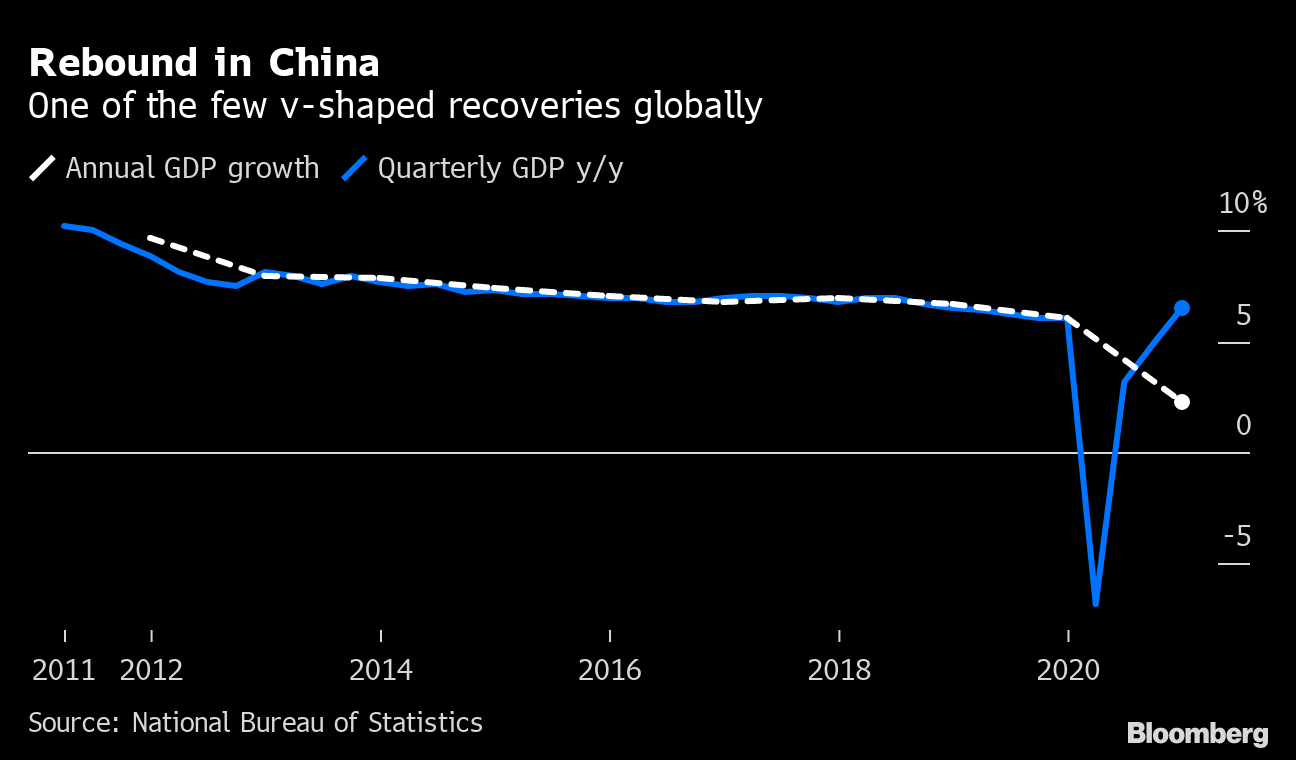 Governing Hong KongBeijing's overarching mantra for Hong Kong has clearly become that the city must be run by "patriots." The events of this past week hammered home that point rather strongly. It began last weekend with the arrest of 47 activists who were targeted for helping organize a primary vote in July to select opposition candidates to contest seats on the city's Legislative Council. Prosecutors argue that primary, along with plans to vote down Hong Kong Chief Executive Carrie Lam's budget and force her resignation, amounted to a subversive plot. Then late on Thursday evening, it was revealed that lawmakers gathering in Beijing for this year's NPC will consider a proposal to overhaul Hong Kong's electoral system. Though the details of that plan are yet to be made public, it is expected to limit the ability of the city's political opposition to hold government office  A demonstrator outside the West Kowloon Magistrates' Courts on March 2 Photographer: Lam Yik/Bloomberg Bubble WorriesChina's economic recovery has created a quandary for policy makers. As the coronavirus pummeled businesses in the early part of last year, Beijing pumped stimulus into the economy to shore up growth. Now that growth has bounced back, Beijing must figure out what to do with that money. To do nothing risks inflating bubbles in the property and stock markets. But pull back stimulus too quickly and it could hobble the recovery. Listening to China's top banking regulator this week, it appears that, as of now, Beijing's bias is for preventing bubbles. Speaking to reporters ahead of the NPC, Guo Shuqing, who's also the Communist Party chief of the central bank, highlighted concerns about a recent acceleration of Chinese home prices and said he was worried about what he saw as bubbles in some overseas financial markets. His comments quickly contributed to a selloff in stocks around the globe. Whatever additional insight that comes from the NPC next week could prove to be similarly impactful. Renewables PushPresident Xi Jinping put a deadline on China's push to become a greener economy last September when he committed the country to achieving carbon neutrality by 2060. Since then, policy makers have worked to flesh out how the world's largest emitter of greenhouse gases will get there. State-owned giant State Grid Corp. of China this week unveiled some of the steps it plans to take. They include building a network of electric-vehicle charging stations, larger-scale application of energy storage and ultra-high voltage transmission lines connecting wind and solar farms in sparsely populated parts of western China to the metropolises along the country's eastern coast.  Other firms and government agencies are likely to also unveil their plans during the course of the NPC. But this push will also involve some pain, and not just for industries linked to fossil fuels. Beijing is now evaluating tweaks to how it auctions grid capacity that gives an advantage to renewable-energy companies willing to forgo subsidies. These builders of solar and wind farms would be essentially asked to give up billions of yuan in subsidies in return for a government pledge to buy their electricity at a promised price. For China to hit its 2060 target, there will have to be some sacrifices. What We're ReadingAnd finally, a few other things that caught our attention: | 


Post a Comment