Header Ads

Jay-Z and Jack Dorsey Want to Fix the Music Business. Can They? 

Two billionaires meet on a yacht. One is a bearded technology mogul who runs a microblogging website and payments company, while the other is a rapper turned multi-hyphenate entrepreneur. Together, they decide they are going to save thousands of starving artists by joining forces.

If this sounds like the start of a great movie, you're in luck. We're about to see it play out in real time. Square, the company led by Twitter co-founder Jack Dorsey, is buying Tidal, the music service led by rapper Jay-Z. Dorsey says he is buying Tidal to find new ways for artists to make money.

It's an admirable goal, and one Jay-Z had when he first acquired Tidal for $56 million. But Jay-Z never realized this vision. Spotify and Apple Music ate his lunch, and he didn't have the resources to compete with the technological prowess of either one.

Artists make money from streaming services when lots of people use a service and listen to their music. Tidal never attracted a large user base, so it never paid artists very much money.

Tidal's one big advantage was artist relations. It's owned by a legendary artist who recruited more than a dozen of the biggest acts in the world as his co-owners. Those relations got Jay a few exclusive releases from his wife, his protégé (Kanye West) and his old label mates (Rihanna).

But that didn't help him with the artists he's supposed to be uplifting. Independent acts didn't share in the upside of ownership of Tidal, and instead saw a company run by people who have benefitted from the very industry suppressing them. The music industry exploits thousands of writers, producers and crewmembers to benefit a handful of stars.

Jesse Dorogusker, the Square executive now in charge of Tidal, acknowledged this contradiction in an interview, but stressed the opportunity ahead. When pressed, he was heavy on platitudes and light on specifics.

"We see musicians as entrepreneurs who have some tools but not others. They don't have great financial systems."

He talked about helping musicians sell merchandise, tickets and special experiences. Using data.

There are a lot of companies that serve smaller artists in the ways he describes. There are tools for music creation, like Splice. There are tools for distribution, like DistroKid, CD Baby or AWAL. There are tools for collecting royalties, selling merchandise and selling subscriptions to fans.

Music is a great industry for Square, which has helped small businesses handle payments from lots of buyers and sellers. Artists collect money from thousands of disparate sources, the money arrives delayed and at different times and they constantly need access to capital for recording or going on tour.

When artists go on tour, they need credit for the gear and they need to set up payroll. Right now, the big stars turn to record labels and concert promoters to cover the money or at least the risk.

But most artists either don't have the resources to handle all of these financial needs, or don't want to give over control to a larger company. They want someone to help them manage their finances. There is a start-up called HIFI that does do this, and music industry expert Matt Pincus just so happens to be an investor in it.

"Artists need cash flow management tools," said Pincus. "There's a lot of money flows going everywhere. The Square guys are in a good position to capture that."

But Tidal doesn't do any of this. It collects money from music fans and distributes it to music rightsholders. Its biggest selling point, besides exclusives, is high-quality audio. The number of people interested in that has always been pretty low, and it's no longer something unique to Tidal. Amazon and Spotify offer it, too.

Square doing what it's doing makes a lot of sense. It's not clear why buying Tidal makes sense. -- Lucas Shaw

The best of Screentime (and other stuff) 

Fallen King of Cable TV Bets That Live Sports Can Stem Decline
Gerry Smith looks at the future of the USA Network, once the most-watched cable channel and now a headache.
Confessions of a 32-Year-Old Drama Queen
Trisha Paytas makes five times more from OnlyFans than she ever made on YouTube, reports Rebecca Jennings.
Billie Holiday Deserves Better
Soraya Nadia MacDonald on the disappointing portrayal of the great singer.
David Crosby on Joni Mitchell, Phoebe Bridgers and His First Solo Record
Joe Hagan interviews the rock star about anything that comes to his mind.

Theme parks are opening. When are movies coming back? What about concerts?

Photographer: Lam Yik/Bloomberg

Photographer: Lam Yik/Bloomberg

California gave the all-clear for theme parks and baseball stadiums to open at limited capacity. Big cities, including New York, are starting to open theaters at limited capacity too. So what's the time frame for a return to normalcy?

That remains unclear.

It's still hard to see any studio releasing a major movie until theaters are fully open, unless they are also releasing the movie on streaming services at the same time (like Warner Bros.).

Universal, the first studio to bail on the summer of 2020, appears more optimistic about 2021. The studio delayed "F9" one month from May to June, suggesting it feels good about releasing a movie this summer. "F9" is a huge franchise in Asia, where movies are breaking records.

It pushed "Minions: The Rise of Gru" into next year. The "Despicable Me" franchise relies a bit more on the U.S. and Europe, and Europe in particular still looks a bit shaky in terms of the vaccine rollout.

The biggest movie still scheduled for release in May is Disney's "Black Widow," while Paramount just moved "A Quiet Place II" up to Memorial Day Weekend. Both of those companies have streaming services they are eager to boost as well.

It's even harder to discern what's going on in live music. Live Nation, the world's largest promoter, has said shows will resume in the summer. Other promoters are less certain. Just this week, the organizers of the Spanish festival Primavera canceled plans for a June event.

Like movie studios, musicians will be reluctant to play unless they can open everywhere at full capacity. It's hard to make money on an expensive production if a theater is only open at 50% capacity, or you can't tour at all in California or New York.

But more and more agents are sounding optimistic about scheduling tours in the fall.

The NFL falls for Amazon

Amazon is now the leading contender to acquire the rights to "Thursday Night Football." This would be the first time a technology company is the primary destination for one of the NFL packages.

Most of the big media companies want the NFL to give them streaming rights as well, so they can use football to drive subscriptions. ViacomCBS already offers football on Paramount+, while both Disney and Comcast are getting more rights for ESPN+ and Peacock, respectively.

Is this the moment the biggest sport in the U.S. goes online? Not quite. The four main broadcast networks are all securing rights to the games for up to 11 years, according to Joe Flint. But they will increasingly use those events to drive subscribers to streaming.

A Rupert Murdoch docu-series

Breaking news today from Gerry Smith and yours truly: CNN and the New York Times are collaborating on a multipart documentary series about Rupert Murdoch, the media mogul who controls Fox News and the Wall Street Journal, among other assets. 

Murdoch is no stranger to media scrutiny, but this is unusual in that two of his biggest competitors have teamed up to tell his story.

Fox News is back on top

Murdoch's cable news network reclaimed its position as the most-watched in the U.S. It felt out of the spot in January, a newsy month that benefitted CNN. But now that we return to more normal programming, expect Fox News – the voice of the opposition – to stay on top.

If anything, it's MSNBC and CNN that have problems.

Golden Globes ratings fall to a new low

The awards show attracted just 6.9 million viewers, the smallest audience since 2008. Making matters worse, the show hit a record low in the age 18-to-49 demo.

Chart of the week

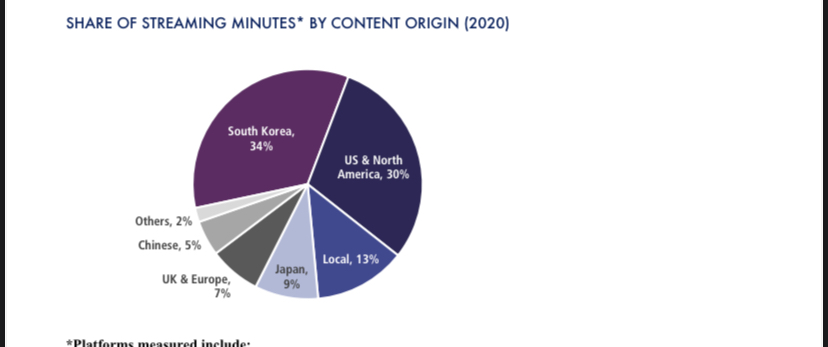
Just days after Netflix announced plans to spend $500 million on programming in South Korea this year, Media Partners Asia released a study to underscore why that country is so important. South Korean programming is more popular than U.S. movies and TV shows in Indonesia, the Philippines, Singapore and Thailand:
 

Deals, deals, deals

  • Hundreds of Korean op songs have been pulled from Spotify due to a contract dispute with local label Kakao M.
  • In Netflixland: The company rolled out a new feature that looks a lot like TikTok, and announced plans for 40 original programs in India this year.
  • Former Disney executive Kevin Mayer is replacing former ESPN chief John Skipper as chairman of DAZN, the sports streaming service owned by billionaire Len Blavatnik.
  • AMC Entertainment CEO Adam Aron got paid more than $20 million in 2020, doubling his salary in a year where the company's shares slumped 71%.

Weekly playlist

I have fallen hard for the new album from singer-songwriter Julien Baker, who sings about addiction and lost love. Amanda Petrusich reviewed it for the New Yorker.


Like the Screentime newsletter? Get unlimited access to Bloomberg.com, where you'll find trusted, data-based journalism in 120 countries around the world and expert analysis from exclusive daily newsletters.

Before it's here, it's on the Bloomberg Terminal. Find out more about how the Terminal delivers information and analysis that financial professionals can't find anywhere else. Learn more.


No comments