| Dovish Powell disappoints the bond market. China moves to limit Hong Kong opposition's ability to win public office. Bitcoin could reach $1 million, crypto exchange CEO says. Here's what people in markets are talking about today. Federal Reserve Chair Jerome Powell sounded a gentle word of caution to the bond market on Thursday that he's watching the jump higher in long-term interest rates, but stopped well short of trying to rein them in. Ten-year Treasuries extended losses and U.S. stocks sold off after he spoke, and futures in Asia were in the red. Bond yields have climbed in recent weeks; trading has been turbulent at times and higher yields have also unsettled the stock market. Powell reassured markets that the Fed was nowhere close to pulling back on its massive support for the economy. "We will be patient," he said. "We're still a long way from our goals." As the leader of crypto exchange Kraken, Jesse Powell is bound to be bullish on Bitcoin. Even so, his vision is a disruptive one. Powell thinks Bitcoin could reach $1 million in the next decade, saying that "The true believers will tell you that it's going all the way to the moon, to Mars and eventually, will be the world's currency." In a a separate interview, long-time crypto proponent Mike Novogratz said digital coins have become "an institutional asset class" and banks are "frantically" trying to get in on the action. Still, Bitcoin slumped along with other risk assets in Thursday trading. China is pushing ahead with a controversial plan to limit the Hong Kong opposition's ability to win public office, according to the official Xinhua News Agency. A draft resolution on "improving Hong Kong's electoral system" will be reviewed as part of the biggest Chinese political meeting of the year, the National People's Congress, which kicks off in Beijing today. The action is the latest step by President Xi Jinping's government to curb dissent in the former British colony. Meanwhile, Americans continue to support a tough stance on China, but are doubtful Biden will be able to adopt a hardline approach to the world's second largest economy. Saudi Arabia and its OPEC+ allies shocked the oil market with a decision to keep supply in check, sending prices surging and adding inflationary pressure to the global economy as it emerges from the pandemic. One year on from the outbreak of a bitter price war that sent crude below zero, the kingdom showed that its priority is preserving the hard-won oil recovery rather than worrying about tightening the market too much. Meanwhile China's fuel demand is going from strength to strength, leaving the capital blanketed in smog despite concerns a virus resurgence prior to Lunar New Year would derail the robust rebound. Last year may have been the worst in history for the airline industry, but for Nicolas Maduro's ragtag Venezuelan airline, business boomed. Somehow, operations jumped 85% in 2020, making it one of few carriers to post any growth during the pandemic. Meanwhile, Boeing is seeking a new $4 billion safety net from a group of banks, as it prepares to ride out the possibly lengthy slowdown of global aircraft demand. If you're wondering what all this says about where the industry is headed, here's what two airline titans have to say about it. What We've Been ReadingThis is what's caught our eye over the past 24 hours: And finally, here's what Tracy's interested in todaySo Jerome Powell reaffirmed the Fed's commitment to easy money in an interview and markets ... sold off? One way to view the surprisingly negative market reaction to the Fed Chair's interview with the Wall Street Journal is through the prism of market structure. As I've written in this space before, the smooth functioning of the U.S. Treasury market has effectively become a policy consideration for the Fed in a way it's never been before. The market is growing ever larger as U.S. deficits balloon, while the clash between monetary policy and post-financial crisis regulation has created an environment where Treasury blow-ups happen a couple of times a year. 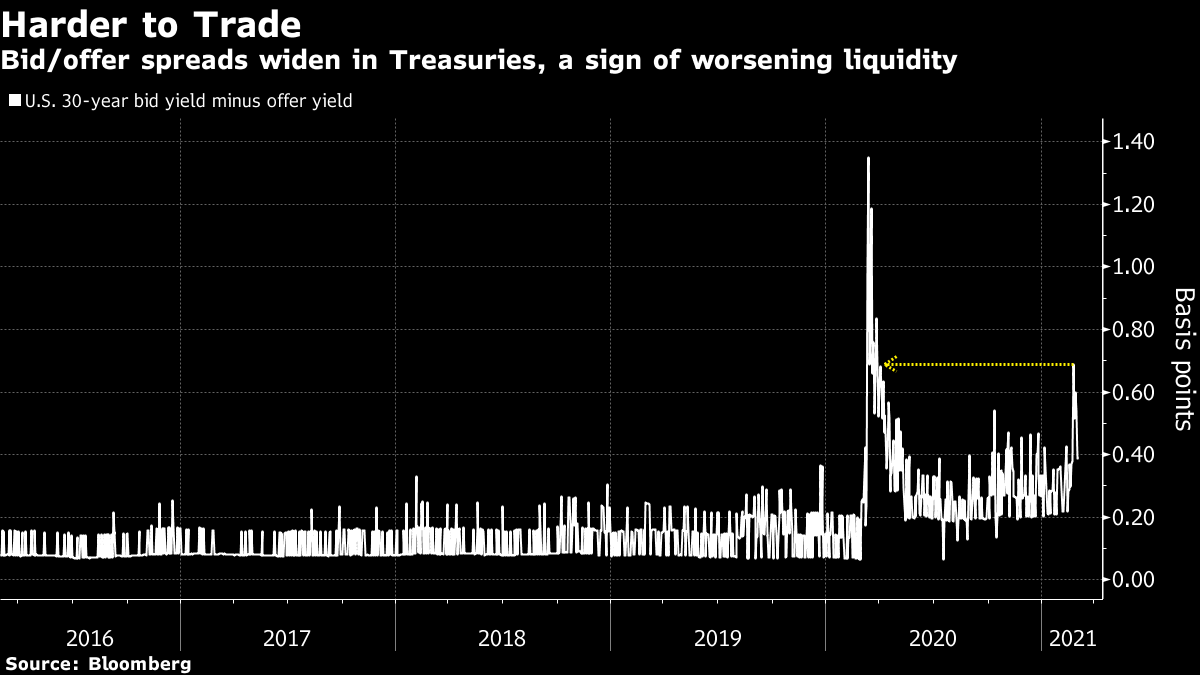 Obviously the Fed has always looked at the Treasury market insofar as it feeds into financial conditions and transmits monetary policy to the wider economy. Or as Powell put it in his interview: "As it relates to the bond market, I'd be concerned by disorderly conditions in markets or by a persistent tightening in financial conditions broadly that threatens the achievement of our goals." But the market now seems to be expecting something else: that the Fed not only maintain its pledge to keep benchmark rates low, but that it publicly and seriously commit to backstopping the smooth functioning of the $21 trillion market. You can follow Tracy Alloway on Twitter at @tracyalloway.. | 


Post a Comment