|
Boeing calls itself America's biggest exporter. But what if it lost all its business in China, the company's most important overseas market and one that is set to overtake the U.S. in size over the coming two decades?
The giant plane maker forecasts that China will buy 5,000 commercial aircraft between 2019 and 2038. Projecting forward a 45% market share, the loss of orders would add up to a colossal $342 billion, according to a study this month by the U.S. Chamber of Commerce and the Rhodium Group. On top of that, Boeing and other U.S. companies would forgo revenues from maintenance and other aviation services—another $533 billion. And the damage wouldn't end there. 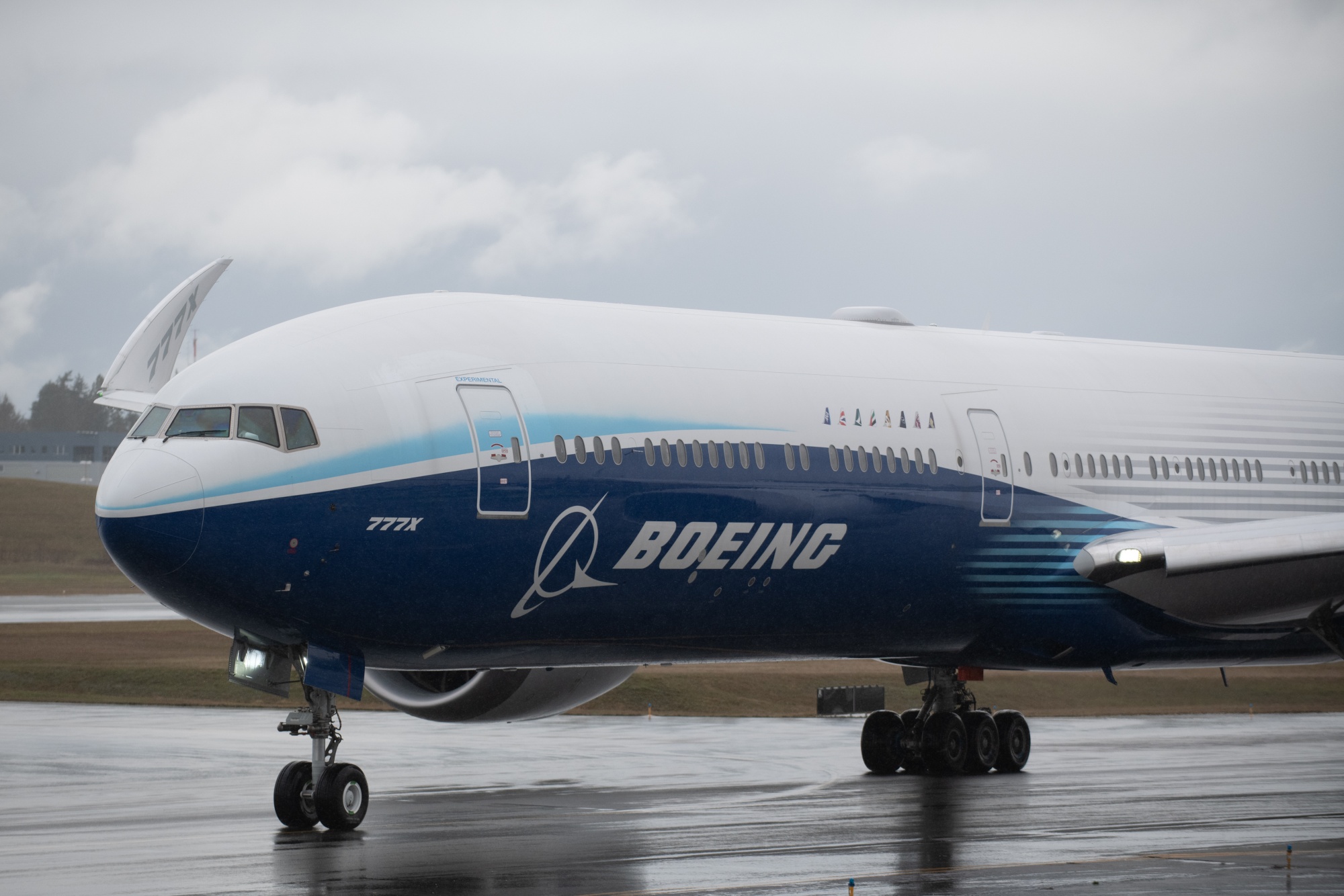 A Boeing Co. 777X airplane taxis on the runway at the Paine Field airport in Mukilteo, Washington. Photographer: Chona Kasinger/Bloomberg This week in the New Economy
A complete sales cutoff to China would reduce economies of scale across the U.S. aviation industry, a key driver of U.S. productivity. That would raise the cost of U.S.-made products, eroding their competitiveness globally. Airbus, of course, would gleefully pick up Boeing orders. Tens of thousands of high-skilled, well-paid jobs would disappear, spreading pain across communities in Washington state and California that depend on Boeing and its network of suppliers.
Ultimately, U.S. travelers would pay for all the disruption through higher ticket prices. A chain reaction of this kind is why conventional wisdom has long assumed that a full U.S.-China "decoupling"—a scenario under which trade and investment plummet to zero—is unthinkable. But the unthinkable is indeed being contemplated. Indeed, the U.S. Chamber warns that "if the current trajectory of U.S. decoupling policies continues, a complete rupture would in fact be the most likely outcome." The effects would be potentially crippling in similar ways for other U.S. industries, including semiconductors, chemicals and medical devices. In all these areas, America is a magnet for foreign companies that take advantage of its world-beating universities, labs and research institutes to develop products for the China market. If the U.S. and Chinese economies split apart, these companies would likely move their R&D operations elsewhere, delivering a blow to the U.S. innovation ecosystem. One could argue that China has made such an outcome all but inevitable. Much of President Xi Jinping's recently unveiled "dual circulation" economic strategy looks like a rehash of longstanding Chinese industrial policy designed to replace foreign technologies with home-grown ones. And Xi is quite frank about why he wants the U.S. and other countries to become more reliant on China-based supply chains: In his words, it will give China "powerful retaliation and deterrence capabilities against supply cut-offs by foreign parties."  China President Xi Jinping and U.S. President Joe Biden How should the U.S. respond? The Biden administration's order this week to review critical U.S. supply chains is a sensible start. It will cover everything from semiconductors to rare earths and drug ingredients. As U.S. President Joe Biden put it (without mentioning China), "we shouldn't have to rely on a foreign country, especially one that doesn't share our interests or our values." It's one thing though to take precautions in dealing with a rival. Decoupling from China is another matter altogether. As the U.S. Chamber study suggests, politicians who advocate for a cutoff should ask themselves whether they are ready to fill the gigantic revenue shortfalls of U.S. companies with government spending, while supporting the innovation that China now funds. At the very least, they should understand the astronomical costs. __________________________________________________________ Like Turning Points? Subscribe to Bloomberg.com for unlimited access to trusted, data-driven journalism and gain expert analysis from exclusive subscriber-only newsletters. The pandemic is roiling trade and supply chains that drive the global economy. Arm yourself with the latest developments—sign up to get Bloomberg's Supply Lines newsletter in your inbox daily. Download the Bloomberg app: It's available for iOS and Android. Before it's here, it's on the Bloomberg Terminal. Find out more about how the Terminal delivers information and analysis that financial professionals can't find anywhere else. Learn more. | 


Post a Comment