| The Fed's Jerome Powell signals continued support. Quarantines are getting longer and lonelier. Covid billionaires' fortunes fade. Federal Reserve Chairman Jerome Powell signaled that the central bank was nowhere close to pulling back on its support for the pandemic-damaged U.S. economy, even as he voiced expectations for a return to more normal, improved activity later this year. Before the Senate Banking Committee Tuesday, he also played down concerns of an inflationary outbreak from another big fiscal stimulus package or from an unleashing of pent-up demand as a growing number of Americans are vaccinated against the virus. And he called the recent run-up in bond yields that has unsettled the stock market "a statement of confidence" in a robust economic outlook. U.S. stocks reversed losses after Jerome Powell's reassuring comments and Asian equities look set for a mixed start. The S&P 500 Index erased a drop to end Tuesday higher, though declines among technology shares left the Nasdaq 100 down. Airlines, lodging companies and cyclical shares set to benefit from the end of pandemic lockdowns were the biggest winners. Treasuries were volatile, with 10-year yields initially rising before fading to hover around 1.36%. Elsewhere, Bitcoin tumbled below $50,000 after a bout of volatility highlighted lingering doubts about the durability of the token's rally. Oil dipped in New York as technical indicators signaled prices are due for a pullback following a strong rally this month. With the world hoping the advent of Covid-19 vaccines will open up air travel once again, in reality quarantines are getting longer and stricter as governments try to stem the threat from highly infectious coronavirus variants. The moves are damping hopes of a swift rebound in international travel. Take Hong Kong for instance — all visitors are subject to a soul-crushing three weeks in a hotel room, while England has only just put in place its toughest border curbs of the pandemic, imposing 10-day hotel quarantines for British and Irish nationals and residents arriving from dozens of countries. Read the full story here. And don't book those flight tickets just yet. SoftBank plans to invest billions in biotech and health-care stocks, opening up a new front in its growing asset management strategy, according to people familiar with the matter. SoftBank has already made a clutch of equity investments in the sector, including a $312 million stake in Pacific Biosciences, a U.S. DNA-sequencing company whose stock has risen almost nine-fold in the last year. The Japanese firm is now planning to spend billions investing in public biotech companies. In the health-care industry, the coronavirus pandemic led to some big fortunes, fast. Now some of them are evaporating just as quickly. Founders of Seegene, a maker of Covid-19 test kits, and Alteogen, a biotech with subcutaneous-injection technology, became billionaires as shares surged last year. Now with the vaccine rollout, they've lost their titles after both stocks sank more than 40%, according to the Bloomberg Billionaires Index. It's a similar story for glovemakers in Malaysia, which counted at least five industry billionaires by August as the worsening health crisis increased demand for the protective gear. The moves show just how fleeting fortunes can be. What We've Been ReadingThis is what's caught our eye over the past 24 hours: And finally, here's what Tracy's interested in todayWe're learning all sorts of interesting things during this particular bout of cryptomarket volatility. First off, it should be more than obvious at this point that Bitcoin isn't an "uncorrelated asset" that can act as a hedge for a sell-off in stocks. Instead, the cryptocurrency is going in the same direction as equities. Notably, it seems to be trading much more in line with tech favorites like the Nasdaq 100 or Cathie Wood's ARKK ETF than the broader S&P 500. Whatever Bitcoin is (and it is many things to many people) it's not something that stands apart from general enthusiasm for tech, growth stocks and other risk assets that have become very popular in recent months. The second interesting thing about the current sell-off is that it's taking place with a lot of additional crypto architecture built around it, which gives rise to a whole new ecosystem and potentially new indicators. For instance, as Investment Hulk points out on Twitter, the Dai stablecoin surged above its $1 dollar peg during the selloff, as this chart shows: 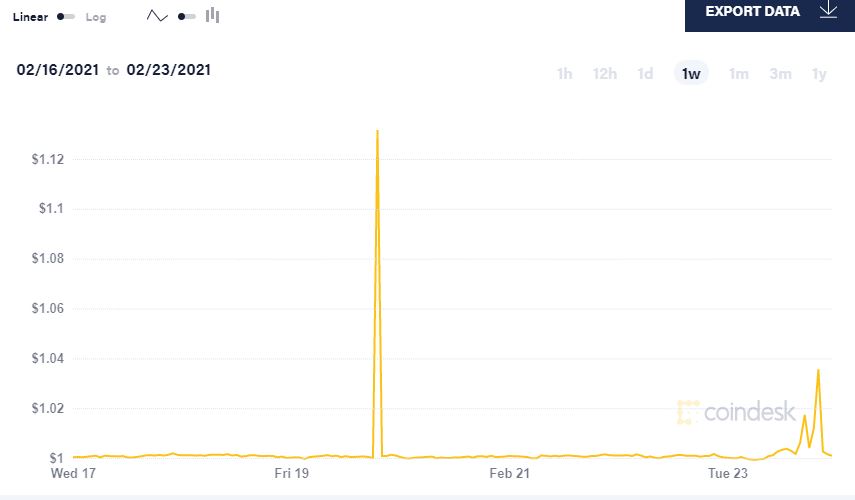 Bloomberg Bloomberg It's not the first time that's happened, but it does seem to confirm that people are pouring into stablecoins during the worst of the crypto market volatility. As Investment Hulk puts it, Dai is basically acting like a "Crypto Ted-Spread under market stress," and rising as investors deleverage. Dai spiked on Friday, Feb. 19, while the Bitcoin sell-off started snowballing over the weekend, which might even make it an early indicator of stress in the crypto market. You can follow Tracy Alloway on Twitter at @tracyalloway. | 


Post a Comment