They like the stockOh no not this again: GameStop Corp. soared Thursday as retail investors revived the surge in Reddit-favorite stocks, pushing it to reap $5.9 billion in market value over two days. The video-game retailer rose as much as 85% to $170.01 in New York, its highest since Feb. 1, as trading volume soared. Among other favorites of traders populating Reddit forums, AMC Entertainment Inc. advanced 13% after gaining 59% in the first three days of the week, while Koss Corp. surged 64%. Nokia Oyj, also a favorite of the meme crowd, climbed 7.4% in Europe. The meteoric rally in some Reddit-promoted stocks triggered volatility halts in GameStop, Koss and Express Inc. The surge was initially spurred by a final-hour rally on Wednesday that brought GameStop its biggest advance since Jan. 29, the day Robinhood Markets restricted trading in it and 49 other stocks at the height of the frenzy. An equally weighted Bloomberg basket of those rose more than 5%, the most since late January. The activity inflated trading volumes in the meme stocks and caused an outage on Reddit's WallStreetBets forum, the hub of the January volatility.
GameStop closed at $44.97 on Tuesday and $91.71 yesterday; as of 10 a.m. today it was, uh, halted at $119.46, super. There is a generation of young investors who grew up going to the mall to buy video games at GameStop and then, years later, started YOLOing the stock out of nostalgia. But in like 10 years there is going to be another generation of young investors who grew up YOLOing GameStop stock and occasionally do it again out of nostalgia. "Hey, remember GameStop, that was fun," they'll say, and then go buy some out-of-the-money call options for old times' sake. My preferred explanation of the recent price action is "life is random, we are all just a bunch of atoms bouncing off each other, do not seek meaning in the price of GameStop stock," but there are others I guess? The funniest one is that GameStop's chief financial officer departed on Tuesday: Various explanations circulated as to what spurred the rallies. The GameStop frenzy came after Bloomberg News reported late Tuesday that Chief Financial Officer Jim Bell was pushed out in a disagreement over strategy to make way for an executive more in line with the vision of activist investor and board member Ryan Cohen, the co-founder of online pet-food retailer Chewy.com.
"Ah," you might say, "what was holding this mall-based retailer of video games back from being a giant dominant player in e-commerce was this CFO whose name I hadn't heard until today; now that he's gone the stock will really take off." Fine! Okay! Every time I write about GameStop I feel some obligation to pretend that this might be a story about fundamental valuation, that the expected value of its future cash flows really has tripled in 20 hours due to some important piece of business news. But now I have discharged that obligation and we can move right along. A perennially popular explanation for GameStop moves is options: Some investors piled into bullish options that had strike prices above $500 a share. Those options would only pay off if the stock climbed above that level — a price only briefly hit during the January rally. Christopher Jacobson, a strategist at Susquehanna, said the options activity seemed to exacerbate the move in GameStop shares, although he said he did not believe the positioning in derivatives markets was an "instigator of the rally".
Yesterday someone bought thousands of GameStop call options with an $800 strike price expiring tomorrow. They cost 87 cents per share. If the stock closes above $800 tomorrow those options will pay out; also though all notions of money and value and human society will be rendered meaningless, so I don't know what you'll do with your payout. Options are a popular explanation for GameStop moves because of the "gamma squeeze" that we've discussed before. The idea is that when you buy a call option, the market maker who sold you the option has to hedge by going out and buying some GameStop shares, which pushes up the price of the stock. As the price goes up over time, the market maker has to buy even more shares to adjust its hedge, which pushes up the price further. Fun fact, the Bloomberg options value calculator tells me that the delta of that $800-strike call option expiring tomorrow is zero.[1] That is, the right theoretical hedge for a market maker who sells that option is to do nothing, to buy zero shares to hedge against the minuscule risk of the stock going to $800. Standard options math, and also frankly common sense, tells you that if the stock is trading at $40 or $90 or whatever, and someone comes to you and asks to buy a two-day option struck at $800, the proper reaction is to say "lol okay sure pal," take their money and never think about it again.[2] But I'm sure people bought other options that market makers did hedge, why not. We've discussed some recent research finding that options positioning predicts late-in-the-day trading moves, and I suppose the shape of yesterday's late-afternoon rally could be partially explained by options. Another popular explanation for GameStop moves is a short squeeze, but probably nah? Short interest in the stock has substantially diminished. As of Feb. 12, short interest in GameStop stood at roughly 30% of the stock's free float, representing the lowest short interest in the company since the end of December 2018, according to Dow Jones Market Data. That compares with well over 100% at the start of 2021.
I don't know why you'd be short GameStop at $40 really. If you shorted it at $20 last year, life got horrible for you last month and you probably got out. If you shorted it at $400 last month, you made a ton of money in a couple of days and you probably got out. Getting short GameStop at $50 two weeks ago, riding it down to $40, and keeping the trade on seems like not a great risk-reward proposition. You know GameStop can go up a ton for no reason; what's the point? Another very funny explanation is, uh, T+1 settlement? The clearinghouse whose demands for increased margin collateral from Robinhood forced the brokerage to restrict trading last month published a white paper Wednesday that laid the grounds for speeding up the stock settlement process. It proposed cutting settlement to one day from two, prompting some chest puffing among the retail crowd on Reddit.
We'll discuss T+1 settlement below, but the important point here is that it has absolutely nothing to do with GameStop. GameStop's future cash flow will not be higher or lower due to a shorter stock settlement cycle, and that cycle will not be better or worse for the price or liquidity of GameStop stock than any other stock. Still it was suggested as a reason for GameStop to go up, and, sure, why not? The mechanism here would be something like: - GameStop went crazy last month due to people on Reddit getting really enthusiastic about it.
- A bunch of other crazy stuff happened; there were weird knock-on effects of GameStop's stock going crazy.
- One crazy thing that happened is that Robinhood, the popular free retail broker, restricted GameStop trading for a while due to problems meeting its clearinghouse margin requirements.
- This made people on Reddit really mad at Robinhood.
- Later Robinhood blamed T+2 settlement for this problem and said the market should go to real-time settlement.
- This made people on Reddit really mad at T+2 settlement.
- Now the market may get rid of T+2 settlement.
- So people on Reddit won a glorious victory over T+2 settlement.
- So to celebrate their victory they are buying GameStop stock.
It is tempting to say that if Robinhood had said "we had to restrict GameStop trading due to fflurbvimaxes," and then someone—Citadel Securities? Warren Buffett? Elon Musk?—put out a press release saying "I have gotten rid of all my fflurbvimaxes, I promise," people would also have bought GameStop to celebrate. I suspect a lot of GameStop buyers had never heard of T+2 settlement a month ago, or thought about its implications for clearinghouse margin; these are not topics that come up a lot.[3] But T+2 became a very hypothetical bad guy in the GameStop story, and vanquishing it is a very hypothetical success in that story. Whatever is moving this stock's price is more likely to be a popular story, one full of events and heroes and villains, than economic fundamentals. T+somethingRight, yes: The clearinghouse that played a role in last month's Reddit-fueled market frenzy is proposing that settlement times for U.S. stock trades be cut in half -- from two days to one -- by 2023. Depository Trust & Clearing Corp. offered a blueprint for speeding up the process in a white paper published Wednesday. The behind-the-scenes system underlying any trade -- where buyers and sellers exchange cash for securities -- was thrust into the spotlight after retail investors coordinated on Reddit to bid up GameStop Corp. and other stocks. ... "The hardest thing to do when trying to make a change like this in the industry is to get consensus and get the whole industry to coalesce around the date," said Murray Pozmanter, head of clearing agency services at DTCC. "So 2023 at this point seems to be the date that we can get the industry to agree to move forward." Settling transactions in a single day, or T+1 in industry parlance, could reduce the volatility-based portion of members' margin requirements by 41%, the clearinghouse said in its white paper.
Here is the white paper. The basic point to make here is that the difference between T+3 settlement (the norm when I started in banking), T+2 settlement (the norm now) and T+1 settlement (DTCC's proposal) is just a matter of degree, of administrative and technical coordination. You go to the stock exchange and "do" some trades, in the sense that the buyer and seller agree to exchange stock for cash, and then one or two or three days later you make the actual exchange of stock for cash. It takes time to reconcile everyone's computer systems and line up the cash and stock, but those are largely technical problems that can be solved with better computer systems and faster processes and so forth. Going from T+2 (or T+1, etc.) settlement to real-time settlement, as some people have called for, is a very different matter. With T+anything settlement, you first agree on the trade, and then you have some time to get your cash together (if you're buying) or get your stock together (if you're selling). With real-time settlement, the buyer needs to have the exact amount of cash for the trade in its account before it agrees on the trade; the seller needs to have all the stock in its account first too. This is relatively easy for retail investors buying and selling shares in cash accounts, but lots of market plumbing doesn't work that way. Market makers, for instance, stand ready to buy or sell stock from anyone who comes to them on the exchange. If someone comes to buy, they will sell stock, even if they don't currently own it. If someone comes to sell, they will buy stock, without sending a particular packet of cash out the door to buy it. At the end of the day they will add up all their buys and sells, and they'll mostly cancel out: They bought $103 of stock and sold $97 and have to go get $6 of financing to meet their settlement obligations, or they bought $97 and sold $103, are short, and have to go borrow $6 worth of shares to meet their obligations. There are well-established processes to do that; big trading firms have stock-borrow relationships and capital and financing lines and so forth that allow them to trade each day confident that they'll be able to settle in two days, or in one day really. And the fact that the transactions mostly net out—big market makers buy a lot of stock and sell a lot of stock but mostly end up flattish—makes these processes even easier; you can trade lots of stock without borrowing lots of money or stock, because you can cancel most of it out at the end of the day and only settle the net amount. But those processes break down if you have to get your money and borrow your stock before you trade. So DTCC writes: One of the significant barriers to T+0 is that it does not allow for predictive financing needs of clients. In other words, clients generally will not know their financing needs for a given day until trading has stopped – which means securing end-of-day funds, or determining intraday investment amounts, will be difficult and excessively expensive. … Real-time settlement eliminates important netting and financing opportunities because it requires that all transactions be funded on a transaction-by-transaction basis. With real-time settlement, the entire industry – clients, brokers, investors – loses the liquidity and risk-mitigating benefit of netting, which is particularly critical during times of heightened volatility and volume.
It is not unimaginable that the stock market could move to real-time settlement; you could put stocks on the blockchain hahaha. But it would be very different from the current system, and the transition would involve a lot of disruption. Keeping delayed settlement, but making the delay shorter, is an easier matter. Elsewhere in settlement delaysFedwire broke: For about four hours Wednesday, Federal Reserve systems that execute millions of financial transactions a day -- everything from payroll to tax refunds to interbank transfers -- were disrupted by what appeared to be some sort of internal glitch. Systems were mostly restored by the end of the day, but the outages once again raise questions about the resilience of critical infrastructure that Americans rely on to process payments. The episode follows two significant disruptions to the Fed's payment services that occurred in 2019. "It does raise awareness about what their business continuity measures are and what's going on over a single point of failure that doesn't have a lot of redundancies. It's pretty concerning," said David Hart, president of consulting firm NETBankAudit who was previously a senior bank examiner and IT auditor at the Richmond Fed. The central bank restored the automated clearinghouse system known as FedACH as well as its Fedwire Funds, Fedwire Securities, Central Bank, National Settlement, FedCash, Check 21 and Check Adjustments services, according to a website operated by the central bank. Account Services was still suffering outages as of 5 p.m. New York time.
I feel like this is less of a problem in a world of delayed settlements than it would be in a world of real-time settlements. As it is, people knew how much money was due to them, and had to wait a few hours to get it. In a world of real-time settlements, if you couldn't use Fedwire to send cash or securities, you couldn't trade. Coinbase IPOIs this a first for an initial public offering registration statement? 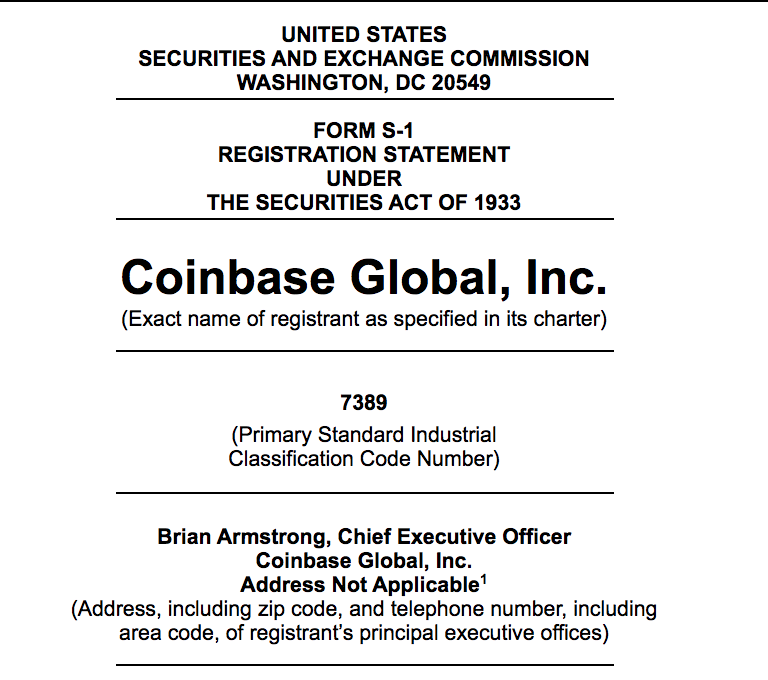 When you register to sell stock, you put your address and phone number on the cover, because that is required by the U.S. Securities and Exchange Commission form to register securities. Coinbase has no address. The footnote explains "In May 2020, we became a remote-first company. Accordingly, we do not maintain a headquarters." That's cool I guess. Seems right that the first big U.S. public crypto exchange would be located nowhere. It should list a blockchain address instead. I say "initial public offering registration statement," but actually Coinbase Global Inc. is doing a direct listing, not an IPO: It is registering its stock to allow sales by its insiders and early investors, but it is not doing a big coordinated offering of stock, and it is not selling any stock itself. Why would it need to? It had $322 million of net income in 2020, and $3 billion of operating cash flow[4]; it has $1 billion of cash and $316 million of crypto assets on its balance sheet. Running a mature crypto exchange is a good and lucrative business that brings in a lot more money than it costs, so there is no particular reason for Coinbase to raise money by selling stock. How good is it? For 2020, Coinbase reported $1.1 billion of transaction revenue on about $193 billion of transaction volume.[5] So Coinbase takes about 0.57% of every transaction on its platform for its own fees. How does that compare to the traditional financial system? Intercontinental Exchange Inc., which runs the New York Stock Exchange and a bunch of other financial exchanges, reported total revenue—from transactions and data and other stuff, for stocks and options and futures and mortgages and other stuff—of $8.2 billion in 2020; about $2.6 billion of that comes from cash equities transactions, though most of that revenue went to pay SEC fees and rebates to liquidity providers.[6] Nasdaq Inc., which runs the Nasdaq and a bunch of other exchanges, reported $5.6 billion of revenue, of which about $2.2 billion was from cash equities trading.[7] Cboe Global Markets reports that Nasdaq and NYSE each trade something north of $100 billion of U.S. shares per day; let's round down to $100 billion per day or call it $25 trillion per year. So the traditional U.S. stock exchanges—which collectively trade more volume in a day than Coinbase does in a year—collect on the order of 0.01% of volume in exchange fees, conservatively. Running a crypto exchange is at least 60 times more lucrative than running a stock exchange. Much of the fun in reading a crypto exchange prospectus is of course in the risk factors. One thing that I used to say a lot around here is that the fate of all crypto exchanges is to lose their customers' Bitcoins, because they are hacked by outsiders or because their executives steal the Bitcoins or because they lose the private keys to their Bitcoin wallets. I say that less these days, as crypto custody is a better-understood and better-regulated problem, and mature regulated exchanges have actually put up multi-year streaks of not losing all their customers' Bitcoins. So when Coinbase lists "The Most Material Risks Related to Our Business and Financial Position," "all our Bitcoins might get hacked" is only fifth on the list: Cyberattacks and security breaches of our platform, or those impacting our customers or third parties, could adversely impact our brand and reputation and our business, operating results, and financial condition. Our business involves the collection, storage, processing, and transmission of confidential information, customer, employee, service provider, and other personal data, as well as information required to access customer assets. We have built our reputation on the premise that our platform offers customers a secure way to purchase, store, and transact in crypto assets. As a result, any actual or perceived security breach of us or our third-party partners may: [be bad].
Though it appears again 12 pages later: Our failure to safeguard and manage our customers' fiat currencies and crypto assets could adversely impact our business, operating results, and financial condition.
And again: The loss or destruction of private keys required to access any crypto assets held in custody for our own account or for our customers may be irreversible. If we are unable to access our private keys or if we experience a hack or other data loss relating to our ability to access any crypto assets, it could cause regulatory scrutiny, reputational harm, and other losses.
The top risk factors have to do with the volatility of crypto and the variability of demand for it. Other big ones include regulation (including classification of crypto assets as securities), competition, litigation, technology, etc. It is all sort of normal. I feel like five years ago the No. 1 risk factor for a crypto exchange would have been "we will definitely lose everyone's Bitcoins and have to shut down, sorry in advance about that." Now Coinbase is in a sweet spot where the crypto business is mature enough that it probably won't lose everyone's Bitcoins, but immature enough that it can still charge 0.57% of transaction volumes. I tease, but this seems like an obviously big deal. I have said a lot in recent years that "private markets are the new public markets," that private companies can get huge and raise tons of money and become household names without actually going public. And that is true; Coinbase has raised hundreds of millions of dollars, become a huge crypto exchange and hit a $100 billion valuation without going public. Still there is some special legitimacy to being a public company: Your financial statements are public and audited, you are required to release news and submit to SEC regulation and generally do more compliance and disclosure stuff than even a huge private company in a regulated industry. For a consumer tech unicorn this doesn't matter very much—arguably it's a disadvantage—but for a financial-services company it matters a lot. Institutional investors thinking about dabbling in Bitcoin have to worry about trading venues and custody, and traditionally many venues and custodians made them nervous; they did not always have a robust tradition of following the law and not losing their customers' Bitcoins. But now there will be a Bitcoin exchange with public SEC filings, audited financial statements, a listed stock and (perhaps) a $100 billion valuation. The moment Coinbase is listed it will transform from "big startup doing crypto" into "venerable institution legitimizing crypto." That has to be good for business. Things happenTexas Electric Bills Were $28 Billion Higher Under Deregulation. WeWork's Neumann to Leave Board for a Year Under Proposed Deal. WeWork's Adam Neumann to Get Extra $50 Million Payout in SoftBank Settlement. Munger Calls Out Robinhood, Other Brokers for 'Dirty' Money. McKinsey Partners Vote Out Leader in Wake of Opioid Settlement, Other Crises. Saudi Arabia Borrows at Negative Rates for First Time as Oil Recovers. Head of EY Germany set to step down amid Wirecard scandal. Paul Ryan to Join Solamere Capital. CD Projekt Ransomware Hack Severely Disrupts Work on Cyberpunk Updates. "My general thought would be that if you have less money than Elon, you should probably watch out." Mars rover's giant parachute carried secret message. Innovative 10-year-old creates 'stick library' for local dogs. If you'd like to get Money Stuff in handy email form, right in your inbox, please subscribe at this link. Or you can subscribe to Money Stuff and other great Bloomberg newsletters here. Thanks! [1] That's GME US 02/26/21 C800 Equity OV, pulling in default assumptions. [2] To be clear, market makers are not required to do what the model tells them, and the "common sense" answer is perhaps ambiguous. Arguably the fact that someone bought thousands of these options means that the probability of them paying off is a bit higher than the model suggests. If you are selling way-way-way-out-of-the-money options, you probably should not be blindly following your model. Here is a story I like from Nassim Nicholas Taleb. [3] I am not saying that to be dismissive! I had heard of T+2 settlement because I used to be an equity capital markets banker and it matters in that niche line of work. I had never thought about the implications of T+2 settlement for clearinghouse margin, because the extension of credit in regular-way equity transactions is, to almost everyone, including almost everyone who works in finance, an entirely theoretical and arcane concept. You need really weird events for it to matter. [4] That number is misleading; most of it—$2.7 billion—is changes in "custodial funds due to customers," so not, like, free cash flow that Coinbase has access to. Still. [5] Transaction revenue of $1,096 million is reported on page 107 of the prospectus. Trading volume of $193,097 million is reported on page 14. [6] See pages 46, 54 and 58 of ICE's 10-K. [7] See pages 40 and F-5 of Nasdaq's 10-K. | 



Post a Comment